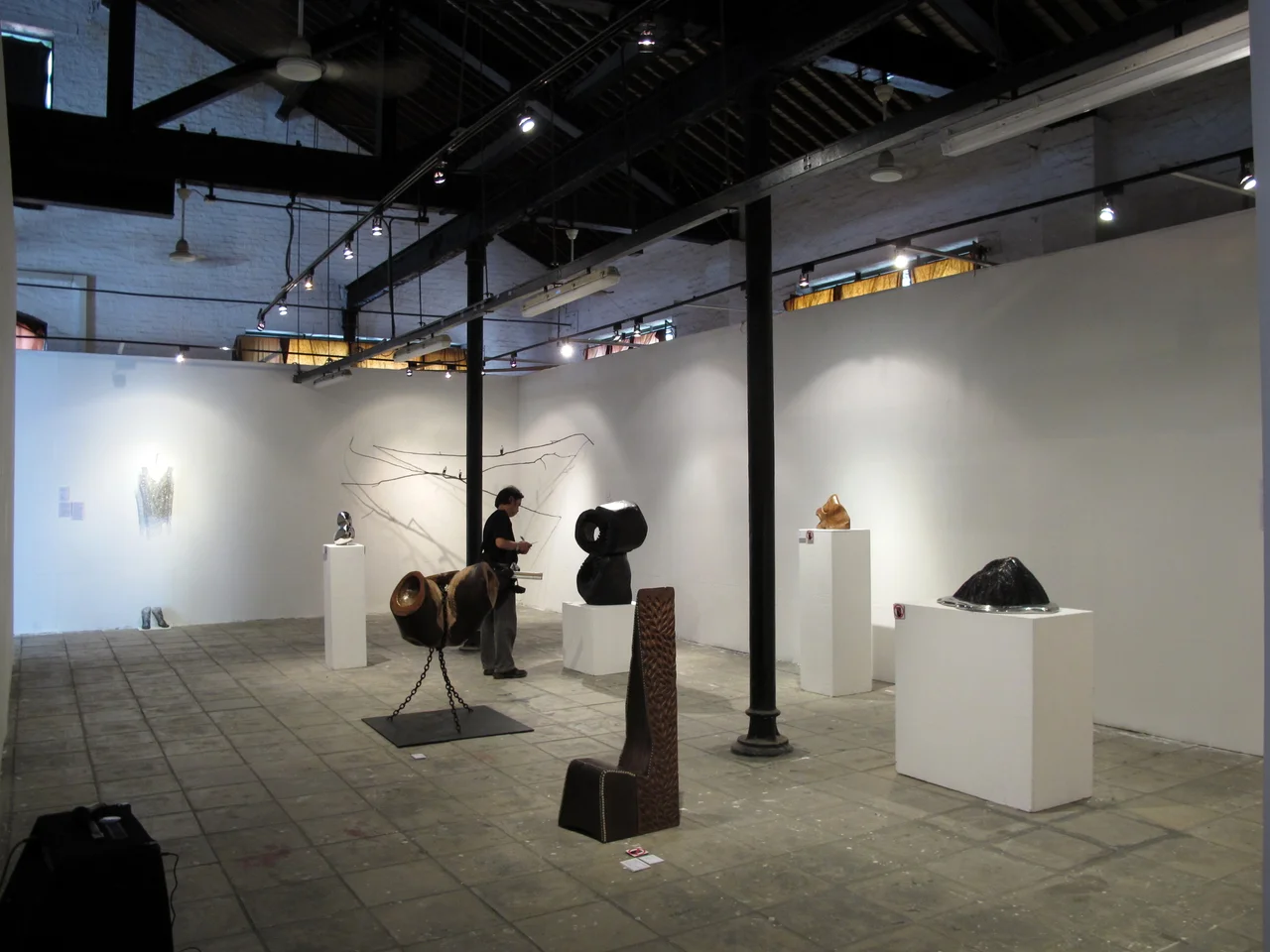

Cattle Depot Artist Village
The government sign outside reads 'Ex-Ma Tau Kok Animal Quarantine Depot.' Officially, according to at least one administrator, it isn't even allowed to call itself an artist village. Yet painters and performance groups, sculptors and theatre companies have made their studios inside these low red-brick buildings since 2001 — in spaces that, for the ninety-one years before that, held cattle waiting to be slaughtered. The tension between what the Cattle Depot Artist Village is and what the paperwork says it is turns out to be exactly the kind of creative friction Hong Kong artists have learned to work with.
Ninety-One Years of the Slaughterhouse
The depot's origins lie in a railway decision. When the Kowloon–Canton Railway was being built, the original slaughterhouse in Hung Hom — occupying 1.7 acres, large enough for 120 head of cattle, 200 lambs, and 400 pigs — had to move. It relocated to Ma Tau Kok, near To Kwa Wan, and the Ma Tau Kok Quarantine Depot opened in 1908. The Cantonese name it earned, 馬頭角牛房 — roughly 'cattle pens at Horse Head Corner' — stuck far better than any official designation. For over nine decades the site functioned as a quarantine and slaughter centre, processing livestock for the growing city around it. By 1999 the neighbourhood had grown so thoroughly urban that residents had long since stopped accepting the sounds and smells of a working abattoir as background noise. Their complaints succeeded: the depot closed that year.
From Quarantine to Canvas
The transformation happened quickly by Hong Kong standards. In 2001, an artist community that had been displaced from Oil Street in North Point — and shuffled through temporary arrangements at the Cheung Sha Wan Abattoir and the old Kai Tak airport site — moved into the vacated compound. The red-brick pens, laid out horizontally across the lot rather than stacked in the vertical towers typical of Hong Kong, offered something rare: ground-level studios with doors that didn't have to stay shut. Unlike factory-building ateliers elsewhere in the city, the open layout encouraged interaction. Visiting a neighbour meant a short walk across a courtyard, not a trip up eight flights of stairs. The compound now holds around 20 units, occupied by a mix of artist groups and independent practitioners who use them as studios, rehearsal spaces, and offices.
Art Under Bureaucratic Constraint
Being a Grade II historic building gives the Cattle Depot its character and its complications in equal measure. The classification means the brick fabric is protected, but it also imposes rules that any artist would find maddening. Tenants are prohibited from painting on the walls of their own studios. They cannot put plants or artwork outside their doors. They cannot stay overnight. Corridors are classified as public space, so even rehearsals in the hallways are technically not permitted. For years, visitors had to present their Hong Kong identity card at the gate; that requirement has since been relaxed. Leases, which once ran three years, have since 2004 been renewable only every three months — a constant uncertainty that makes long-term planning almost impossible. The government agency that manages the property has even objected to the depot using the name 'Cattle Depot Artist Village' on signage.
A Space Hong Kong's Creative Scene Needs
Despite — or perhaps because of — these constraints, the place has attracted attention well beyond the city. Journalists from mainland China and Japan have come to report on it, recognising something distinctive in the combination of historic setting and working creative community. Hong Kong's Arts Development Council has studied the depot's future, weighing it against the backdrop of the Kai Tak development next door and the heritage fabric of the 13 Streets area directly across the road. One idea that has circulated: extending the artist village concept into those old residential blocks, giving artists both studio and living space within walking distance of each other. Whether that vision eventually takes shape or not, the depot's argument — that a city growing as fast as Hong Kong needs places where culture can take root and breathe, even imperfectly — is harder to dismiss every year.
The Red-Brick Village Today
Walk into the compound on any given weekday and the contrast with the surrounding neighbourhood is immediate. The density of Ma Tau Kok presses close on all sides, but inside the gates the horizontal spread of low brick buildings and open courtyards creates an unexpected pocket of quiet. Some studio doors are open; others are not. A performance group might be running a rehearsal; a visual artist might be preparing work for an upcoming festival. Five units remain vacant — too deteriorated for occupancy — and the whole compound continues to operate at the edge of what the fire safety and public-entertainment regulations permit for large gatherings. But the artists who have made their practices here have shown that working inside constraints, official and physical alike, is something they understand better than most.
From the Air
Cattle Depot Artist Village sits at approximately 22.3208°N, 114.1910°E in the Ma Tau Kok district of eastern Kowloon. From the air at 2,000–3,000 feet, look for the tight grid of older low-rise streets around To Kwa Wan and the conspicuous curve of the former Kai Tak runway site to the northeast. The compound itself is a small cluster of red-brick buildings on 63 Ma Tau Kok Road, distinguishable from surrounding residential blocks by its low profile and courtyard layout. Hong Kong International Airport (VHHH) lies approximately 15 nautical miles to the west-northwest across the harbour; the former Kai Tak site is less than 1 nm to the northeast. Visibility permitting, the Victoria Harbour waterfront and the towers of Central are visible to the southwest.
Nearby Stories
- Lok Ma Chau Loop 2.3 km away
- Portas do Cerco 2.3 km away
- Kweilin Incident 17 km away
- Wanshan Archipelago Campaign 34 km away
- Nanxiong Formation 115 km away
- Battle of Nanpeng Island 148 km away
- Heyuan 169 km away
- Cape Maobitou 632 km away