,_Cavern_Club_2010.jpg)
Cavern Mecca
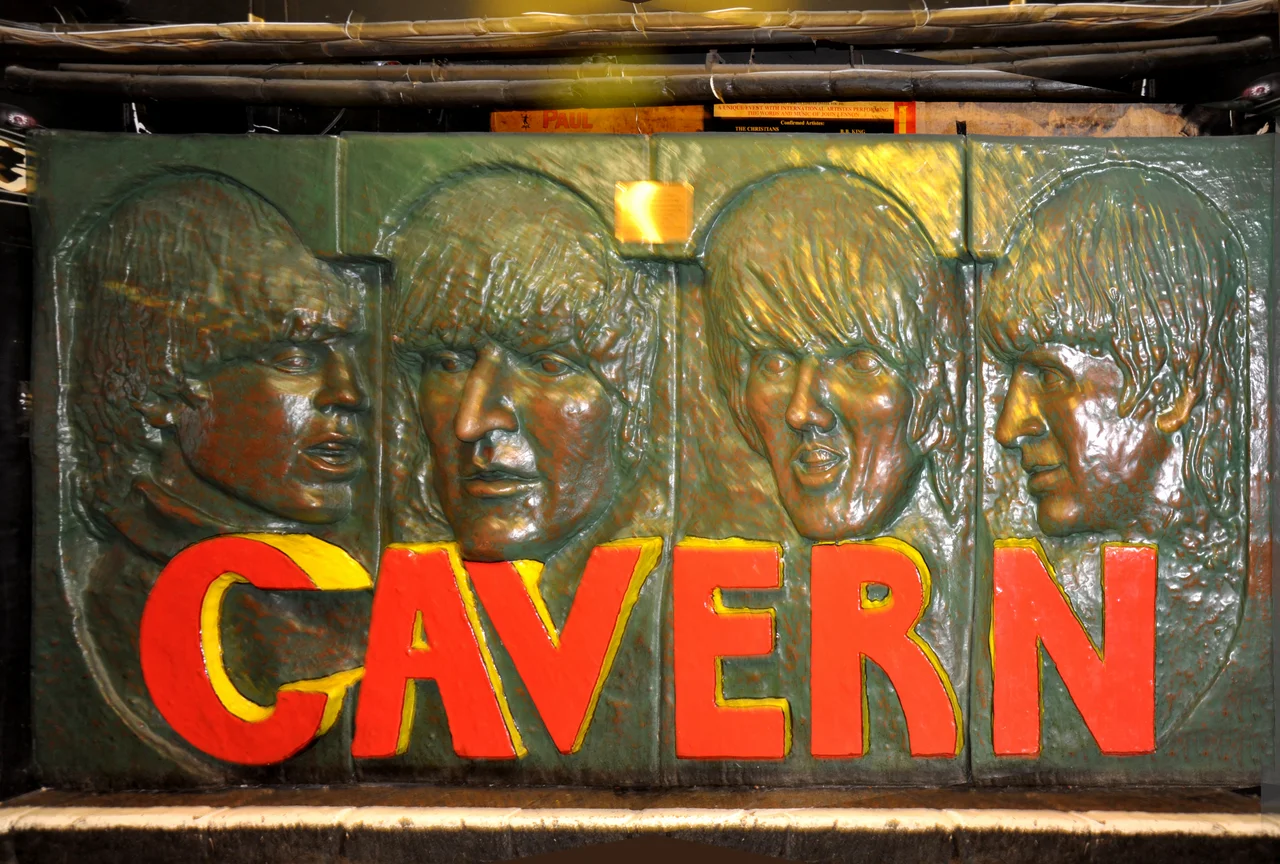
By 1981 the Beatles had been broken up for over a decade and Liverpool had decided, more or less officially, not to talk about them. The Cavern Club where they cut their teeth had been demolished in 1973 and the cellar filled in for the construction of the Merseyrail underground loop. The city's tourist board promoted Liverpool's cathedrals, its waterfront, and its football, not its rock and roll. Then Liz and Jim Hughes opened a small museum on the corner of Rainford Square and Mathew Street, directly opposite the buried Cavern, and the city was forced to remember.
Two Beatles Fans with a Lease
Liz and Jim Hughes were not curators. They were Beatles fans, with the obsessive cataloguing instinct that the best fans have, and they had built up a personal collection of photographs, memorabilia, and ephemera that wanted a home. They took a lease on a small space on the corner of Rainford Square in 1981, named it Cavern Mecca to make the pilgrimage point explicit, and opened the doors. The display was homely, almost domestic, with cases of singles and concert posters and a wall of photographs. Liz handled visitors. Jim handled correspondence and fundraising. Together they ran the Beatles fan club out of the same address, and the museum quickly became the gathering place for fans who arrived in Liverpool not entirely sure where to go.
The Annual Convention
What the Hugheses did next is what made the city take notice. They organised an annual Beatles Convention, drawing fans from across Britain and increasingly from abroad, with talks, performances, and raffles for memorabilia. The convention became, in one historian's words, what "single-handedly jump-started" Beatles tourism in Liverpool. It has continued ever since, under different organisers, and is now the centrepiece of the city's Beatles Week festival every August. Jim Hughes also founded the John Lennon Statue Appeal Fund after Lennon's murder in 1980, which raised money for the original 1981 statue near Mathew Street and helped fund a 1984 successor created by Alan Curran. The fund and the convention together made the case that fans, not city councils, would build Liverpool's Beatles economy if no one else would.
The Cavern Comes Back
The same year that Cavern Mecca opened, plans were announced to excavate and reopen the original Cavern Club, which had been buried under the Merseyrail works. The timing was probably not coincidental. The Hugheses' museum, the convention, and a renewed fan interest in Mathew Street all made the case that the buried club had economic value as well as cultural. The new Cavern opened in 1984, with much of the original cellar excavated, on roughly the same site as the lost one. It would close again in 1989 before reopening for good in 1991 as both a club and a museum. Whether the Hugheses' work directly caused the resurrection is hard to prove, but the chronological coincidence is hard to ignore.
Closed by Illness
Cavern Mecca closed in December 1984 when Liz Hughes fell seriously ill. The collection went into storage, some of it eventually finding its way into other Liverpool museums. The Cavern Walks shopping and entertainment complex was built on the wider Mathew Street area in 1984, which would have taken the museum's lease in any case. Jim Hughes continued to work on Beatles projects for the rest of his life. He died in January 2018. By then the city had built an entire industry around what he and Liz had argued for in the early 1980s: that Beatles fans were not a nuisance to be tolerated but a community to be welcomed, and that the buried Cavern was worth digging out.
What 290,000 Dollars Bought
One artefact from the museum has had a long second life. In 2003 a signed copy of Sgt. Pepper's Lonely Hearts Club Band, accompanied by an official souvenir programme from the fourth annual Beatles Convention of Cavern Mecca, sold at auction for 290,000 dollars. At the time it broke the record for a signed Beatles album cover. The buyer was buying the four signatures, but they were also buying a programme from a tiny museum in a city that had once preferred to forget. Stand today on the corner of Rainford Square and Mathew Street, look across at the Cavern, and you can see the geography of what Liz and Jim built. They did not have curators, conservators, or a budget. They had two chairs, a lease, and the conviction that the city would come around. It did.
From the Air
Mathew Street and Rainford Square sit in central Liverpool just east of the waterfront and north of the modern Liverpool ONE shopping district, at 53.41°N, 2.99°W. The building that housed Cavern Mecca is still on the corner of Rainford Square; the Cavern Club itself is across Mathew Street. Best viewed from 1,500-3,000 ft. Liverpool John Lennon Airport (EGGP) is 8 nm to the south-southeast. The whole area is hard to pick out from altitude but lies just inland from the Three Graces on the Pier Head.
Nearby Stories
- RAF Wrexham 3.3 km away
- Birkdale Palace Hotel 3.7 km away
- Turton Tower 4.1 km away
- Tatton Park 5.6 km away
- Abergele Rail Disaster 9.6 km away
- Diglake Colliery Disaster 13 km away
- Ysbyty Ifan 16 km away
- Celtic Array 62 km away