
CBS International Business School
Walk south from Cologne's center along the Rhine, past Severinsbrücke, and the medieval city quietly thins into the residential streets of Bayenthal. Here, in 1908, a private institution opened to teach German merchants how to do business in foreign languages - the Europäische Wirtschafts- und Sprachenakademie. The building it occupied is still in use, but the school inside has shed almost everything except its address. Today it teaches roughly 3,000 students from 75 countries, mostly in English, mostly the language of contemporary business: marketing, finance, sustainability, the ethics of autonomous vehicles. It calls itself CBS International Business School, and the journey from Wilhelmine language academy to Klett-owned multi-campus university is the kind of quiet German institutional reinvention that rarely gets noticed.
From Language Academy to Bachelor Pioneer
The Europäische Wirtschafts- und Sprachenakademie spent most of the twentieth century training secretaries, translators, and junior managers in the practical English, French, and Spanish they would need at the export desks of Rhineland firms. In the winter semester of 1993-94, the academy made a sharp turn. It launched a new Anglo-American Bachelor's program under the name International Campus, becoming - alongside the University of Bochum - one of the first institutions in Germany to award the now-universal Bachelor degree. At the time, German higher education was still organized around the longer Diplom and Magister qualifications; the Bologna Process that would eventually force Bachelor and Master degrees on every German university was still six years away. International Campus was, briefly, ahead of its country.
A Name That Changed Five Times
The renaming is the story. In 1999 the school became Cologne Business School - International Campus, preserving the acronym CBS. In 2006 it opened a second campus in Mainz under the brand European Management School. In 2016, the Stuttgart-based Klett educational group - publishers of millions of German schoolbooks - bought the school and folded it into a wider portfolio. In 2020 the two brands were merged under a single banner: CBS International Business School, with the slogan Creating tomorrow. Two years later it absorbed the management division of yet another Klett property, the European University of Applied Sciences. The result is a network of campuses in Cologne, Mainz, Potsdam, Aachen, Brühl, Neuss, and Solingen - a private university group sewn together from acquisitions, anchored by an old building in south Cologne.
The Curriculum and the Center
Around 40 degree programs run at the Bachelor, Master, and MBA levels, the great majority taught in English. A semester abroad is built into the fifth term of every English-language Bachelor; internships overseas are encouraged and brokered through the campus career service. The school's research center - the Center for Advanced Sustainable Management, founded in 2016 - studies what corporations are now obligated to do when they say they care about sustainability. CASM has partnered with Zhejiang University in China and Stellenbosch in South Africa, run Erasmus+ projects on circular economy and sustainable finance, and hosted international conferences on responsible leadership. The school also houses the office of hochschulgründernetz cologne, a network of twenty Cologne-area universities, banks, and chambers of commerce that offers free start-up advice to local students and researchers.
Who Comes Out the Other End
Private business schools in Germany occupy a particular niche - they cost real money in a country where public universities are nearly free, and they attract students who want a fast English-language path to a corporate career, or who could not place into the state system for a particular program. CBS's alumni list reflects that bias toward startup founders and venture investors. Thomas Bachem, born 1985, went on to found the Code University of Applied Sciences in Berlin and now invests in software companies. Christopher Muhr co-founded Citydeal, the German Groupon clone that Groupon itself acquired in 2010. Christian Miele runs a venture fund and presides over the Federal Association of German Startups. Gleb Tritus runs Lufthansa Innovation Hub. The pattern is not coincidence; it is what a school like this is built to produce.
The Cologne Campus
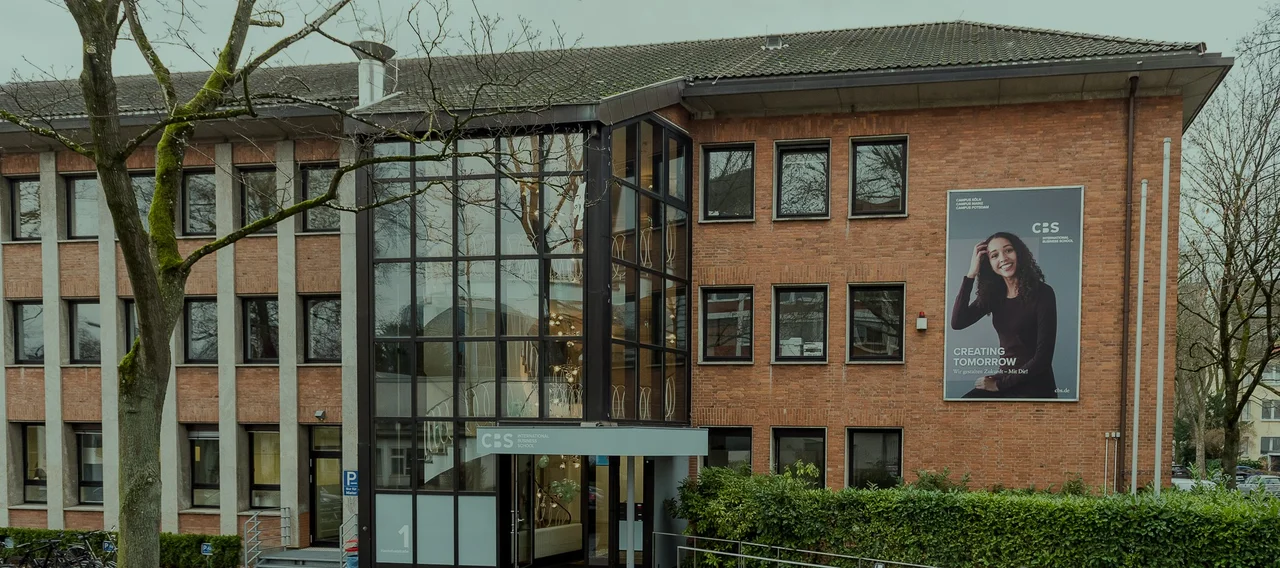
The main campus, in the Bayenthal-Marienburg district just south of the inner city, is a low set of buildings around a courtyard, a few minutes' walk from the Schönhauser Straße U-Bahn stop. There is no quad and no spire; the building looks more like a regional bank headquarters than a university. That is partly the point. CBS markets itself on tight class sizes - around 25 students per cohort - lecturers who arrive from industry to teach a single afternoon, and case studies drawn from companies headquartered down the Rhine in Düsseldorf and Bonn. It is not the University of Cologne, which sprawls over the neighborhoods to the north with 45,000 students. It is the smaller, English-speaking, fee-paying alternative across the river - a different kind of German school, in a country whose education system is still arguing about what private universities are for.
From the Air
The Cologne campus sits at 50.9245 N, 6.9492 E, on Hardefuststraße in the Bayenthal area roughly 2 km south-southwest of Cologne Cathedral and a few hundred meters back from the west bank of the Rhine. From cruising altitude over the Rhine valley, look for the Severinsbrücke - the campus is in the residential grid immediately south of the bridge's western end. Cologne Bonn Airport (EDDK / CGN) is 12 km east-southeast; the campus often appears below traffic on left-downwind for CGN runway 14L. Best viewing 3,000 to 6,000 ft.
Nearby Stories
- Diamond Interchange: How a Simple Idea Reshapes Towns Like Julich 2.8 km away
- Dusseldorf-Unterbach 6.1 km away
- Baumwollspinnerei Ermen & Engels 11 km away
- RAF Bruggen 15 km away
- Hagen Open-air Museum 21 km away
- Belgium 130 km away
- Marcinelle Mining Disaster 173 km away
- Zwingenberg Castle 178 km away