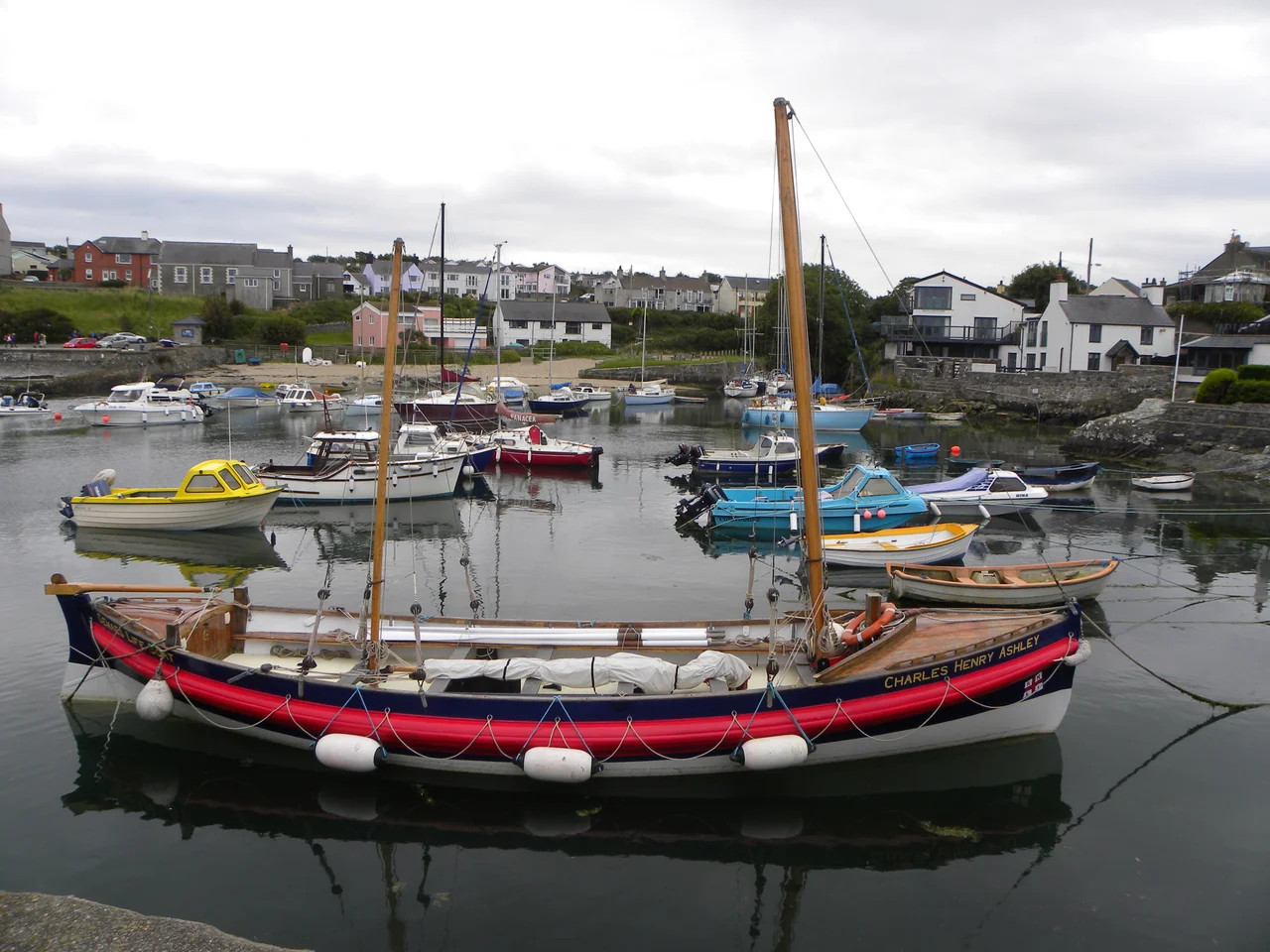

Cemaes Lifeboat Station
On the afternoon of 14 October 1877, the full-rigged sailing ship Sarah, bound from Quebec to Liverpool with a cargo of timber, ran onto Middle Mouse Rocks two miles off the north coast of Anglesey in heavy weather. The new lifeboat at Cemaes - the Ashtonian, paid for from a Manchester legacy and barely a year old - was launched into a long Atlantic swell. Eighteen men came off the wreck. Ashtonian would launch eight times in her five years on station and save thirty-three lives. The station that bought her had only opened five years before, and would last sixty more.
The Inheritance From Cemlyn
Cemaes never planned to have a lifeboat. The first Anglesey lifeboat station, founded in 1828, was at Cemlyn a few miles to the west, the work of the Reverend James Williams and his wife Frances after they watched 140 people die in a single shipwreck in 1823. But by 1872 the Cemlyn crew problem - too few experienced seamen living close enough to a remote beach - had become unmanageable, and the RNLI decided to close the station and open a new one at Cemaes instead. The Cemlyn lifeboat Sophia was simply rowed and sailed a few miles east and brought to a new boathouse at Porth yr Ogof cove, on the west side of Cemaes Bay. Sophia served four years from her new home before being replaced.
Boats With Donors' Names
Four lifeboats followed Sophia at Cemaes, and each one's name tells a small Victorian story. Ashtonian was paid for from the legacy of George Higginbottom of Ashton-under-Lyne in Lancashire. The second Ashtonian, in 1881, came from another bequest. George Evans, the 34-foot lifeboat that arrived in 1887, was funded by the widow of Admiral George Evans, who had been Conservator of the River Mersey. The final boat at Cemaes was Charles Henry Ashley, arriving in 1907 - one of five lifeboats funded by a £65,000 legacy from Charles Carr Ashley, who had died at Menton on the French Riviera. A new boathouse with a roller slipway was built to house her, at a cost of £3,840.
The Reverend Williams and His Horse
The most extraordinary story in Cemaes lifeboat history actually predates the station itself. On 7 March 1835, the Belfast vessel Active was driven ashore at Cemaes Bay in a winter storm. Several attempts to launch a boat had failed. The Reverend James Williams of Llanfair-yng-Nghornwy - the same man who founded the original Cemlyn station - was at the scene. With no boat able to reach the wreck, Williams rode his horse into the surf and got a line out to the ship. All five crew came ashore. For this service he was awarded the gold medal of the Royal National Institution for the Preservation of Life from Shipwreck, the highest civilian award for marine rescue. Few clergymen anywhere in Britain have done quite the same thing.
Sixty Years, Forty-Two Lives
Across her 60-year life, the Cemaes lifeboat was launched 60 times and rescued 42 people. The station closed in 1932 after 25 years with few launches and no rescues - the same calculation that had closed Bull Bay six years earlier. Faster motor lifeboats at Holyhead could now cover the same coast. The Charles Henry Ashley, the last boat at Cemaes, was preserved locally and remained sea-going for an extraordinary 117 years after her launch. In 2024 her hull finally deteriorated past the point of safe operation and she was retired from the water. She is preserved by the Cemaes Boat Club, kept ashore as a working museum of how the lifeboat tradition actually looked when it ran on oars.
From the Air
Cemaes Lifeboat Station was located in Porth yr Ogof cove at 53.42°N, 4.48°W, on the west side of Cemaes Bay near Wylfa Head, north Anglesey. From the air the site lies just west of the distinctive box of the decommissioned Wylfa nuclear power station, in a small cliff-fold cove invisible from most distances. Nearest airports: Anglesey/Valley (EGOV) 11 nm southwest, Caernarfon (EGCK) 21 nm south. The Mouse rocks - West, Middle and East Mouse - sit 1-3 nm offshore and are the dominant hazard. The Skerries lighthouse, 5 nm west-northwest, marks the worst of the navigational dangers.
Nearby Stories
- Llandudno Lifeboat Station 3.8 km away
- Glynllifon 6.1 km away
- German submarine U-1024 9.4 km away
- Irish Sea Bridge 11 km away
- Ysbyty Ifan 12 km away
- Irish Sea 18 km away
- Celtic Array 18 km away
- Birkdale Palace Hotel 56 km away