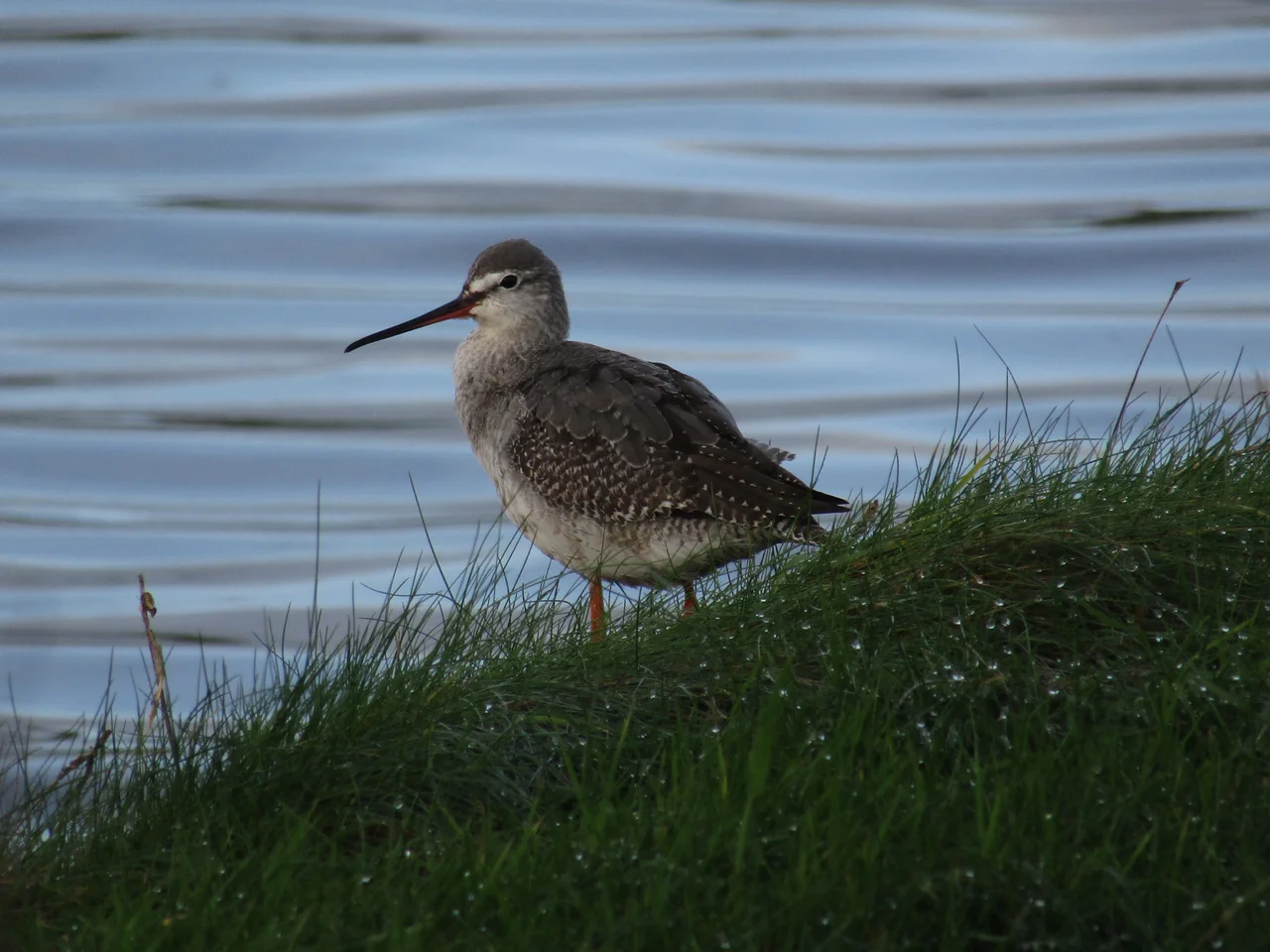

Cemlyn Bay and Lagoon
Sandwich terns nest by shouting at each other. Visit Cemlyn Bay between May and August and the sound of around 1,500 breeding pairs reaches you before the colony itself comes into view - a continuous mechanical chorus rising over the lagoon, broken by the harsher cries of the Arctic and common terns that nest alongside them, and the warning calls of black-headed gulls. The colony sits on a few small islands in a brackish lagoon. The lagoon is held back from the open sea by a curving shingle ridge thrown up by Irish Sea storms. Walk the ridge and the two worlds touch within metres - on one side the constant wash of salt water, on the other a tern colony making more noise than any human-built city of its size.
How a Storm Beach Built a Lagoon
The geography is straightforward but unusual. A long shingle beach, thrown up over centuries by Irish Sea storms pushing pebbles inland, runs in a smooth curve across the mouth of the original bay. Behind it, fed by small streams and topped up by occasional storm waves over the ridge, a brackish lagoon has accumulated. A weir at the western end - at a spot called Bryn Aber - regulates the water level. The whole site was designated a Site of Special Scientific Interest in 1957, falls within the Anglesey Heritage Coast and the Isle of Anglesey Area of Outstanding Natural Beauty, and is owned by the National Trust. The Cemlyn Nature Reserve itself - 25.2 hectares around the lagoon - has been leased and run by the North Wales Wildlife Trust since 1971.
The Only Welsh Colony
Cemlyn matters out of all proportion to its size because of what nests on it. Sandwich terns - sleek black-capped seabirds that winter along the West African coast - choose only a handful of European sites for breeding, and the colony at Cemlyn is the only one in Wales. Numbers have climbed in recent years to around 1,500 breeding pairs, making it the third-largest in the United Kingdom. Arctic terns, common terns and the very rare roseate tern have nested here in smaller numbers. The colony is wardened every summer from May to August, and is protected as part of the Ynys Feurig, Cemlyn Bay and The Skerries Special Protection Area, which also recognises two nearby sites where the same birds spend other parts of the season.
Vagrants and Surprises
Cemlyn occasionally draws birds it has no right to host. In July 1988 a bridled tern - a species more at home around the Caribbean and Indian Ocean - turned up and stayed for several weeks, drawing British twitchers from across the country. In July 2005 a sooty tern, an even more unlikely tropical visitor, was present on and off through the month. A squacco heron appeared in June 2015. The lagoon also supports breeding ringed plovers, oystercatchers and shelducks, and through the winter holds modest numbers of wigeon, shoveler and teal. Even the shingle ridge itself supports specialist plants - sea kale, sea beet, sea campion, thrift and the bright yellow-petalled yellow horned poppy - that grow nowhere except in this kind of disturbed coastal habitat.
Walking the Ridge
The Anglesey Coastal Path crosses Cemlyn Bay on the shingle ridge itself. From the National Trust car park at the eastern end, a walk along the beach takes you past the colony - viewing points on the lagoon side are roped off to keep visitors away from the nesting birds, but the whole spectacle is in plain sight. Westwards the path continues across the weir at Bryn Aber and on toward The Skerries lighthouse, four miles away, where the tern population partly overlaps with another colony. Eastwards it leads to Cemaes village. Twitchers come for the rare visitors. Walkers come for the geography. Wales comes for the only place in the country where Sandwich terns choose, every summer, to lay their eggs.
From the Air
Cemlyn Bay at 53.41°N, 4.51°W, on the north coast of Anglesey, 2.5 km west of the Wylfa nuclear power station. From the air the bay is unmistakable: a long, curving shingle bar pulled smooth between two rocky headlands, with the dark band of the brackish lagoon visible behind it. The tern colony is on a few small islands at the western end of the lagoon. Nearest airports: Anglesey/Valley (EGOV) 10 nm south-southwest, Caernarfon (EGCK) 21 nm south. The Skerries lighthouse is 5 nm to the west-northwest; West Mouse rock lies 2 nm offshore.
Nearby Stories
- Llandudno Lifeboat Station 3.8 km away
- Glynllifon 6.1 km away
- German submarine U-1024 9.4 km away
- Irish Sea Bridge 11 km away
- Ysbyty Ifan 12 km away
- Irish Sea 18 km away
- Celtic Array 18 km away
- Birkdale Palace Hotel 56 km away