
Cemlyn Lifeboat Station
On 26 March 1823, the Reverend James Williams and his wife Frances stood on the cliffs at Llanfair-yng-Nghornwy and watched a ship called the Alert break up in the storm. One hundred and forty people died in their view. Williams was the parish priest. For the next five years he and Frances raised money, lobbied, organised, and argued for a lifeboat for this stretch of coast, and on 3 November 1828 a 25-foot eight-inch lifeboat costing £55 arrived at Cemlyn from a builder in Limehouse, London. It was the first lifeboat ever stationed on Anglesey, and the founding station of what would become the Anglesey Association for the Preservation of Life from Shipwreck. Williams' son Owen took on the unpaid post of coxswain.
The Steamship Leeds and Three Men
When the steamship Leeds struck Harry Furlong Rocks, the Cemlyn lifeboat launched into rising seas. By the time the boat reached the wreck, a second steamship, Commerce, had also come up and was taking off most of the passengers in her own boats. One small boat, however, had drifted clear and could neither reach land nor regain Commerce. The Cemlyn crew rowed across, took on the three men aboard, and brought them home. Coxswain Owen Lloyd Williams was awarded the silver medal of the Royal National Institution for the Preservation of Life from Shipwreck for this service. In December 1845 the barque Frankland, on passage from Bahia to Liverpool, was wrecked at Cemaes Bay; three more Cemlyn crewmen - Robert Griffiths, Richard Owen and Owen Highland - earned silver medals for rescuing the 18 men aboard.
Five Boats Over Ninety Years
The original boat served until 1853. A series of replacements followed - some new builds, some transfers from other Welsh stations. The Sophia, a 30-foot self-righting boat, arrived in 1865 and stayed until the station was first closed. The naming of the lifeboats often reflected their donors: Good Shepherd, paid for in 1877 by the Loyal Order of Ancient Shepherds (Ashton Unity), was renamed B. J. Nicholson in 1890 after a new benefactor. Annie Collin came over from another station in 1904. Sir John, the last lifeboat at Cemlyn, served the final five years, also transferred in from elsewhere. Cemlyn's location made it perennially difficult: a remote shingle beach with no protected boathouse approach, far from where most able seamen actually lived.
Closed, Reopened, Closed
By 1872, raising a crew at Cemlyn had become impossible - the men were not living close enough to launch in a hurry, and the RNLI decided to close the station and open a new one at Cemaes a few miles east. The Cemlyn boathouse stood empty for five years. Then enough experienced seamen returned to the village that a request to reopen was approved, a new boathouse was built, and a 32-foot lifeboat - the Good Shepherd - arrived in October 1877. The station ran for another 42 years. Finally, on 13 March 1919, after the slow decline that affected most coastal stations as bigger motor lifeboats took over their work, the second closure of Cemlyn was permanent.
The Memorial
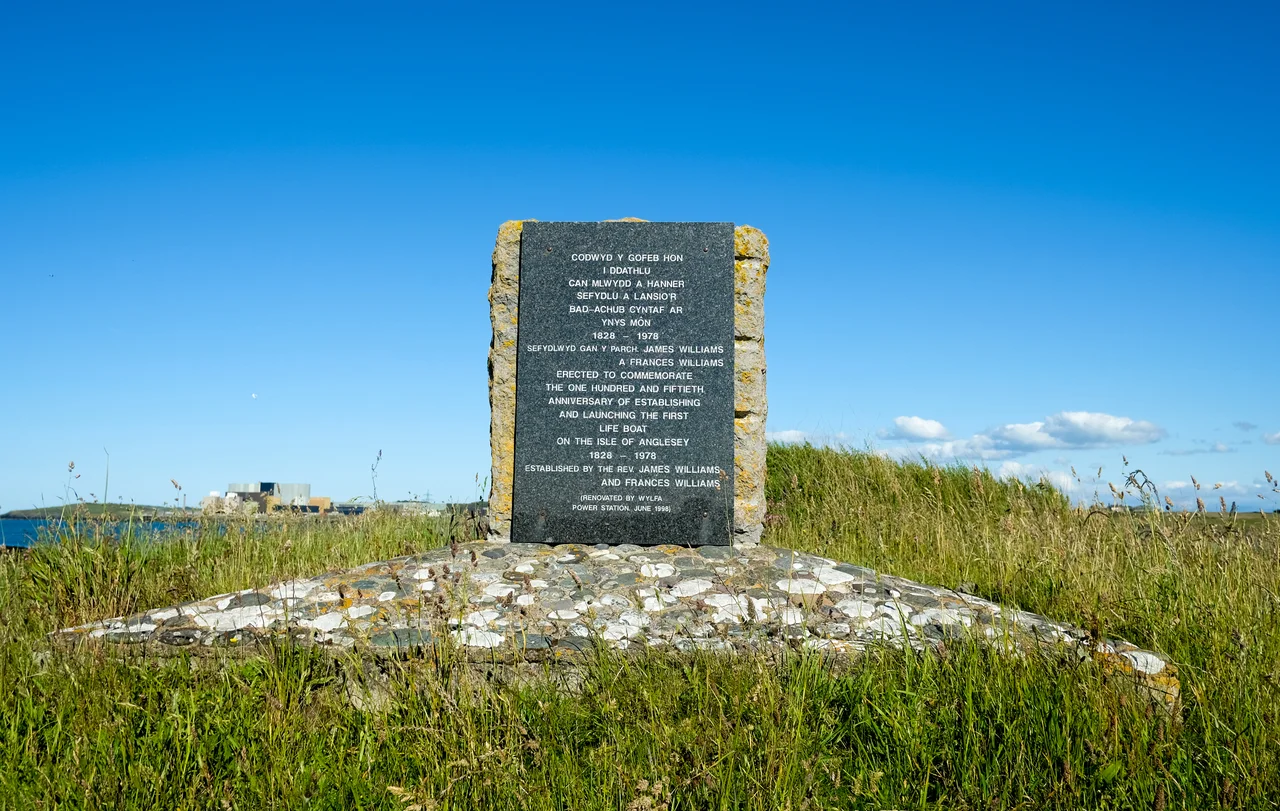
In 1978, on the 150th anniversary of the original Cemlyn station - and of the founding of the Anglesey Association for the Preservation of Life from Shipwreck - a memorial was erected near the site of the boathouse. It commemorates the first Anglesey lifeboat station and the two people who built it: the Reverend James Williams and his wife Frances, who refused to let what they had watched from the cliffs in 1823 simply be repeated. Williams died in 1872. Frances died before him. The Association they founded merged into the RNLI in 1855, contributing to the institution that today runs the Holyhead and Moelfre stations covering the same coast. The Cemlyn boathouse is gone, but the lagoon and the shingle ridge it stood beside are now the most important breeding site for Sandwich terns in Wales.
From the Air
Cemlyn Lifeboat Station once stood at 53.41°N, 4.51°W, on the west side of Cemlyn Bay on the north Anglesey coast. From the air the bay is unmistakable - a long curving shingle ridge enclosing a brackish lagoon, 2.5 km west of Wylfa nuclear power station. The former boathouse site is on the western (Bryn Aber) end of the beach. Nearest airports: Anglesey/Valley (EGOV) 10 nm south-southwest, Caernarfon (EGCK) 21 nm south. The Skerries lighthouse and West Mouse rock dominate the offshore hazards. The same coast is covered today by Holyhead RNLI 13 nm to the southwest.
Nearby Stories
- Llandudno Lifeboat Station 3.8 km away
- Glynllifon 6.1 km away
- German submarine U-1024 9.4 km away
- Irish Sea Bridge 11 km away
- Ysbyty Ifan 12 km away
- Irish Sea 18 km away
- Celtic Array 18 km away
- Birkdale Palace Hotel 56 km away