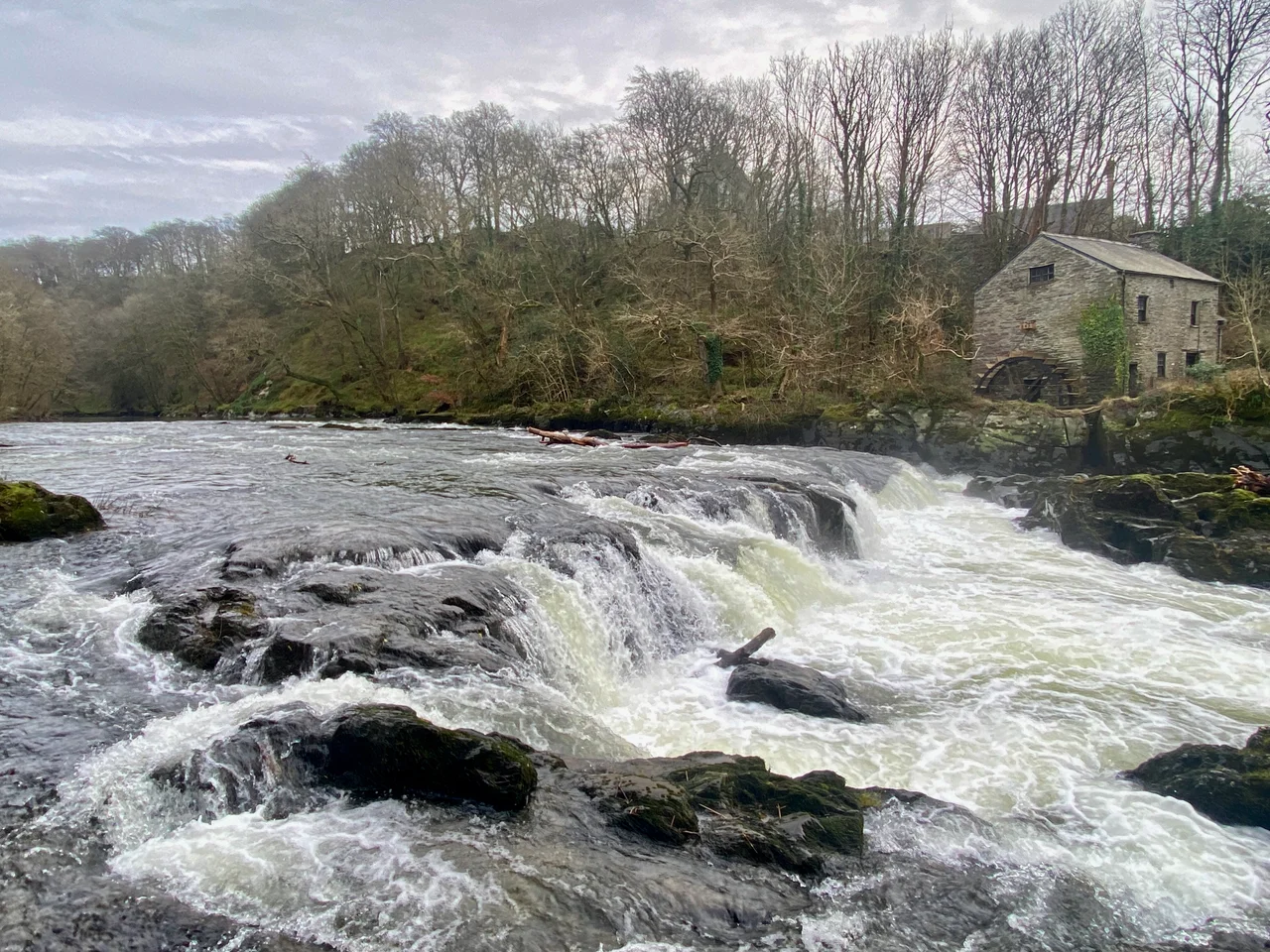

Cenarth Falls
In autumn, when the salmon are running, people walk down through the woods to stand beside the river and wait. The Teifi pushes over the ledge in three separate falls, white water foaming around mossed boulders, and somewhere in the dark green pools below, fish are gathering. Then one launches itself. A flash of silver flank, the shock of the leap, a body curving up through the spray and into the rock face, sometimes finding a way through, sometimes falling back to try again. Cenarth Falls is the first significant barrier that salmon and sea trout meet on their migration up the Teifi to spawn, and for as long as anyone has lived on this river, the falls have been worth watching.
Edward I's Mill
A water-powered mill is recorded at Cenarth Falls from 1298, the year Edward I became Lord of the Manor of Cenarth. The site was already old then. The shape of the falls makes them ideal for a mill: the river narrows through a rocky cleft, the head of water is constant, and the surrounding stone gives a solid foundation for the leat and wheelhouse. The present 18th-century mill building still sits beside the lower fall, its wheel quiet now, restored as a visitor centre but still capable of being turned by the river. For seven centuries, every loaf eaten in the surrounding parishes had probably passed through this mill at some point in its making, the wheels turning the stones, the stones grinding the grain, and the water that powered them tumbling away down the falls.
The Salmon Leap
The Teifi is one of the most famous salmon rivers in Wales. Adult salmon return from the North Atlantic feeding grounds west of Greenland, navigating up the Bristol Channel and round into Cardigan Bay before pushing into the river mouth at Cardigan and starting upstream. Cenarth is the first real test. The river drops about two metres over the ledge in three steps; in dry weather it is climbable, in spate it can be brutal. Sea trout, called sewin in Welsh, run the river too, and in good years you can see them silvering against the rocks. The Welsh Government and Natural Resources Wales monitor the stocks closely; Atlantic salmon numbers across Britain have declined dramatically since the 1970s, and the Teifi is no exception, though it remains one of the better rivers in the principality.
Frank Miles and the Painted Falls
In 1878, the English artist George Francis Miles, better known as Frank Miles, painted Salmon Leap at Cenarth Falls. The picture, now in the collections of Nottingham City Museum, shows the cascade in late afternoon light, dark water against bright rocks, the figure of a fisherman barely visible on the far bank. Miles had a personal connection to the place; his father had inherited Cardigan Priory from Philip John Miles before becoming Rector of Bingham in Nottinghamshire. Frank Miles himself was a fashionable Victorian portrait painter who shared lodgings in London with the young Oscar Wilde; the Cenarth painting is among the more peaceful things he made. Earlier images survive too: an 1830 engraving of the salmon leap after a watercolour by David Cox, and an 18th-century aquatint by James Baker showing the falls as a wilder, more romantic scene of Welsh nature.
Coracles
Across the river bridge from the falls stands the National Coracle Centre, housed in a 17th-century flour mill. The coracle is a round, leather-and-lath, single-person boat that has been used on Welsh rivers for at least two thousand years; a Roman writer mentions seeing them on the Severn. The Teifi is the last river in Wales where coracle fishing for salmon and sewin has been continuously practised into modern times. The boats are light enough to be carried on a single shoulder, paddled with a one-handed sweep, and used in pairs to draw a net between them. Licences are now strictly limited; in recent years only a handful are issued for the Teifi, and the boats are usually pulled up on the banks downstream at Cenarth, Cilgerran, and St Dogmaels. The Coracle Centre at Cenarth holds the most complete public collection of these small craft anywhere in the world.
Where the River Slows
Below the falls the Teifi calms into deep wooded pools, the kind of water that anglers describe with a particular tone, then continues westward through Cenarth village under William Edwards's 1787 bridge with its perforated spandrels, finally reaching tidal water some six miles downriver. A footpath runs along both banks at the falls, with viewing platforms and steps down to the rocks. A few miles upstream, the lesser-known Henllan Falls offer a similar but quieter chance to watch the salmon climb. Visitors come year-round, but the autumn migration season, broadly October to December, is when the river puts on its strangest and oldest show: dark fish flying out of dark water against grey stone, repeating an act that has happened here every autumn since the river first cut its bed.
From the Air
Located at 52.05 degrees north, 4.52 degrees west on the River Teifi between Cardigan and Newcastle Emlyn, at the meeting point of Ceredigion, Carmarthenshire, and Pembrokeshire. Cruise altitude 2,000-4,000 feet, ideal for tracing the silver thread of the Teifi through wooded valleys. The MoD Aberporth danger area lies a few miles north; check NOTAMs. Nearest civil airport is Haverfordwest (EGFE); Swansea (EGFH) further south-east.
Nearby Stories
- RAF Haverfordwest 3.7 km away
- Great Western Railway in West Wales 7.7 km away
- West Wales 9.9 km away
- Fishguard Lifeboat Station 13 km away
- Battle of Mynydd Hyddgen 15 km away
- Strata Florida Abbey 18 km away
- Neath and Tennant Canal 21 km away
- HMS Tyler 44 km away