_-_Salmon_Leap,_Cenarth_Falls,_Cardiganshire_-_NCM_1919-11_-_Nottingham_Museums.jpg)
Cenarth
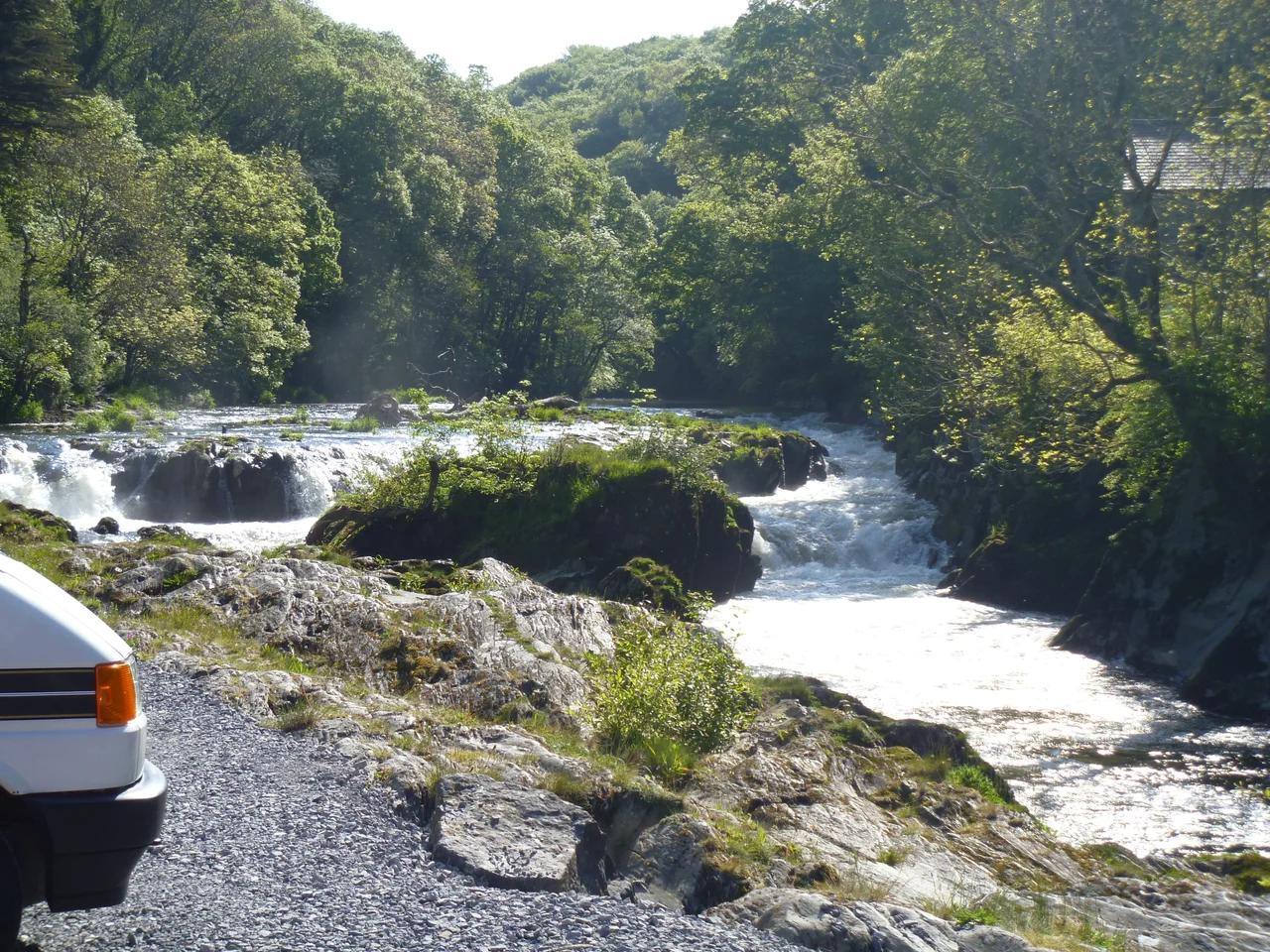
Cenarth has one bridge, one waterfall, one bishop-house dedicated to a forgotten Welsh saint, and one museum devoted to a kind of boat almost nobody builds anymore. None of these things would justify a stop in any other country. In Wales, in this exact corner where Carmarthenshire meets Ceredigion meets Pembrokeshire, they justify each other. The village sits in the wooded gorge of the River Teifi six miles east of Cardigan, where the river makes a series of dramatic falls over a rocky ledge and where, for at least eight centuries, the same set of human activities has been organised around the same river.
Three Counties, One River
Cenarth is in Carmarthenshire, but only just. The River Teifi here forms a long county boundary, and the village's parish has historically extended both north and south of the river. Newcastle Emlyn, four miles to the east, was part of the same ancient parish until 1934. The community is bordered by Newcastle Emlyn, Llangeler, Cynwyl Elfed, and Trelech in Carmarthenshire; by Clydau and Manordeifi in Pembrokeshire; and by Beulah and Llandyfriog in Ceredigion. The Welsh-language story of the village is striking: in 1891, ninety-eight percent of the people of the ancient parish were Welsh-speakers; by 1981, that figure had fallen to sixty-nine percent across the post-1934 enlarged community. The pattern repeats across rural west Wales: a slow erosion of everyday Welsh, broken in places by deliberate language schools and community efforts.
William Edwards's Bridge
The dominant feature of the village is Cenarth Bridge, just west of the falls, built in 1787 by William Edwards of Eglwysilan and his son David. William Edwards is a fascinating figure in Welsh engineering history: a self-taught mason who designed the great single-arch bridge over the Taff at Pontypridd, perfecting a technique that solved a real problem in 18th-century stone bridge construction. The method involves piercing the heavy spandrels (the wedge-shaped bits of stonework either side of the arch) with circular holes. This dramatically reduces the weight of the structure while losing very little of its strength, so a stone bridge can stand against floods that would push a heavier, solid-spandrel version off its foundations. Cenarth Bridge has those signature circles. It is Grade II*-listed, partly in Carmarthenshire and partly in Ceredigion, and it has carried traffic over the Teifi for nearly two and a half centuries.
The National Coracle Centre
Beside the falls stands a 17th-century corn mill, restored, and now home to the National Coracle Centre. Coracles are round, lightweight one-person boats, traditionally made of woven willow or hazel covered with hide or tarred cloth, used for net fishing on Welsh rivers since prehistory. The Roman writer Pliny the Elder mentions them. The Teifi is the last river in Wales where coracle fishing for salmon and sea trout has continued in living memory, and Cenarth is the centre of that tradition. The museum displays coracles from rivers all over Britain and from other parts of the world too: Tibet, India, North America, anywhere a need for a light water craft met available local materials. A handful of licensed coracle fishermen still work the lower Teifi between Cenarth and Cardigan, though the numbers shrink with each generation.
St Llawddog of the Cantref
The parish church is dedicated to St Llawddog, a local 6th-century saint about whom not very much is recorded. He was reputedly the son of a Welsh prince, gave up his princely life to become a hermit and then an abbot, and founded several churches in the Teifi valley. The present church at Cenarth is relatively modern, rebuilt in the 19th century, but it stands on an important ancient site. In the early medieval period it was the bishop-house of the cantref of Emlyn: a cantref was an old Welsh administrative unit roughly equivalent to a hundred, and Emlyn was one of the seven cantrefi of Dyfed. A bishop-house was a major ecclesiastical centre, indicating that Cenarth was once far more important religiously than it is now. The dedication keeps that memory alive, even if very few people who pass through know who Llawddog was.
The Falls in Spate
East of the village, the River Teifi emerges from a deep wooded ravine and tumbles over the ledge that forms Cenarth Falls. After heavy rain in the Cambrian Mountains, the falls can be spectacular: thundering brown water, mist hanging in the trees, the bridge audible above the roar. In the autumn migration season, visitors come to watch salmon and sewin trying to leap the cascade on their way upriver to spawn. The 1878 painting by Frank Miles, now in Nottingham City Museum, captures the moment exactly: a fish in mid-air against the falling water. A 13th-century mill stood here too, recorded in 1298 when Edward I became Lord of the Manor. Add the bridge, the coracles, the church on its ancient site, and a village of fewer than 700 residents has assembled, almost by accident, a small encyclopaedia of rural Welsh life.
From the Air
Located at 52.04 degrees north, 4.52 degrees west on the River Teifi between Cardigan and Newcastle Emlyn. The village sits at the meeting point of Ceredigion, Carmarthenshire, and Pembrokeshire. Cruise altitude 2,000-4,000 feet gives a clear view of the river-cut gorge and Cenarth Bridge. The MoD Aberporth danger area lies a few miles north; check NOTAMs. Nearest civil airport is Haverfordwest (EGFE); Swansea (EGFH) further south-east.
Nearby Stories
- RAF Haverfordwest 3.7 km away
- Great Western Railway in West Wales 7.7 km away
- West Wales 9.9 km away
- Fishguard Lifeboat Station 13 km away
- Battle of Mynydd Hyddgen 15 km away
- Strata Florida Abbey 18 km away
- Neath and Tennant Canal 21 km away
- HMS Tyler 44 km away