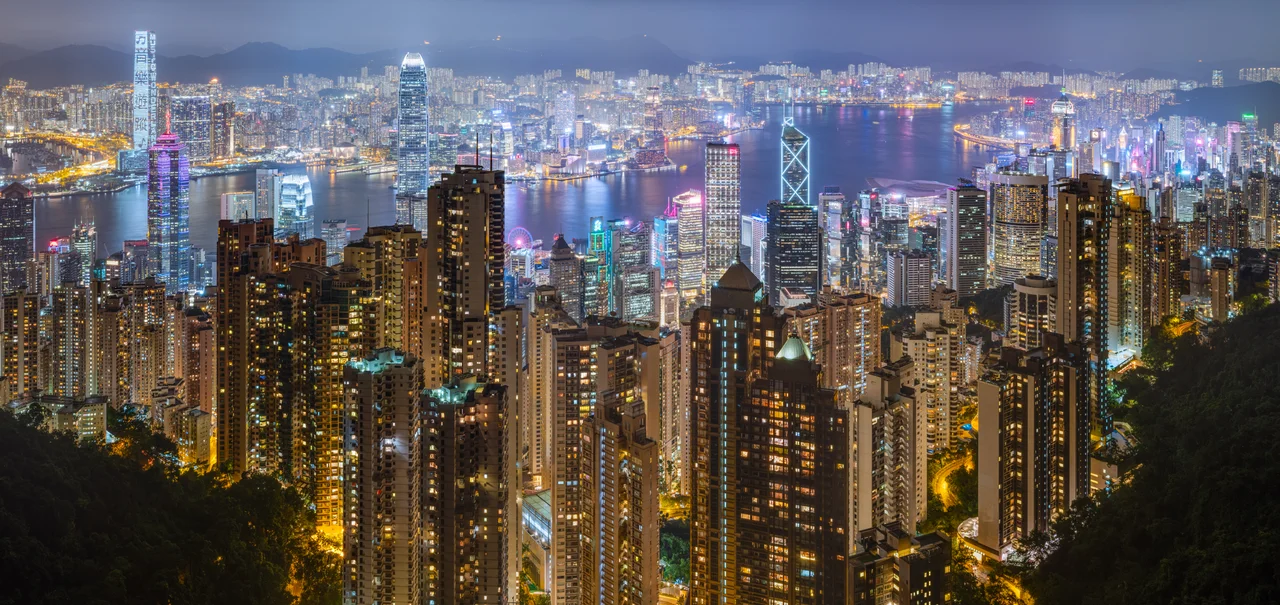

Central and Western District
In June 1841, six months after the British flag was raised at Possession Point, the colonial government held its first land sale. Fifty-one lots went to twenty-three merchant houses — Dent's, Jardine's, Russell's, Olyphant's — who built offices and warehouses on a shoreline they were already reshaping. The streets they laid down became Government Hill. The city they started became Victoria City, and Victoria City became what is now the Central and Western District: 12.4 square kilometres on the northwestern corner of Hong Kong Island that still contains most of the institutions, buildings, and address names from those first years of colonial settlement.
Two Districts, One History
The district's name reflects a distinction that mattered greatly in the nineteenth century. Central was the European commercial district — banks, trading houses, government offices, the kind of address that mattered to Westerners doing business in the colony. Western was where Chinese merchants built their commercial world: Sheung Wan and Sai Ying Pun and Tai Ping Shan, districts that had their own rhythms and their own hierarchies. By 1857 the British had divided Victoria City into seven sub-districts; those that fall within present-day Central and Western include Sai Ying Pun, Sheung Wan, Tai Ping Shan, and Central itself. The divide began to blur around 1860, when Chinese merchants started buying property in the streets around Cochrane, Wellington, and Pottinger. HSBC arrived as the Central district's first major bank. A private police force — the District Watch Force — was established in February 1866 to protect the increasingly valuable property in the area.
The World's Longest Outdoor Escalator
The Central–Mid-Levels escalator opened in 1993 and immediately became one of Hong Kong's stranger civic achievements. At 800 metres, it is the longest outdoor covered escalator system in the world, climbing from Queen's Road Central up to Conduit Road in the Mid-Levels through the narrow SoHo streets that line its route. The direction reverses by time of day: downhill from 6 a.m. to 10 a.m. for the morning commute, uphill from 10:20 a.m. to midnight for the rest of the day. What was conceived as functional transport infrastructure became, almost inadvertently, the spine of an entertainment district. Restaurants, bars, and shops clustered along its route, and SoHo — Hong Kong's version of the New York neighbourhood whose name it borrowed — grew up around the moving staircase. It is one of the few pieces of transit infrastructure anywhere that people ride partly for the experience of riding it.
I. M. Pei's Tower and the Skyline That Changed
The Bank of China Tower stands 315 metres tall, with two masts reaching 369 metres — designed by I. M. Pei and completed in 1989 after construction began in 1985. When it was finished, it was the first building outside the United States to exceed 1,000 feet and also the first to exceed 300 metres. It held the title of tallest building in Hong Kong and Asia until 1992, when the nearby Central Plaza was completed. The tower's triangular geometry and blue-glass cladding made it immediately recognisable, though it drew controversy in Hong Kong for what feng shui practitioners saw as the aggressive angles of its corners pointing at Government House and other nearby buildings. Whatever the metaphysics, the physical fact is striking: a building that arrived as the world's tallest outside America and still defines the Central skyline more than three decades later.
Who Lives Here Now
The Central and Western District had a population of 235,953 in the 2021 census — modest by Hong Kong standards, third smallest among the 18 districts, reflecting how much of its territory is given over to offices, government buildings, and the steep terrain of Victoria Peak. The residents who are here tend to be prosperous: the district has the second-highest median household income in Hong Kong, behind only Wan Chai. Ethnically, it is relatively diverse for the city — 77% Chinese in 2021, with significant Filipino (7.6%) and white (5.8%) populations. Seventy-two percent of residents speak Cantonese as their primary language, while 14% use English and 3% use Mandarin. The University of Hong Kong occupies the western end of the district, extending into Kennedy Town, which was established in the early twentieth century as the furthest western extension of Victoria City. The district also technically includes Green Island and Little Green Island, two uninhabited specks of land to the west of Hong Kong Island.
Heritage Layered Over Heritage
Tai Kwun — the revitalized compound of the former Central Police Station, Central Magistracy, and Victoria Prison on Hollywood Road — opened in 2018 as a heritage and arts destination after years of conservation work. PMQ, converted from former police married quarters on the same stretch of road, hosts design studios and small businesses. The Former French Mission Building now houses the Court of Final Appeal. Flagstaff House, originally the residence of the Commander of British Forces in Hong Kong, survives inside Hong Kong Park as the Museum of Tea Ware — the only military building from that era to remain intact after the barracks around it were demolished in the 1980s. St John's Cathedral, consecrated in 1852, stands nearby as the oldest Western ecclesiastical building in Hong Kong. These layers — colonial, postcolonial, contemporary — sit close enough together that navigating the district is a form of time travel, if you know what you're looking at.
From the Air
The Central and Western District covers the northwestern shore of Hong Kong Island from approximately 22.28°N, 114.15°E (Central waterfront) westward to Kennedy Town. At 3,000–5,000 feet, the district is easily identifiable by the distinctive cluster of skyscrapers along the Central waterfront — the Bank of China Tower's triangular form, the HSBC Main Building's unusual structural exoskeleton, and the twin towers of the International Finance Centre. Victoria Peak rises sharply to the south, its summit at 552 metres, with the Peak Tram route visible as a line cutting up the hillside. The Star Ferry Pier in Central is a useful low-altitude waypoint. Hong Kong International Airport (VHHH) lies approximately 16 nautical miles to the west; the Western Harbour Crossing connects this district to Kowloon to the north.
Nearby Stories
- Lok Ma Chau Loop 2.3 km away
- Portas do Cerco 2.3 km away
- Kweilin Incident 17 km away
- Wanshan Archipelago Campaign 34 km away
- Nanxiong Formation 115 km away
- Battle of Nanpeng Island 148 km away
- Heyuan 169 km away
- Cape Maobitou 632 km away