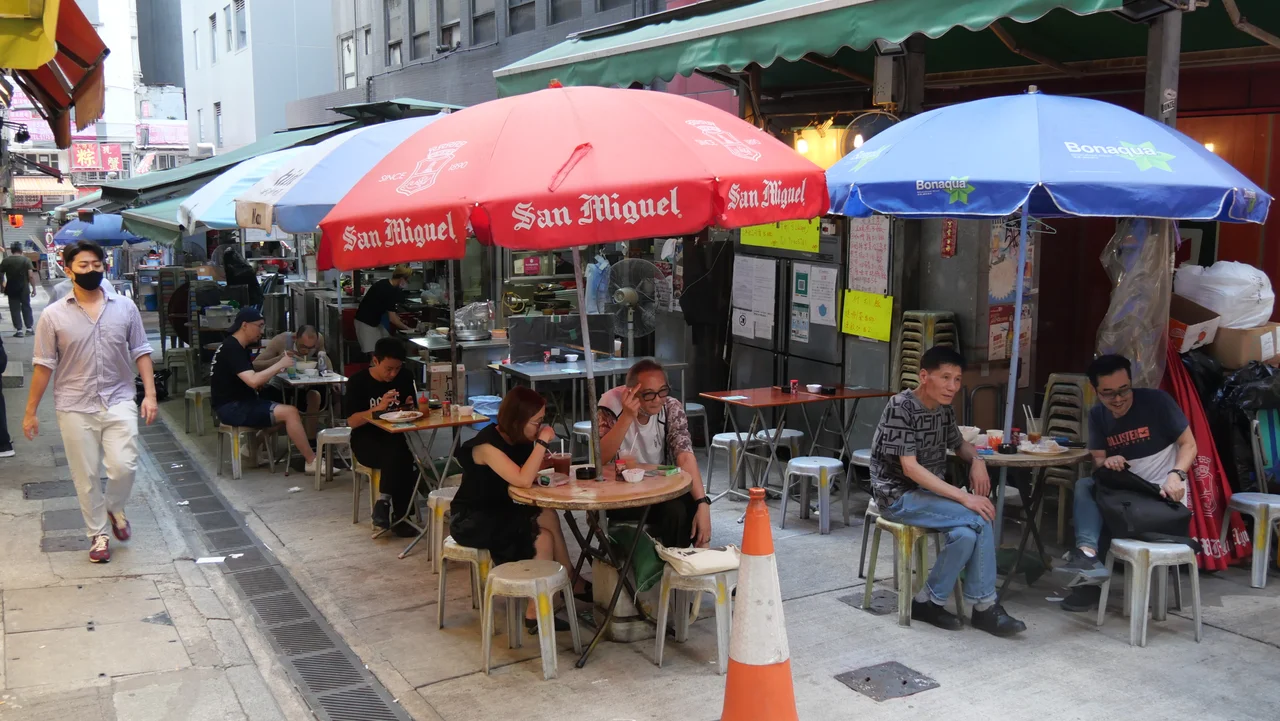

Central, Hong Kong
The British landed at Possession Point in January 1841 and quickly decided they needed a city. They chose the north shore of Hong Kong Island — the ground that is now Central — for its military facilities and administrative centre. A Canton Bazaar rose between Cochrane Street and Graham Street in 1842. By 1848 the population had grown from 5,000 to 24,000. Within two decades, the construction of City Hall, Theatre Royal, and a series of financial buildings had made this small stretch of waterfront the undisputed heart of Hong Kong. That role has never been relinquished. The names of the streets, the addresses of the banks, the location of the harbour ferries — Central is where Hong Kong's story most visibly continues.
What Was Built First
The area's earliest name in Cantonese was Chung Wan — a direct translation of 'central' — and it was one of the sub-districts of Victoria City, the colonial settlement whose English name has largely faded from use. The British zoned the area for Westerners: 'Western-style buildings' meant structures meeting European hygiene and space standards, and Chinese residents were pushed west to Sheung Wan. Government House and the government's other buildings went up on Government Hill. The Royal Navy built its port — Naval Dockyard — and a shore station named Tamar after HMS Tamar, a troopship that had served as a base during the Second Opium War. By the time City Hall and the Theatre Royal were completed between 1860 and 1880, Central had the infrastructure of a proper colonial city, not just a trading post.
Reclaimed Ground and Expanding Ambition
Hong Kong's first road, Queen's Road — now subdivided into Queen's Road East, Central, and West — was built between 1841 and 1843 along the original waterfront. The waterfront didn't stay there for long. In 1904, the Praya Reclamation Scheme added 59 acres of land to Central's harbour edge, pushing the city further into Victoria Harbour. Sir Paul Chater and James Johnstone Keswick, founders of Hongkong Land, were among those who drove that expansion forward. During the 1920s the collaboration between Central's institutions and the waterfront commerce produced rapid economic growth. Land reclamation has continued ever since; the shoreline visible today bears little resemblance to what the first settlers would have recognized. The harbour gap between Hong Kong Island and Kowloon has been narrowed by fill from both sides.
Finance, Glass, and Steel
Central is the address of choice for the financial institutions that define Hong Kong's global role. The Hongkong and Shanghai Banking Corporation — HSBC — has its headquarters here in the building completed in 1985, designed by Norman Foster with its distinctive external steel frame. The Bank of China Tower, I. M. Pei's 72-storey glass triangle completed in 1989, stands to the east. The Hong Kong Monetary Authority operates from IFC 2, the second-tallest building in Hong Kong. Bank of East Asia, Hang Seng Bank, Standard Chartered — the roster of financial institutions headquartered within a few blocks of each other reflects Central's identity as one of Asia's primary financial centres. Exchange Square houses the Hong Kong Stock Exchange. Before 1999, Cathay Pacific had its head office in the Swire House here before relocating to the airport.
The Streets That Carry History
Central's streets still carry the names of the colonial era. Jubilee Street was named for the Golden Jubilee of Queen Victoria in 1887. Pottinger Street, one of the 'ladder streets' that climb the hillside in steps, is named after the first governor. Theatre Lane, running off Queen's Road, became known for shoe shiners who set up there for decades. Duddell Street still has its Victorian gas lamps, a listed monument. Lan Kwai Fong — a short L-shaped street of bars and restaurants — has been Central's nightlife centre since the 1980s. SoHo, the neighbourhood that grew along the Central–Mid-Levels escalator route, offers a different kind of evening. Tai Kwun, the revitalized former police station compound on Hollywood Road, opened in 2018. Nearby PMQ occupies former police married quarters. The streets and their institutions accumulate like sediment.
Where Protests Go
Central's concentration of financial and government authority has made it a focal point for political expression. From October 2011 to September 2012, an Occupy Central movement gathered in front of the HSBC Main Building, its immediate target the same institution whose headquarters had defined this block for decades. In September 2014, democratic activists initiated Occupy Central with Love and Peace, demanding universal suffrage for the election of Hong Kong's Chief Executive; the movement eventually grew into the broader Umbrella Revolution. The protests occupied streets and disrupted the district's commercial rhythms for weeks. Central absorbs all of it — the finance and the demonstrations, the colonial architecture and the contemporary towers — in the way that places do when they have been the centre of something for long enough that the centre becomes structural.
From the Air
Central lies at approximately 22.2819°N, 114.1581°E on the north shore of Hong Kong Island. At 2,000–4,000 feet, the waterfront is defined by the two towers of the International Finance Centre, the stepped silhouette of Exchange Square, and the distinctive HSBC Main Building with its external steel frame. The Star Ferry Pier is visible at water level, and the narrow strait of Victoria Harbour — roughly 1 nm wide here — separates Central from Tsim Sha Tsui on the Kowloon side. Victoria Peak rises sharply to the south; the Peak Tram's upper terminus is visible on its flank at 396 metres. Hong Kong International Airport (VHHH) is approximately 15 nautical miles to the west-northwest; the Airport Express line runs from Hong Kong Station in Central directly to the airport. The Central–Wan Chai Bypass tunnel entrance is visible at the eastern edge of the waterfront.
Nearby Stories
- Lok Ma Chau Loop 2.3 km away
- Portas do Cerco 2.3 km away
- Kweilin Incident 17 km away
- Wanshan Archipelago Campaign 34 km away
- Nanxiong Formation 115 km away
- Battle of Nanpeng Island 148 km away
- Heyuan 169 km away
- Cape Maobitou 632 km away
Sources
- Central, Hong Kong - Wikipedia
- Wikipedia - Possession Street (British landing at Possession Point January 1841)
- HSBC Building (Hong Kong) - Wikipedia
- Bank of China Tower (Hong Kong) - Wikipedia
- Occupy Central (2011–2012) - Wikipedia
- Umbrella Movement - Wikipedia
- Praya Reclamation Scheme - Wikipedia
- Cathay City - Wikipedia