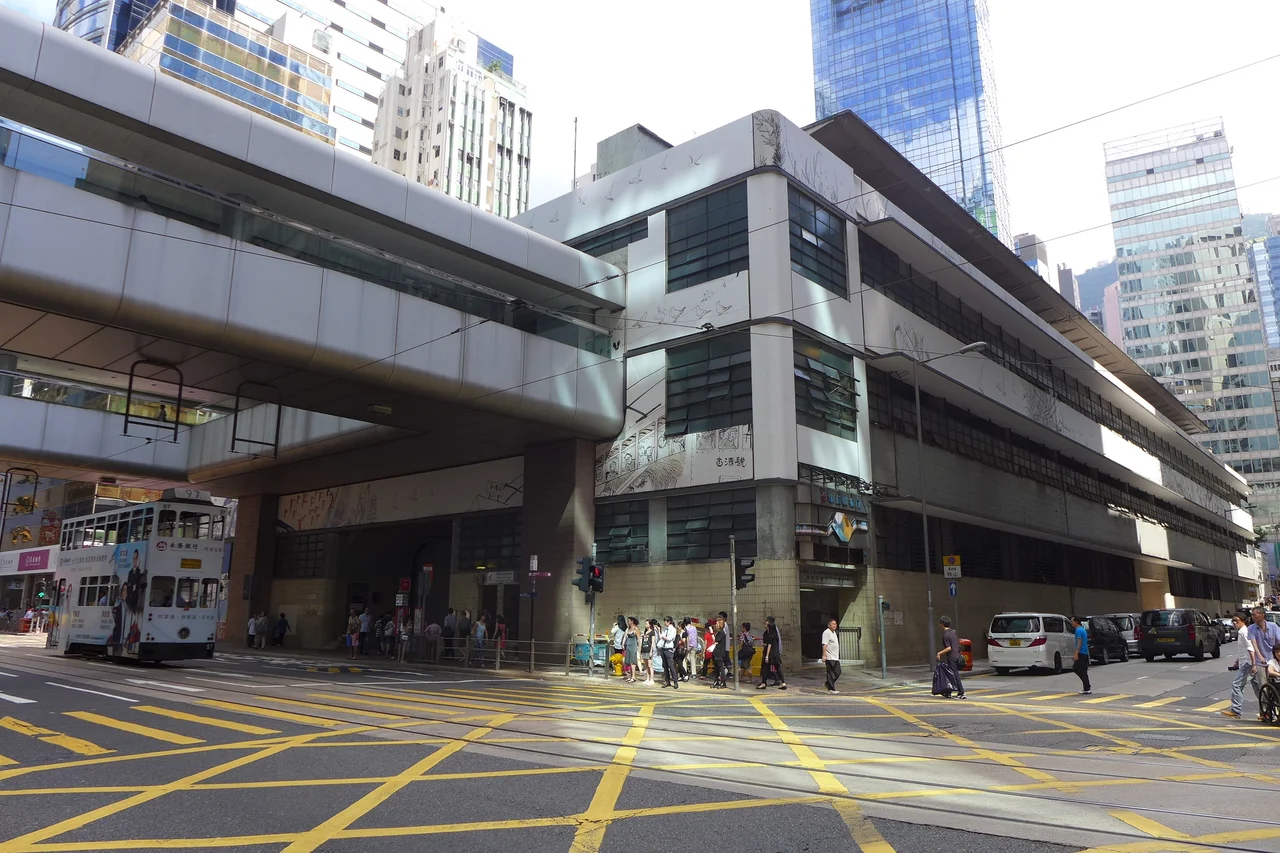

Central Market, Hong Kong
The sign above the Des Voeux Road entrance still bears the Chinese characters that Japanese occupiers insisted upon during the Second World War. They weren't restored to the original script until 1993 — forty-eight years after liberation. That small act of linguistic erasure and its slow undoing says something about Central Market: it is a building that carries history the way old wood carries rings, quietly but completely. What began in 1842 as a colonial bazaar called Canton Bazaar has been rebuilt, renamed, occupied, abandoned, and reborn — and the clean horizontal lines of its 1939 Bauhaus facade look out over Des Voeux Road Central as serenely as ever.
From Canton Bazaar to the Praya
Hong Kong's commercial heart did not arrive fully formed. The original Canton Bazaar opened in 1842 on Queen's Road Central, in the earliest days of British administration, and earned a second name — the Middle Bazaar — by the following year. It moved more than once, pushed aside by fires that drove Chinese residents to Tai Ping Shan, then displaced again when naval construction claimed the land near the harbour. By the 1850s, the market had settled on Des Voeux Road, then known simply as The Praya, and taken the name Central Market. A Victorian rebuild in 1895 gave it a three-storey marble structure topped by a central tower — a fittingly imperial flourish for the colonial era. The marble didn't last. By 1937, that structure too came down.
The Bauhaus That Survived Everything
Construction of the current building cost HK$900,000 and was completed in 1938; the market reopened on 1 May 1939. In a city where tropical heat and humidity are relentless, the design was quietly radical: a four-storey reinforced concrete shell with a generous central court, high ceilings, and walls of glass for cross-ventilation and natural light. Two hundred booths filled the interior. At its peak, Central Market was the largest meat market in Southeast Asia, significant enough that Governor Alexander Grantham paid a visit, as did Governor David Trench in 1967. Then the war arrived. During the Japanese occupation of 1941 to 1945, the Chinese name at the entrance was changed. That altered sign remained for nearly five decades after peace returned.
The Long Silence and the Corridor of Trades
The market closed in March 2003. For the better part of two decades, the building sat in a strange half-life. Most of it stood empty, but along a renovated pedestrian corridor — the Central Escalator Link Alley Shopping Arcade — a handful of shops persisted: tailors, collectors, cleaners, the particular businesses that survive on foot traffic rather than destination shopping. On Sundays, the corridor became something else entirely: a gathering place for Filipino domestic workers, one of the informal social nodes that the city's migrant communities carved out of the urban fabric. Footbridges connected the building to the Hang Seng Bank Headquarters and the Central Elevated Walkway, threading the empty market into the living city around it.
Bauhaus Reborn
The Urban Renewal Authority oversaw the restoration from 2017 to 2021. The challenge was preservation without museum-ification: keeping the bones of a working building while making space for contemporary use. The renovation retained the original stairwell — now an architectural centrepiece — along with some of the original market stalls. On 23 August 2021, Central Market reopened to retailers, eateries, and the public, operated by the Chinachem Group on a ten-year lease. It is listed as a Grade III historic building and anchors the Central and Western Heritage Trail. Central Market remains one of only two surviving Bauhaus market buildings in Hong Kong, the other being Wan Chai Market — a pair of functional monuments to a moment when modernist principles met a subtropical city.
From the Air
Central Market sits at 22.284°N, 114.155°E in the heart of Hong Kong Island's Central district, just inland from the waterfront. From the air, the area is identifiable by the dense grid of towers between Victoria Harbour and the steep green slopes of the Mid-Levels. Approach from the northwest over the harbour at around 1,500 to 2,000 feet for a clear view of the financial core; the building's horizontal Bauhaus profile sits low among its tower neighbours. Hong Kong International Airport (VHHH) is located on Lantau Island approximately 25 km to the west-northwest. Visibility in the harbour corridor is frequently excellent in winter months; summer brings haze and low cloud.
Nearby Stories
- Lok Ma Chau Loop 2.3 km away
- Portas do Cerco 2.3 km away
- Kweilin Incident 17 km away
- Wanshan Archipelago Campaign 34 km away
- Nanxiong Formation 115 km away
- Battle of Nanpeng Island 148 km away
- Heyuan 169 km away
- Cape Maobitou 632 km away