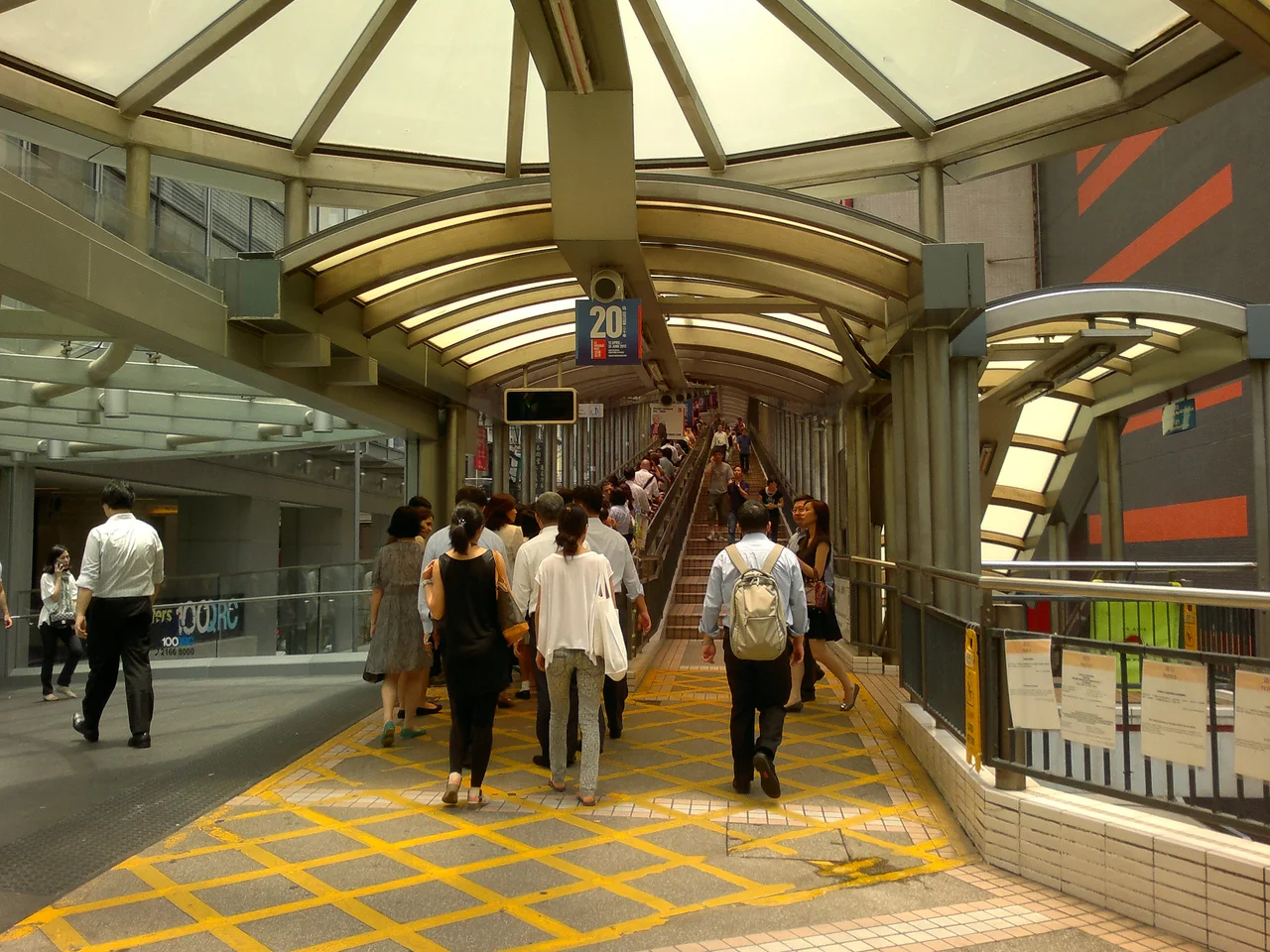

Central–Mid-Levels Escalator
Every morning until ten o'clock, it runs downhill. Then it switches. For the rest of the day and into midnight, the Central–Mid-Levels escalator carries people upward — from the harbour-level streets of Central through sixteen cross-streets and laddered neighbourhoods to the residential plateau of the Mid-Levels, 135 metres above. This tidal rhythm, dictated by commuter demand, is the escalator's most quietly remarkable feature. The 800-metre system is the longest outdoor covered escalator system in the world, and it moves through a city rather than past it: restaurants, bars, antique shops, and the entire SoHo entertainment district grew up alongside the moving steps after 1993, oriented toward riders rather than the roads below.
The Problem Hong Kong's Hills Created
Hong Kong Island is steep. The Mid-Levels rise sharply from the commercial waterfront, and for decades the only routes up were switchback roads that funnel east-west traffic into north-south snarls. By the early 1980s, planners had identified the problem: much of the east-west traffic was really caused by commuters zigzagging to gain altitude. A direct pedestrian link was needed. The consultancy report commissioned in late 1982 considered several solutions — a monorail, a cable car — before recommending an escalator-assisted pedestrian route connecting the Mid-Levels to the existing Central Elevated Walkway. The Executive Council approved the project on 16 March 1990. Construction, carried out by a joint venture between Hong Kong contractor Paul Y.–ITC Construction and the French company Sogen, began in February 1991.
The White Elephant That Transformed a District
The system opened on 15 October 1993, having cost HK$240 million — a 153 percent overrun on the original HK$100 million budget. Within three years, the Director of Audit had labelled it a "white elephant", citing the overrun and a Transport Department study showing no obvious reduction in traffic congestion. The criticism was technically accurate and practically irrelevant. What the audit couldn't measure was the neighbourhood the escalator conjured into existence. New restaurants and bars opened on upper floors of buildings along the route, angling their signage downhill to catch the gaze of passing riders. The SoHo entertainment district — a name borrowed from New York — emerged organically around Staunton Street and Elgin Street, where the escalator rises through the densest stretch of what had been quiet residential blocks.
Eighteen Escalators and a Film Set
The system consists of 18 escalators and three inclined moving walkways, crossing sixteen streets from Queen's Road Central to Conduit Road. Monitoring is handled from a control room near Caine Road, with 75 CCTV cameras and roughly 200 speakers covering the route. The annual maintenance bill runs to about HK$12.5 million. Filmmakers found the escalator early. Wong Kar-wai shot scenes for Chungking Express (1994) here, saying he was drawn by the quality of the light — a particular diffused glow under the escalator's canopy that he felt no other location offered. The Dark Knight (2008) used the system for six days of filming in November 2007; Jeremy Irons's flat in Chinese Box (1997) was positioned directly alongside it. Something about the slow vertical drift, the cross-sections of city life visible at each street crossing, suited cinema.
The Daily Rhythm, Unchanged
Downhill from six until ten in the morning. Uphill from ten until midnight. The tidal logic has remained constant since 1993, unchanged by two rounds of staged refurbishment — the escalators between Robinson Road and Conduit Road were replaced in 2018, those between Mosque Street and Caine Road in 2019. Annual maintenance costs have grown, the annual ridership has grown, and the neighbourhood has expanded further along the slope. What has not changed is the basic premise: that in a city built vertically on an island too steep for easy roads, the most practical solution was sometimes just to put people on a very long escalator and let them rise.
From the Air
The Central–Mid-Levels escalator runs at 22.281°N, 114.153°E, climbing the hillside above Central on Hong Kong Island. From the air, the escalator's covered canopy is visible as a thin diagonal line threading up the dense urban slope between the glass towers of the financial district and the green hillside above. Approach from the northwest at 1,500 to 2,000 feet for the best view of the escalator's full run against the cliff of Mid-Levels residential towers. Hong Kong International Airport (VHHH) is approximately 25 km to the west-northwest on Lantau Island. Victoria Peak, at 552 metres, rises directly behind the escalator's upper terminus and is a reliable visual reference from most approach angles.
Nearby Stories
- Lok Ma Chau Loop 2.3 km away
- Portas do Cerco 2.3 km away
- Kweilin Incident 17 km away
- Wanshan Archipelago Campaign 34 km away
- Nanxiong Formation 115 km away
- Battle of Nanpeng Island 148 km away
- Heyuan 169 km away
- Cape Maobitou 632 km away