
Central Ordnance Munitions Depot
The British called it Little Hong Kong, which was the Cantonese nickname for a fishing village five kilometres away. They used that borrowed name as a code name for the most secret military installation on the island, banking on the confusion it would sow among Japanese intelligence networks operating in the colony. The misdirection worked — well enough, at least, that the Central Ordnance Munitions Depot was still holding out two days after Hong Kong's official surrender on Christmas Day 1941. By then, Major Dewar had wired all 24 underground bunkers to a single detonator. He waited for the Japanese negotiator to understand what that meant.
Built to Disappear
The British Royal Engineers established the depot in 1937, three years before the Pacific war began in earnest. The site measures roughly 820 feet wide by 1,970 feet long, and nearly all of it is underground. The 24 bunkers sit approximately 20 metres below the surface, enclosed in walls one metre thick. Their S-shaped entry corridors were deliberately angled to deflect blast waves; channels cut into the corridor walls at 45-degree angles would force the pressure of an internal explosion downward rather than outward. Each pair of bunkers had its own false-wall inner lining for those designated for high explosives, providing a second layer of containment. A second, smaller corridor at each entrance — just 1.25 metres high and 50 centimetres wide — encircled the outer bunker wall to create a moisture trap, keeping the stored ammunition dry even when the facility sat below the water table. The engineers thought of everything except the speed of the Japanese advance.
The Last Holdout
Hong Kong surrendered on 25 December 1941, after 18 days of fighting. Two days later, the Japanese commander learned that the munitions depot was still in British hands. The bunkers posed a genuine problem: nearly impervious to direct assault, stocked with food, water, and ammunition, defended by soldiers who had not yet received orders to stand down. Captain Suzuki arrived to negotiate. Major Dewar's response was to point to the detonator that connected to all 24 bunkers. Faced with the prospect of triggering a subterranean explosion rather than capturing an intact arsenal, the Japanese captain agreed to terms. The surrendering troops were treated, according to translator Lewis Bush who recorded the event in his diary, like heroes — taken to Aberdeen where a Japanese officer produced beer and whisky.
After the War, a Long Quiet
The Japanese occupied the depot until Hong Kong's liberation in August 1945. It is believed they built the current guard house during those years. The British military continued using the site until 1977, when it transferred to the Hong Kong Police Driving School. In the mid-1980s, at least four pairs of bunkers were demolished for residential development. Eight survived. In 2002, a proposal reached the government that would give those eight bunkers a future: convert them into commercial wine cellars, with a private members clubhouse and a conservatory styled to the period. Crown invested HK$30 million — negotiations with 22 government departments preceded the signing of the lease. Restoration ran from August 2003 to March 2004.
Wine, Memory, and a UNESCO Medal
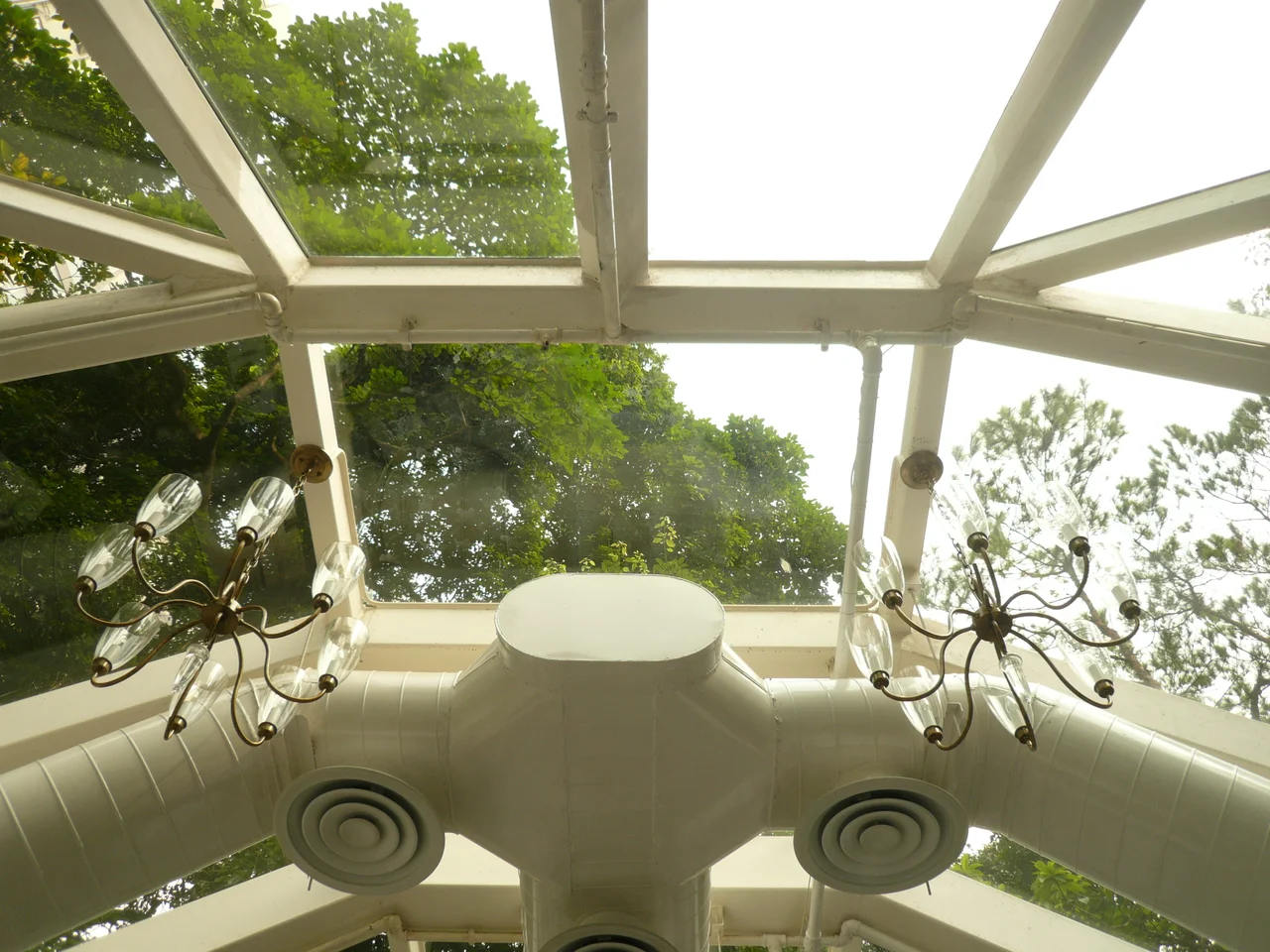
Crown Wine Cellars opened in 2004 in what had once been the most explosively dangerous site in the colony. Two of the eight remaining bunkers became a clubhouse, framed by a conservatory designed in a period style. The steel entrance doors, the wave-patterned steel ceilings built to deflect blast energy, the S-shaped corridors — all of it survived into this new function. The underground temperature stays naturally cool and consistent, which suits wine storage as neatly as it once suited ammunition. In 2007, UNESCO presented an Award of Merit to the project through its Asia-Pacific Heritage Awards for Cultural Heritage Conservation. The bunkers that Major Dewar refused to surrender in 1941 are now among the most carefully preserved wartime structures in Hong Kong.
From the Air
The Central Ordnance Munitions Depot sits at 22.253°N, 114.183°E in the Aberdeen area of Hong Kong Island's southern side, roughly 5 km south of the financial district. From the air, the southern shore of Hong Kong Island is characterised by steep hillsides dropping to the sheltered harbour of Aberdeen; the depot's above-ground structures are modest and set into the slope. The contrast between the green hillside and the dense residential blocks of Aberdeen below makes orientation straightforward. Hong Kong International Airport (VHHH) is located on Lantau Island approximately 20 km to the west. For a view of the southern shore, approach from the southwest at 2,000 to 3,000 feet following the coastline from Lamma Island.
Nearby Stories
- Lok Ma Chau Loop 2.3 km away
- Portas do Cerco 2.3 km away
- Kweilin Incident 17 km away
- Wanshan Archipelago Campaign 34 km away
- Nanxiong Formation 115 km away
- Battle of Nanpeng Island 148 km away
- Heyuan 169 km away
- Cape Maobitou 632 km away