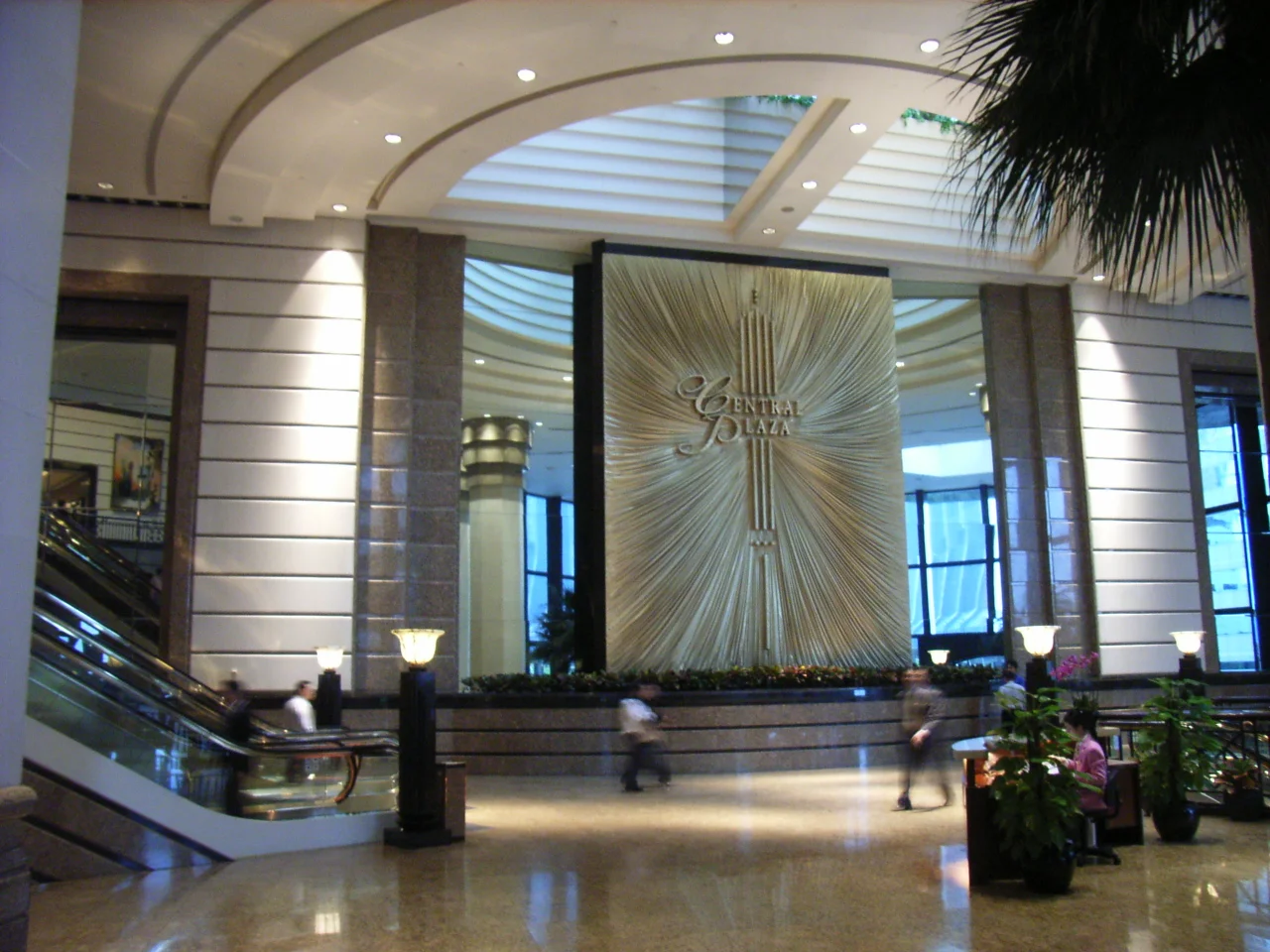

Central Plaza, Hong Kong
The land beneath Central Plaza did not exist forty years before the building opened. It was reclaimed from Victoria Harbour in the 1970s, drained and compacted and prepared for something the city had not yet imagined. What it got, in August 1992, was a 78-storey triangular tower rising 374 metres above Wan Chai — at the moment of completion, the tallest building in Asia. The record lasted four years. But the building has outlasted the record comfortably, and the neon clock on its summit still blinks through four colours every hour, marking quarter-hours in a code of light that Wan Chai residents have been reading from their windows for more than three decades.
Land Made, Then Sold
The 77,800 square-foot site went to auction at City Hall Theatre on 25 January 1989. It sold for HK$3.35 billion — a record at the time — to a joint venture called Cheer City Properties, owned equally by Sun Hung Kai Properties and Sino Land, whose major shareholder was the Ng Teng Fong family. A third developer, Ryoden Development, later joined the consortium and subsequently disposed of its 5 percent interest for office space in New Kowloon Plaza. The first major tenant signed a lease even before the building was finished: the Provisional Airport Authority agreed on 2 August 1991 to take the 24th through 26th floors. A topping-out ceremony presided over by Sir David Ford followed on 9 April 1992. The building completed in August of that year.
A Triangle That Is Not Quite a Triangle
Central Plaza was designed by the Hong Kong firm Ng Chun Man and Associates — now Dennis Lau & Ng Chun Man Architects — and engineered by Arup. The tower uses a triangular floor plan, but with the three corners truncated to improve the internal office geometry. It has two principal components: the 368-metre office tower itself and a 30.5-metre podium block at its base. At ground level, the building contributes 8,400 square metres of landscaped public space — a fountain, trees, stone paving — and the first floor serves as a pedestrian thoroughfare, with bridges connecting the MTR, the Convention and Exhibition Centre, and the China Resources Building. By dedicating this space to public use, the developer gained 20 percent additional plot ratio. The mast extends the total height to 378 metres, placing an anemometer at the building's absolute summit.
Tallest in Asia, Then Third in the City
When Central Plaza opened, it surpassed the Bank of China Tower as Hong Kong's tallest building. More significantly, it was the tallest in all of Asia — and the tallest reinforced concrete building in the world. Both records fell in the mid-1990s: the Asian title went to Shenzhen's Shun Hing Square in 1996, and the concrete record to CITIC Plaza in Guangzhou in 1997. Within Hong Kong itself, the 2 International Finance Centre surpassed Central Plaza on completion, followed by the International Commerce Centre in West Kowloon. Central Plaza is now the city's third tallest tower. Its position in the hierarchy has shifted, but its presence on the Wan Chai waterfront has not. The triangular silhouette is immediately recognisable from the harbour, and the neon clock at the summit — blinking through its four-colour quarter-hour cycle — remains one of the harbour skyline's most idiosyncratic details.
The Highest Church in Any Skyscraper
Inside Central Plaza, the Sky City Church holds the distinction of being the world's highest church within a skyscraper. The building's public areas include the landscaped garden at ground level and three pedestrian bridges that connect it to the surrounding transit and commercial infrastructure. The podium contains no commercial element — an unusual restraint for Hong Kong development — keeping the building's base open and civic in character. Thirty years on, Central Plaza represents a particular moment in Hong Kong's vertical ambition: the early 1990s, when the city was building toward a skyline that would rival any on earth, and when harbour reclamation was still creating new ground for new towers at a pace the harbour itself could barely absorb.
From the Air
Central Plaza stands at 22.280°N, 114.174°E on the Wan Chai waterfront of Hong Kong Island, immediately north of the Hong Kong Convention and Exhibition Centre. The triangular tower is one of the most distinctive shapes on the Victoria Harbour skyline — its truncated corners and the distinctive neon mast at the top make it identifiable from well out over the water. Approaching from the north across the harbour at 1,500 to 2,500 feet gives the clearest view of the full tower against the hillside of Hong Kong Island. Hong Kong International Airport (VHHH) is located on Lantau Island approximately 25 km to the west. The building sits adjacent to Wan Chai's exhibition district, with the Convention Centre's curved roof visible directly to the northeast.
Nearby Stories
- Lok Ma Chau Loop 2.3 km away
- Portas do Cerco 2.3 km away
- Kweilin Incident 17 km away
- Wanshan Archipelago Campaign 34 km away
- Nanxiong Formation 115 km away
- Battle of Nanpeng Island 148 km away
- Heyuan 169 km away
- Cape Maobitou 632 km away