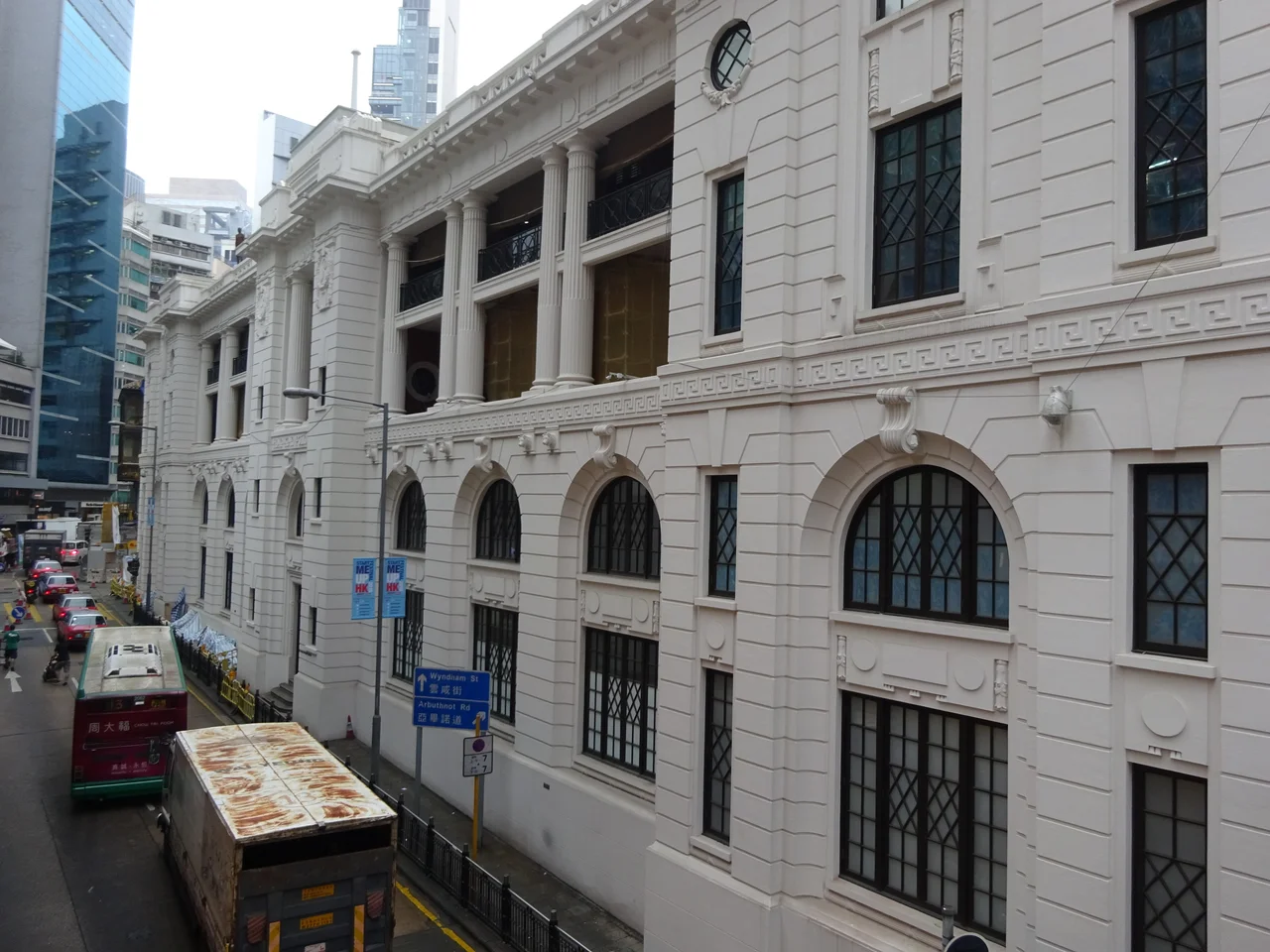

Central Police Station (Hong Kong) / Tai Kwun
Tai Kwun means "the big station" in Cantonese, and the name captures something true about the compound at the eastern end of Hollywood Road: this was always the place that decided things. For most of Hong Kong's colonial history, the Central Police Station, the Central Magistracy, and Victoria Prison occupied the same hillside block, a triangle of authority that processed arrest, judgment, and confinement within a few hundred metres of each other. The oldest structure dates to 1864. The station took Japanese bombs in December 1941, continued operating after the war, absorbed new blocks through the 1920s, and finally closed in the 2000s. In 2018, it reopened as something else entirely.
A Century of Additions
The barrack block built in 1864 was three storeys, constructed directly beside Victoria Prison. A fourth storey came in 1905. Between 1910 and 1925, additional blocks followed, arranged around a parade ground. In 1919, the Headquarters Block went up facing Hollywood Road — the most visible face of the compound, the one that announced authority to everyone walking that stretch of the city's oldest antiques street. The two-storey Stable Block was added in 1925 at the northwest corner of the parade ground; it later served as an armoury. The compound reflects the layering of colonial need: each wave of immigration from mainland China brought a corresponding expansion of the institutions built to manage a population the authorities never quite trusted.
December 1941 and What Was Destroyed
On the afternoon of 15 December 1941, Japanese bombs struck several points along the north shore of Hong Kong Island simultaneously: the junction of Old Bailey Street and Caine Road, the junction of Pottinger Street and Hollywood Road, Wellington Street, and the Central Police Station itself. The ground floor and basement offices of Police Headquarters were destroyed. People died. The bombardment was systematic, a coordinated attempt to disable the command and communications infrastructure of the colony before the assault on the island proper. The station was repaired and continued to function — as police headquarters, dormitory, and prison — into the postwar decades, serving as both the Hong Kong Island Regional Police Headquarters and the Central District Police Headquarters until the early 2000s.
The Fight Over What It Should Become
When the compound became available for redevelopment, the first instinct was commercial. Swire Properties proposed conversion to retail and entertainment as early as 1999; the government called for private bidding on that basis in 2003. The public reaction was sharp. Critics drew comparisons to what had happened to the former Marine Police Headquarters in Tsim Sha Tsui. The commercial plan was shelved in 2004. The alternative that emerged was slower, more expensive, and more ambitious. In 2010, the Hong Kong Jockey Club announced a heritage-led revitalisation. The Charities Trust would bear the capital costs as a not-for-profit undertaking, with no expectation of investment return. Design went to Herzog & de Meuron, working with conservation firm Purcell and executive architect Rocco Design.
Tai Kwun: Three Monuments, Two New Buildings
The compound that reopened in May 2018 is officially composed of three declared monuments — the former Central Police Station, Victoria Prison, and the former Central Magistracy — collectively known as Tai Kwun. Within the physical constraints of the site, Herzog & de Meuron added two new structures: the Old Bailey Galleries and the Arbuthnot Auditorium. New gates — Old Bailey Gate, Arbuthnot Gate, a footbridge to the Mid-Levels Escalator — created additional entrances alongside the historic Pottinger Gate. Chief Executive Carrie Lam opened the site on 25 May 2018. In 2019, Tai Kwun won the Award of Excellence from UNESCO's Asia-Pacific Awards for Cultural Heritage Conservation. The parade ground, once the operational centre of colonial policing, now hosts art events and public gatherings. The compound is the same; what it is for has changed completely.
From the Air
The former Central Police Station lies at 22.282°N, 114.154°E on the hillside above Hollywood Road in Central, Hong Kong Island. From the air, the compound is distinguishable from its tower neighbours by its low colonial silhouette — a cluster of Victorian and early-20th-century buildings set around an open parade ground, visually separate from the glass towers of the financial district below. The steep slope between Hollywood Road and the Mid-Levels makes the heritage compound appear almost embedded in the hillside. Hong Kong International Airport (VHHH) is approximately 25 km to the west-northwest on Lantau Island. Approaching over the harbour from the north at 1,500 to 2,000 feet provides a clear orientation of the compound's position between the financial core and Victoria Peak.
Nearby Stories
- Lok Ma Chau Loop 2.3 km away
- Portas do Cerco 2.3 km away
- Kweilin Incident 17 km away
- Wanshan Archipelago Campaign 34 km away
- Nanxiong Formation 115 km away
- Battle of Nanpeng Island 148 km away
- Heyuan 169 km away
- Cape Maobitou 632 km away