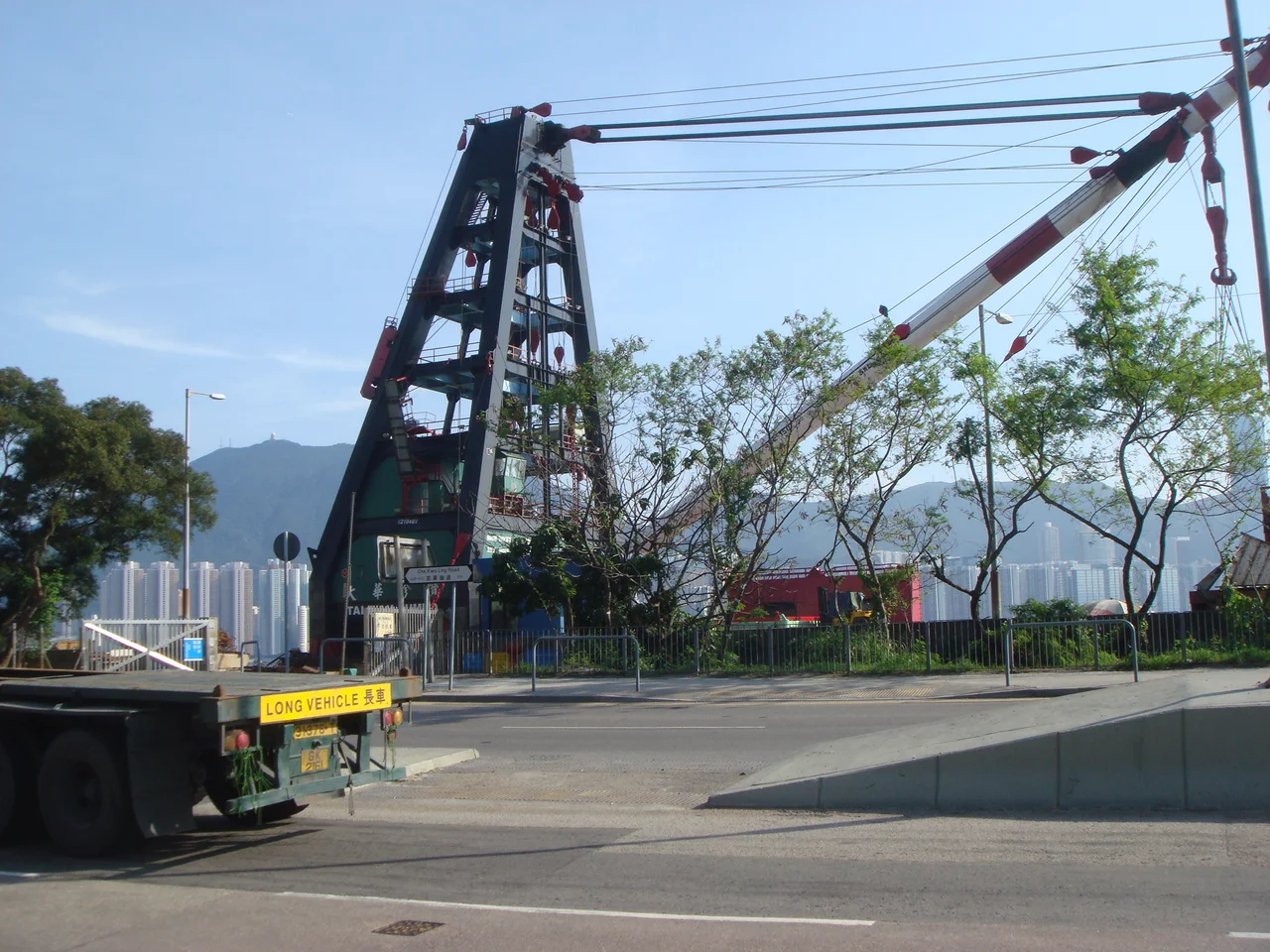

Cha Kwo Ling
The name Cha Kwo Ling is edible history. It comes from the macaranga tanarius tree, whose broad leaves are wrapped around a sticky Hakka rice cake — cha kwo — that generations of villagers made in this corner of eastern Kowloon. Long before the Eastern Harbour Tunnel bored beneath the harbour nearby, before tower blocks rose from reclaimed shoreline, this hillside was known for something far older: stone. The quarrymen came first.
Stone That Built a Colony
When Victoria City was established in 1841, the new colonial capital needed granite, and it needed it fast. Hakka people — skilled, mobile, hard-working — set up quarrying operations on the stone-rich hills of eastern New Kowloon. Cha Kwo Ling was one of four quarry hills supplying the city's construction boom. The granite came out of the hill and crossed the harbour to become foundations, walls, and steps that still stand in Hong Kong today. The work was demanding and precise; the Hakka had a reputation for it. Cha Kwo Ling became a major Hakka settlement, one of 13 recognized village districts in eastern New Kowloon. When new building materials eventually displaced stone — concrete cheaper and faster, the quarry's purpose faded — the community the quarry had built stayed on.
Refugees, Alleys, and a Goddess in a Shack
The Chinese Civil War brought a different kind of arrival. Penniless refugees from the mainland moved into the old quarry village, building makeshift shacks in a tangle of dark alleys that bore no resemblance to a planned settlement. The population swelled and the character changed. Amid the chaos of those years, the local image of Tin Hau — goddess of the sea, protector of fishing communities — was moved to a shack and remained there for three decades. The community's attachment to her persisted even when her temple could not. In 1941, villagers from the four hills — the Si Shan, comprising Lei Yue Mun, Ngau Tau Kok, Sai Tso Wan, and Cha Kwo Ling — pooled funds to build a proper granite temple on the original site. Six years later, that temple was demolished to make way for an oil tank belonging to Asiatic Petroleum Company (South China) Limited. The goddess moved again.
A Village on Borrowed Time
Today the Cha Kwo Ling Village stretches along Cha Kwo Ling Road, a strip of land built on reclaimed seafront that separates the village from Victoria Harbour. About 2,400 people live here, in what is described as one of the last squatter villages in Hong Kong. Laguna City towers over it to the northeast; the Lei Yue Mun seafood district lies 1.4 kilometres to the southeast. The village occupies territory that urban Hong Kong has long since surrounded. In 2019 and 2020, the Chief Executive's policy addresses announced the government's intention to reclaim the land and redevelop it into high-density public housing. The alleys are still there. So are some of the macaranga trees.
A Temple Built From What Remained
The current Tin Hau Temple in Cha Kwo Ling is a rare object: a granite-block building in a city that long ago switched to concrete. Granite construction is uncommon in Hong Kong's urban fabric, which makes this structure visible as a remnant of the quarrying past — the same hills that produced stone for Victoria City also provided stone for the temple that watched over the people who worked those hills. The roof was re-covered with brown ceramic tiles in a 1999 renovation. Before the altar, the temple holds the memory of a community that rebuilt what kept getting demolished — a goddess displaced twice, a village that has outlasted its reason for existing, waiting to see what comes next.
From the Air
Cha Kwo Ling sits at 22.30°N, 114.23°E on the eastern Kowloon waterfront, adjacent to Victoria Harbour. From the air at 2,000–3,000 feet, it is visible as a low-density pocket of older rooftops squeezed between the Laguna City residential towers to the north and the harbour to the south. The northeastern portal of the Eastern Harbour Crossing (Cross-Harbour Tunnel) emerges just west of the area — a useful navigation landmark. The nearest major airport is VHHH (Hong Kong International Airport), approximately 35 km to the west. In clear weather the hillside park of Sai Tso Wan Recreation Ground is visible above the village to the north.
Nearby Stories
- Lok Ma Chau Loop 2.3 km away
- Portas do Cerco 2.3 km away
- Kweilin Incident 17 km away
- Wanshan Archipelago Campaign 34 km away
- Nanxiong Formation 115 km away
- Battle of Nanpeng Island 148 km away
- Heyuan 169 km away
- Cape Maobitou 632 km away