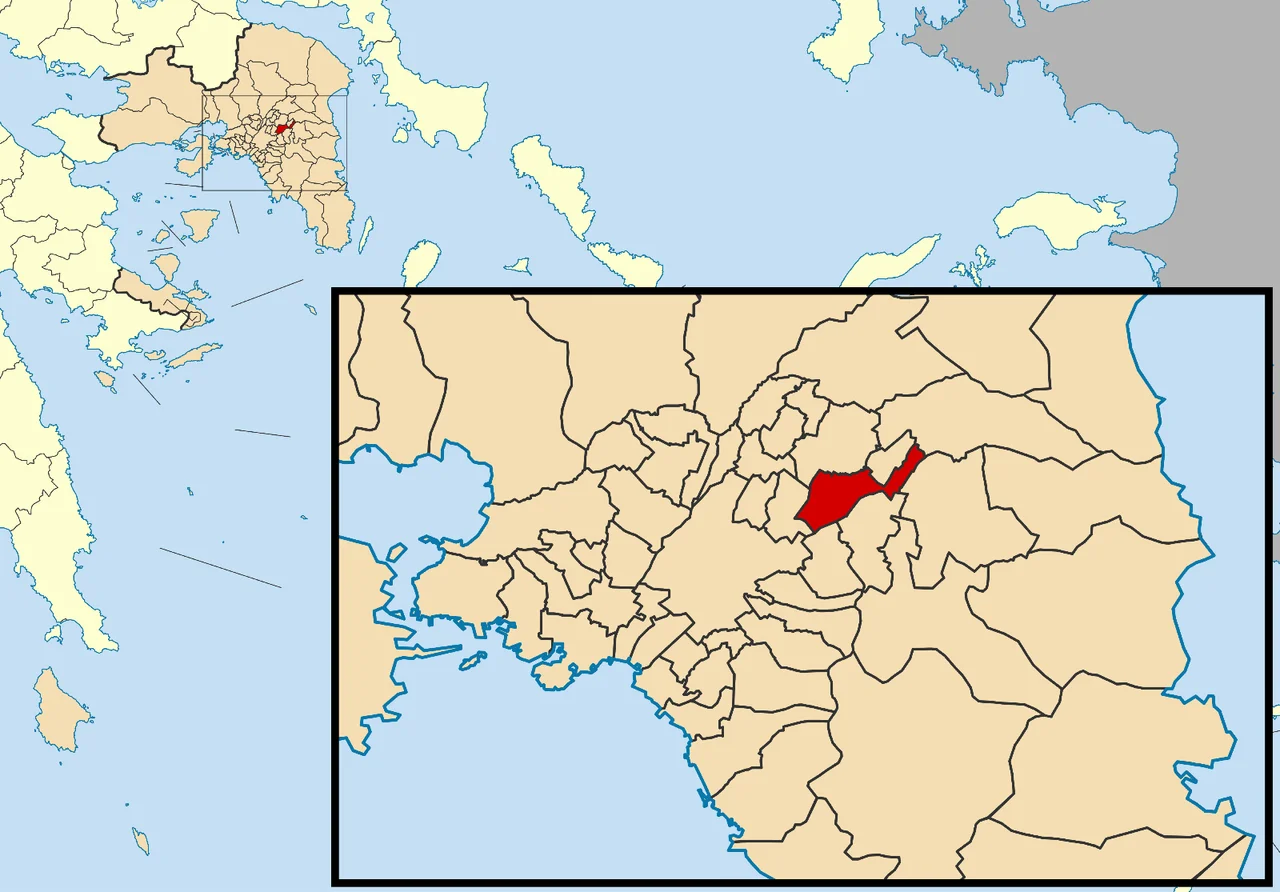

Chalandri
The marble of the Parthenon passed through here. Long before Chalandri was a prosperous suburb of apartment blocks and pedestrian shopping streets, its underground rivers fed a community of stone-cutters who split blocks of marble by driving in wooden wedges and soaking them with water until the wood swelled and the stone cracked. Some of that marble climbed the Acropolis to become part of the most famous temple in the world. The water that made the work possible still runs beneath the streets, a buried thread connecting a busy modern town to the workshops of classical Athens.
The Deme of Phlya
In antiquity this was Phlya, one of the ancient demes, or boroughs, into which the reformer Cleisthenes organized Attica. The name is thought to derive from a root meaning fertility, fitting for a place rich in vegetation and water, set in the Mesogeia plain beneath Mount Pentelicus. People have lived here a very long time, with traces of settlement reaching back through the Bronze Age and the Late Helladic period. In classical times Phlya claimed an extraordinary native son in the tragic playwright Euripides. In Roman and early Christian centuries the place was plundered and left deserted, its glory folding back into the soil.
Villas, Pines, and Plane Trees
For most of its modern life, Chalandri was countryside. After the Ottoman landowners departed in the nineteenth century, its pastures passed to Greek farmers and herders, and gradually wealthy Athenians discovered it. They bought large plots, planted huge gardens, and built two-storey villas among the pine and plane trees. Detached as an autonomous community in 1925 and made a full municipality in 1944, the suburb earned a reputation as a green holiday retreat for the city, valued for its good climate and shade. After the Asia Minor Catastrophe of 1922, refugee families settled here as well, and a monument in a small park still commemorates that uprooting. For decades, Chalandri's identity was the quiet one of orchards, mansions, and open sky.
Lambs, Cinemas, and Aphrodite's Child
Then came the taverns. Around Dourou Square clustered a celebrated run of eateries where the Athenian middle class came to feast on roast lamb and suckling pig, places whose names, the Astoria, O Mimis, passed into local memory. Chalandri filled with cinemas, summer and winter, and one of them, the Cine Eleftheria, became an unlikely launchpad for Greek pop and rock. On Saturday nights, up-and-coming bands took its stage, among them Aphrodite's Child, the group that included Demis Roussos and the future Oscar-winning composer Vangelis. The singers Attik and Nikos Gounaris made the suburb their base, and a bust on Kifissias Avenue honors them, a small monument to a livelier, leafier era.
The Price of Prosperity
The transformation that followed was swift and not entirely kind. After the fall of the military junta in 1974, Athenians fleeing the smog, traffic, and housing costs of the choked city center poured into Chalandri, drawn by its better air. The villas and gardens that had defined it could not survive the boom. By local estimates roughly ninety percent of the suburb's trees were felled and the great majority of its single-family mansions demolished, replaced by apartment blocks, shopping arcades, and the offices of corporations and government ministries. Today, with more than 70,000 residents, Chalandri is a thriving, commercially powerful municipality whose pedestrian shopping street rivals fashionable Kifissia. What it gained in prosperity it largely paid for in pine trees, an old Athenian story of growth told one felled garden at a time.
From the Air
Chalandri lies in the northern Athens suburbs at 38.017°N, 23.800°E, about 12 km northeast of the Athens city center, set in the Mesogeia plain below the marble flanks of Mount Pentelicus. Mount Hymettus rises to the south and Mount Penteli to the northeast, framing the suburb. Nearest major airport is Athens International (LGAV), roughly 18 km to the southeast along the Mesogeion corridor. The continuous low-rise urban fabric of northern Athens makes individual suburbs hard to distinguish from altitude; use Pentelicus and Hymettus as your bracketing landmarks.
Nearby Stories
- Great Sand Beach 5 km away
- Battle of Delium 7.7 km away
- Tower of Aliartos 9 km away
- HMHS Britannic 10 km away
- Saronic Gulf 15 km away
- Sousaki Volcano 17 km away
- Sanctuary of Apollo Maleatas 24 km away
- Skyros 66 km away