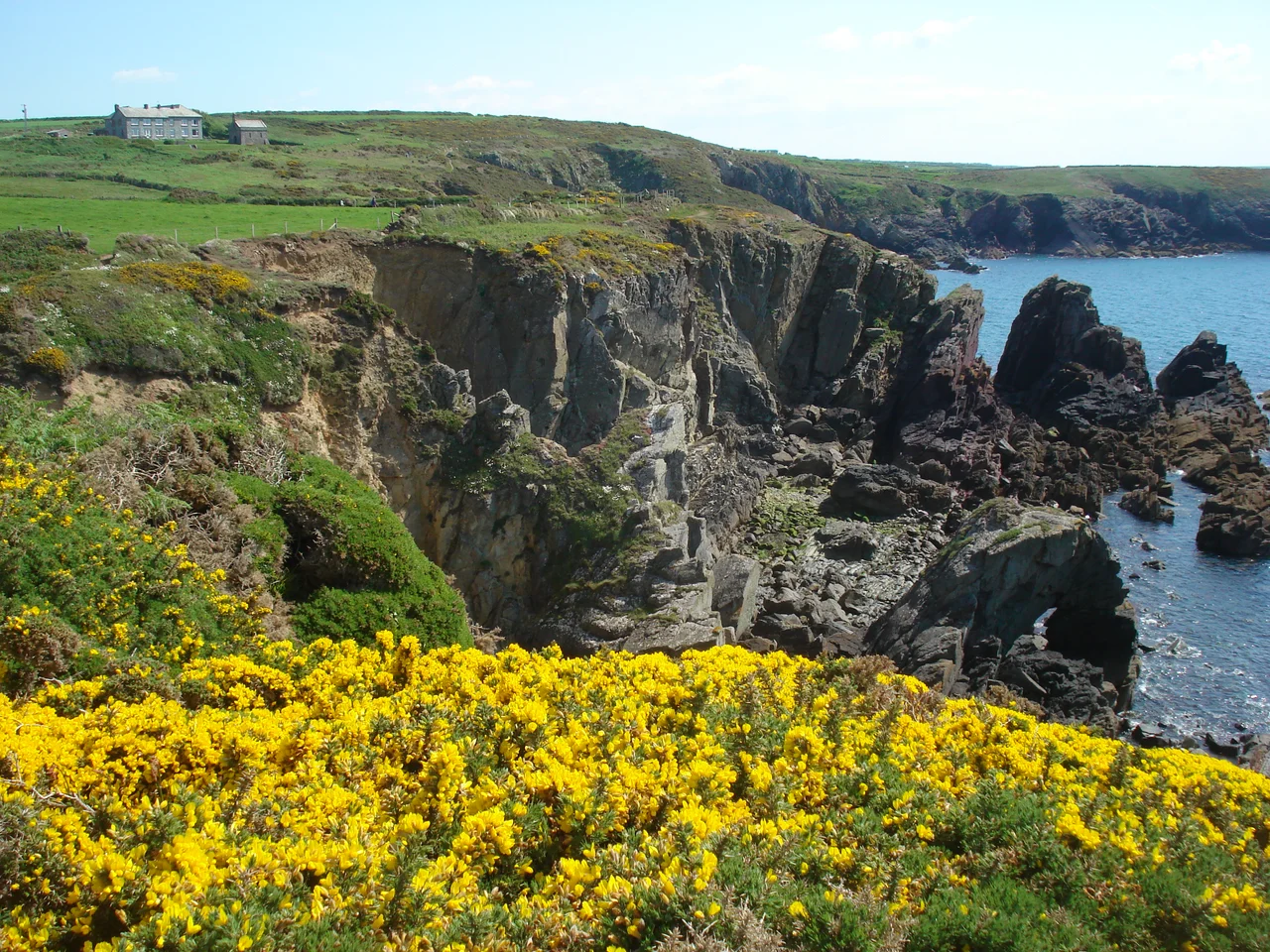

Chapel of St Non
Tradition holds that on a wild night in the sixth century, a young Welsh woman named Non gave birth on the cliffs above the bay that now bears her name, while a storm tore across St Bride's Bay and lightning split a nearby standing stone in two. Her son grew up to become Dewi Sant: Saint David, patron saint of Wales. The ruin where she is said to have laboured sits low against the wind, walls a few feet high, oriented north to south rather than east to west like an ordinary chapel. People still come. They throw coins into a well behind the rocks. The well still gives water.
The Stones
The chapel is unusual on several counts. Its alignment ignores the east-west convention that ruled Christian architecture from the early medieval period onward, and most scholars take that as evidence the building predates the convention itself, making it one of the oldest Christian sites in Wales. In the surrounding field stand a scatter of upright stones, possibly the remains of an Iron Age settlement that long preceded any chapel. A worked stone within the ruin can be dated to between the seventh and ninth centuries, though no one can prove it originated here. The site was protected in the 1950s and now belongs to Cadw, the Welsh heritage service. The walls themselves have weathered down to the suggestion of a footprint, but the footprint remains.
The Holy Well
Just beyond the chapel ruins, water rises through stone into a small vaulted chamber roofed by an 18th-century repair over medieval foundations. The well was already venerated when Browne Willis surveyed St Davids in 1717, reporting visitors arriving on St Non's Day, the second of March, to leave pins and pebbles and sit on the benches set around it. A 1811 report called the spring's fame incredible and still resorted to for many complaints, particularly afflictions of the eyes. The Catholic Church restored the well in 1951 and built a small shrine using stones rescued from the older ruins nearby. In 2010, when Pope Benedict XVI visited Britain, water from this well was used in the blessing. People still drop coins through the opening. The water still rises.
Morgan-Griffiths's Chapel
In 1934 a solicitor from Carmarthen named Cecil Morgan-Griffiths built a new chapel beside the old. He had a house on the headland, but the nearest Catholic church was sixteen miles away, and he wanted somewhere closer to worship. Working with stone salvaged from ruined chapels across the surrounding countryside, he raised a building only twenty-five feet long by twelve wide, the smallest and most westerly chapel in Wales. The stained glass inside shows St Non with her son David, alongside St Bride, St Brynach, and St Winifred, all Welsh saints whose stories tangle into the same misty centuries. The window above the altar is in the school of William Morris. The stoup at the door was rescued from the lost Chapel of the Fathoms. The altar stone came from St Patrick's Chapel. Morgan-Griffiths died the year after the work was completed.
The Retreat
Behind the new chapel sits Morgan-Griffiths's former home, now St Non's Retreat. For decades it was run by the Passionist Fathers and the Sisters of Mercy, hosting yoga workshops, days of reflection, and sanctuary for bereaved parents. The Roman Catholic Archdiocese of Cardiff-Menevia owns it now, and after extensive refurbishment it reopened in April 2024. The clifftop here is one of the more contemplative places in Pembrokeshire: open sea to the west, the spire of St Davids Cathedral inland, the Atlantic wind that has been arriving from the same direction since long before Non or David or anyone with a name. Pilgrims still walk down the path from St Davids to stand at the chapel ruin, look out at the water, drop a coin in the well, and walk back.
From the Air
St Non's sits at 51.87 degrees north, 5.27 degrees west, on the headland a mile south of St Davids on the Pembrokeshire coast. From altitude the site reads as a small grouping of buildings on grassland between St Davids itself and the open bay; St Non's Bay opens to the west with cliffs dropping forty to sixty feet to the sea. Haverfordwest (EGFE) lies about fifteen miles east-northeast; Swansea (EGFH) is about sixty miles east. Atlantic weather rules this coast and sea fog can shroud the cliffs even in summer.
Nearby Stories
- RAF Angle 0.9 km away
- Cardigan Bay Special Area of Conservation 5.4 km away
- Abercych 11 km away
- Cantre'r Gwaelod 12 km away
- Burry Port Lifeboat Station 22 km away
- Johnstown Castle 61 km away
- Hook Lighthouse 92 km away
- 1979 Fastnet Race 157 km away