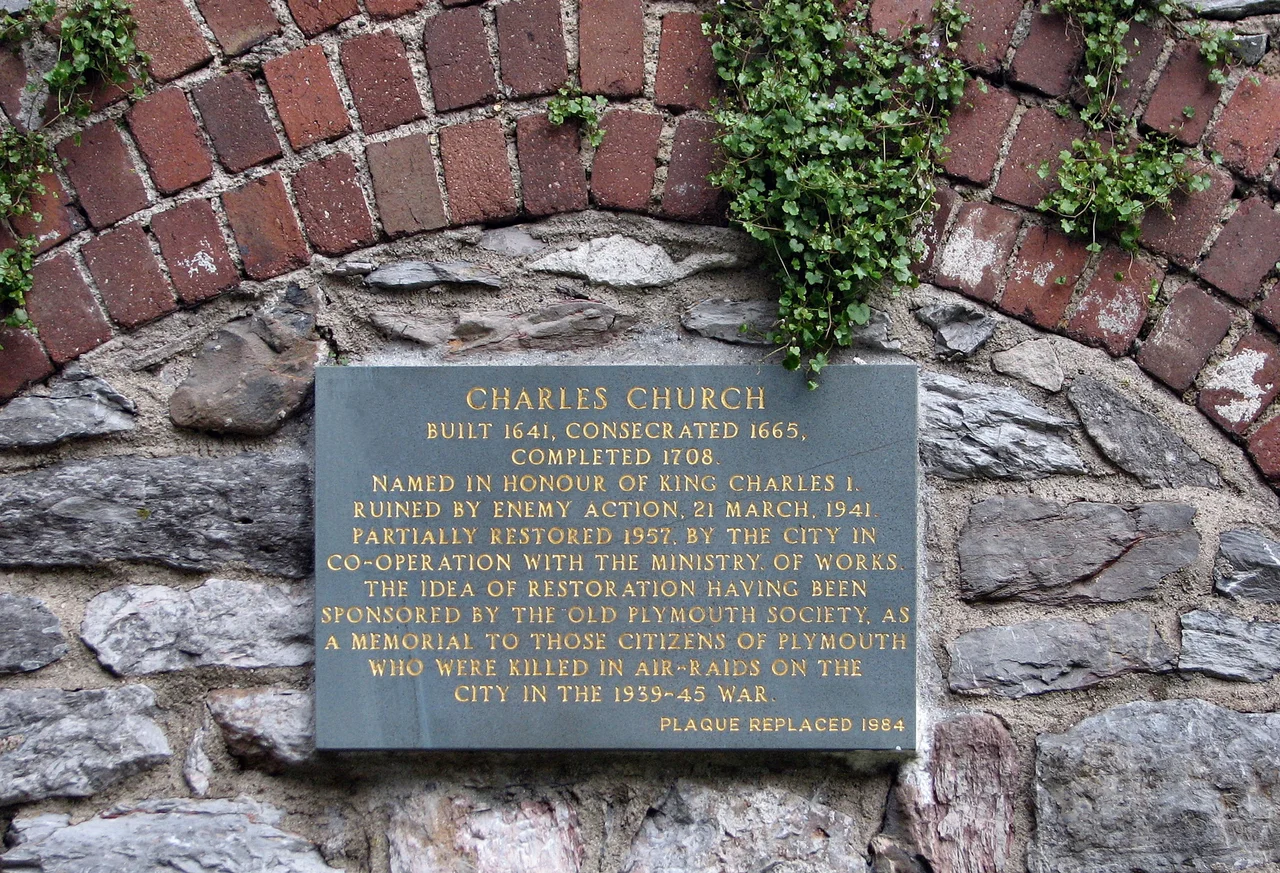

Charles Church, Plymouth
On the night of 20 March 1941, incendiary bombs fell on Plymouth. Charles Church burned. The fire took everything that could burn: every pew, every gallery, every bell rope, the wooden ceiling. The bells themselves fell through the burning tower and shattered, all except one, which cracked. When the dawn came, the font lay smashed into fragments that were later gathered into a small cairn. Plymouth lost 1,200 civilians to the bombing campaign that the Luftwaffe pressed against the naval city. After the war, the people of Plymouth made a decision: they would not rebuild Charles Church. They would leave it exactly as the fire left it. The ruin would be the memorial.
A Puritan Church for a Puritan Town
Charles Church should never have been called Charles Church. The Plymouth that petitioned King Charles I in 1634 for a second parish was a Puritan town, sympathetic to the Pilgrim Fathers who had sailed from its harbour fourteen years earlier. The High Anglican king had no love for Plymouth's Presbyterian leanings, and he ignored the petition for seven years. Only in 1641 did he relent, and only after Robert Trelawny, the local MP with royalist sympathies, pressed him. The letters patent were signed on 21 April 1641, the Act of Parliament passed that summer. The king insisted on one condition: the new church would bear his name. Within two years, England was at war with itself, and Charles I would lose his head.
Built During a Siege
Construction began in 1641 and stopped almost immediately. Plymouth declared for Parliament and was besieged by Royalist forces from 1643 to 1646. The half-built church served as stabling for cavalry horses, and yet parts of it were still used for worship. A wedding is recorded on 10 May 1644. Baptisms began in January 1645. The first preaching minister, Francis Porter, was in place by 1643, sermonising in a roofless shell while cannonballs landed elsewhere in the town. A map of besieged Plymouth from 1643 shows the church marked but unroofed, a building under construction that refused to wait for the war to end. The church was finally consecrated on 2 September 1665, twenty-four years after the first stone was laid.
The Star of the West
Robert Hawker became minister in 1784 and stayed for forty-three years. He was called 'the Star of the West' for sermons that could hold thousands rapt for an hour at a time. He was a bold Evangelical, prolific author, advocate for the parish poor, and beloved by his congregation in ways that outlasted him. When he died in 1827, his successor was not chosen from the obvious candidate, his own curate Septimus Courtney, and the congregation revolted. They built their own church for Courtney instead, the first of eight daughter churches that Charles would seed across Plymouth between 1829 and 1910. The Household of Faith Sunday school, founded at Charles in May 1784 with twenty children, may have been the first purpose-built Sunday school building in the world.
The Memorial
When the fires were out and the war was over, Plymouth had moved its population to the new suburbs. The city centre was rebuilt around the bones of the old. Charles Church stood at the heart of it: roofless, scorched, surrounded ten years later by the construction of a roundabout that turned the ruin into a traffic island. On a Saturday in 1958, the vicar J. Allen James dedicated the church as a living memorial to the civilians killed in the Plymouth Blitz. The commemorative plaque on the north wall has been replaced once since. In 2001 a service of reconciliation between Germany and Plymouth was held inside the roofless walls, with the German ambassador present. One parishioner, Miss Leigh, born in 1903 and a member of the church from birth, said the bombing of Charles in 1941 was one of the few things in her life that made her cry. 'My life seemed to be completely broken on that day.'
From the Air
Charles Church stands at 50.37 degrees north, 4.14 degrees west, at the heart of central Plymouth, encircled by the Charles Cross roundabout. From the air the roofless shell with its surviving spire and tower is instantly recognisable: a Gothic ruin marooned in a circle of asphalt, with the Drake Circus shopping centre behind it. Plymouth (EGHD) is 2 nm to the west; Exeter (EGTE) lies 35 nm to the north-east. Best viewed at 1,500-2,500 feet, ideally on overcast days when the limestone and granite tower contrasts cleanly with the surrounding city.
Nearby Stories
- Davidstow Circuit 3.7 km away
- Golden Hind 3.9 km away
- Powderham Castle 4.4 km away
- Fowey Lifeboat Station 5.1 km away
- Okehampton Castle 12 km away
- Battle of Plymouth (1652) 19 km away
- Goonhilly Satellite Earth Station 44 km away
- German Submarine U-672 73 km away