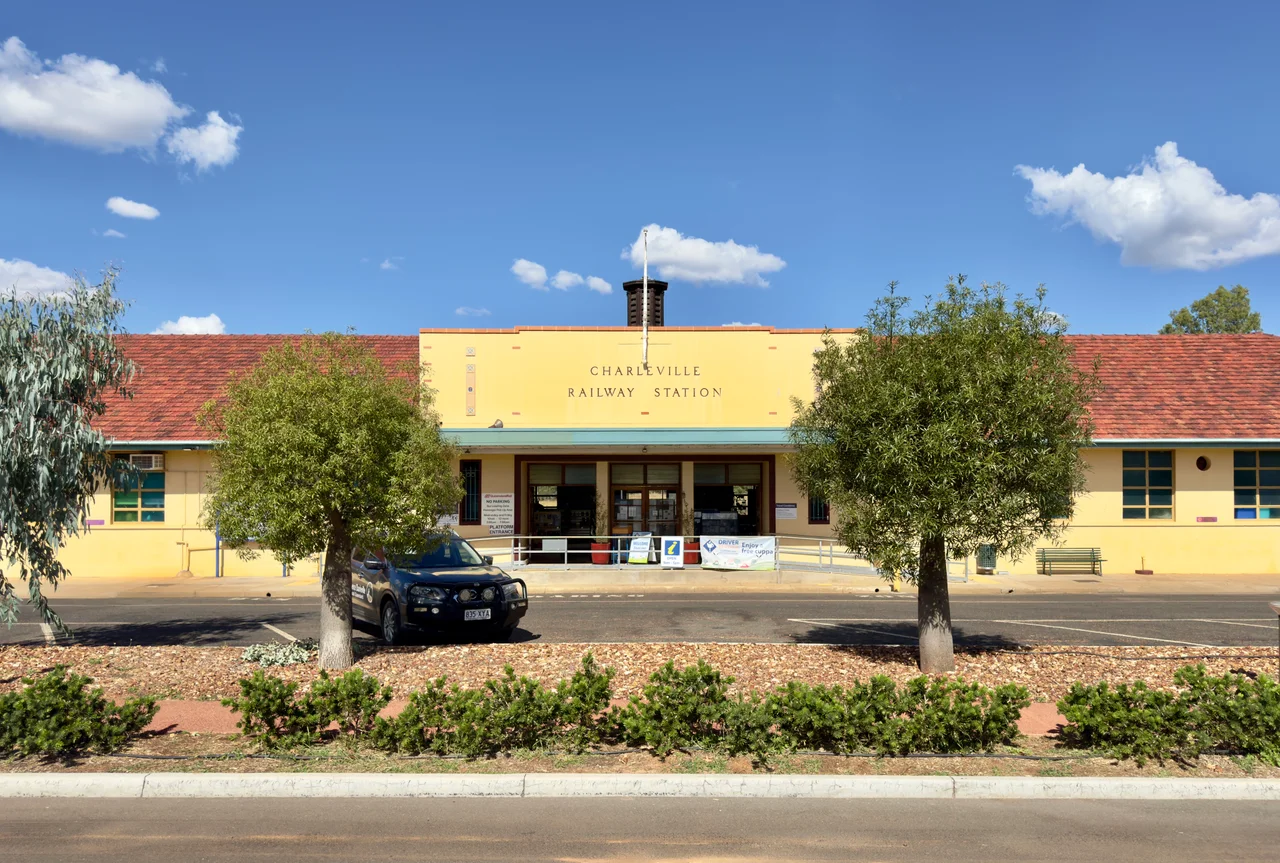

Charleville railway station, Queensland
For ten years, this was the end of the line. When the first train pulled into Charleville on 1 March 1888, the rails simply stopped, and beyond them lay Western Queensland, vast, dry, and reachable only by horse, bullock and coach. The station that grew here was no humble country halt. Charleville mattered: it sat on the Warrego River, on a natural stock route down from New South Wales, and it became the great western railhead, the place where the iron road met the open inland. The building you see today, long and cream and severe, was raised in 1957 from reinforced concrete, designed to do something a timber station could not: survive the climate that defines this corner of the continent.
The Long Push West
Charleville's station is the far end of a slow, deliberate march inland. Queensland's first railway opened in 1865, between Ipswich and a place then called Bigge's Camp, thirty-four kilometres of track meant to drag freight up over the Great Dividing Range and open the country beyond it to closer settlement. The line crept westward in stages, to Dalby, then a long pause, then on again to Roma in 1880, Mitchell in 1885, and at last Charleville in 1888. Here the push halted. The economics of laying rail any further into that sparse, distant country were doubtful, and the depression of the 1890s settled the question. For at least a decade Charleville remained the most western railhead in the state, a frontier with a timetable.
A Station Worthy of the Town
Because Charleville was no ordinary stop, it got no ordinary station. By August 1888 the complex was largely complete: platform, telegraph and booking offices, a goods shed, a stationmaster's house, cottages for guards, enginemen and firemen. Engine and carriage sheds were carted out from Mitchell. Cattle and sheep yards followed, and a weighbridge after that. The town became a locomotive depot, simply because the nearest one at Roma was too far away. This was Cobb and Co country too: the famous coaching firm built its coaches in Charleville from 1886, and in the 1890s shifted its coachbuilding business here, drawn in part by a climate kinder to seasoning timber. Where the rails ended, the coaches began, and Charleville was the hinge between them.
Built Against the Heat
Fire wrote the next chapter. On 6 July 1954 the original wooden station burned to the ground. Its replacement, opened in 1957, was a deliberate answer to the country it stood in. Designed by Queensland Railways under the veteran reinforced-concrete specialist Charles Da Costa, possibly one of his last works before retiring, it stretched almost 92 metres along King Street with a concrete platform more than 160 metres long. The concrete walls were not for grandeur but for survival: they insulated the interior against extremes of temperature, while projecting eaves shaded the windows and large openings caught what breeze there was. It is the only station of its design on the Queensland Rail network, a building shaped as much by the western sun as by any architect's hand.
The Quiet After the Boom
At its height, Charleville was the busiest passenger station on the Western Line and the third busiest for goods, its traffic earning more than Roma or Dalby. The 1957 station was built in that confidence, in the flush of a 1950s wool boom and post-war investment in the railways, a structure meant, in the words spoken at its opening, to serve the increasing needs of travellers for many years to come. Those years brought decline instead. Roads, aircraft and a falling rural population thinned the traffic until the great concrete station served a fraction of the passengers it was built for. Today the Westlander still runs twice a week from Brisbane and terminates here, and coaches carry on west to Cunnamulla and Quilpie. The platform that once roared now waits quietly, a monument to the age when the rails ran out at Charleville and the rest of Queensland began.
From the Air
Charleville railway station sits at approximately 26.41 degrees south, 146.24 degrees east, on King Street on the south-eastern edge of Charleville township, beside the Warrego River in south-west Queensland. From the air the long, pale 1957 passenger building and the corrugated-iron goods shed flank the Western line as it runs through town; the river and the regular grid of Charleville's streets are the clearest landmarks. The station is barely 3 km north of Charleville Airport (YBCV, elevation about 1,003 ft); Roma (YROM, about 1,027 ft) lies to the east. Terrain is flat floodplain and surrounding mulga. Best viewed in clear, dry daylight, when the rail corridor and river stand out sharply; the wide brown Warrego can swell dramatically after inland rain.
Nearby Stories
- Dillalah 16 km away
- Cooladdi 22 km away
- Koroit opal field 99 km away
- Yapunyah waterhole 146 km away
- Augustus Charles Gregory 179 km away
- Carnarvon Gorge 204 km away
- Hornet Bank Massacre 290 km away
- Jimbour Homestead 461 km away