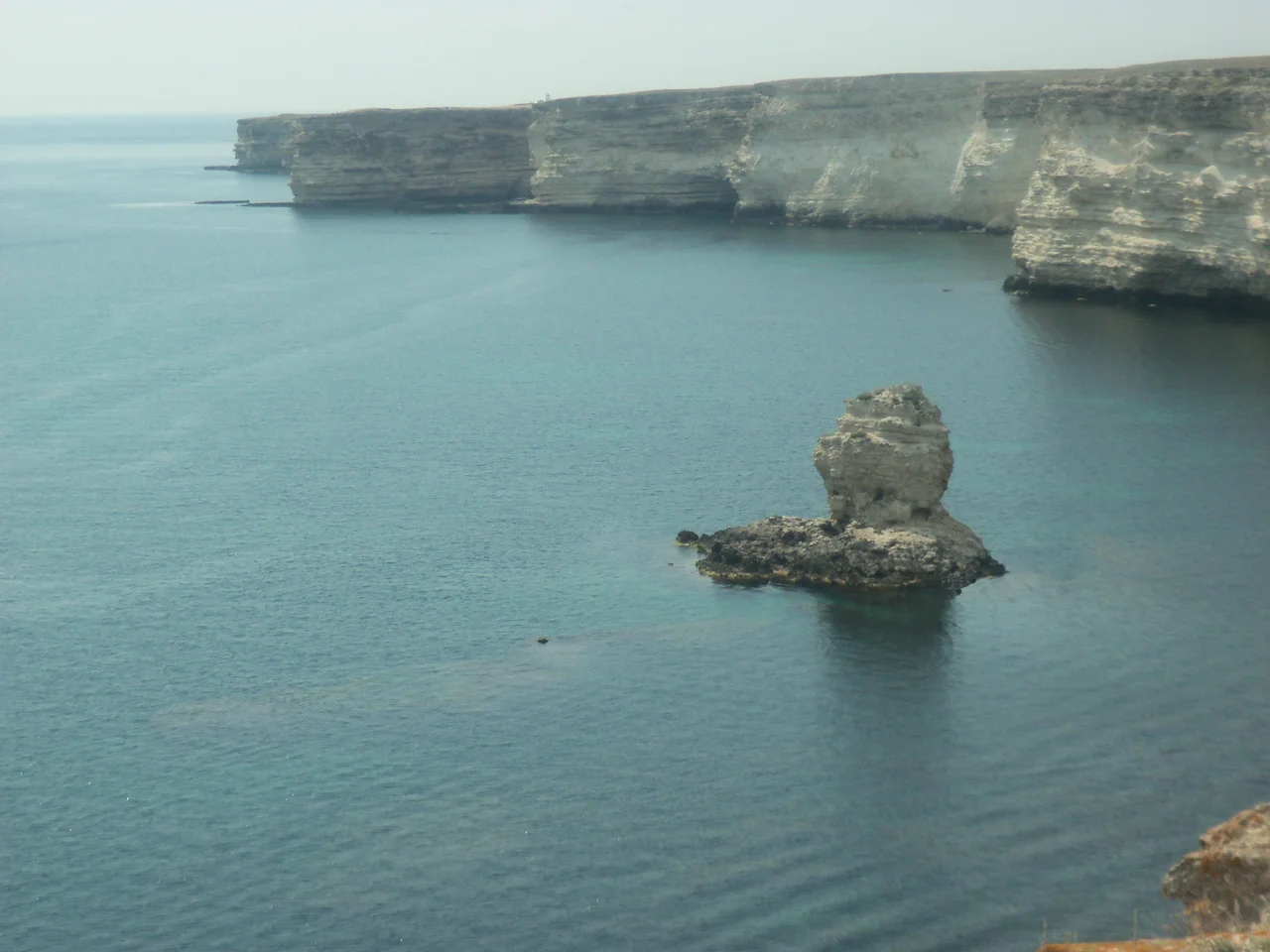

Charming Harbor National Nature Park
In the gullies that cut down toward the sea at Bolshoy Castel, botanists have found plants that grow almost nowhere else along this coast. Fifty species cling to these ravines that have vanished from the broader steppes around them, survivors of a landscape that once stretched for hundreds of miles and now hangs on in pockets. Charming Harbor National Nature Park exists to protect exactly this: not a single spectacular feature, but the quiet persistence of an ecosystem the modern world has nearly erased. The park guards three fragments of the western Crimean coast, where dry steppe meets the Black Sea in cliffs and rock.
A Sea of Grass Against a Sea of Water
The park protects a stretch of the Tarkhankut Peninsula where the semi-arid mountain steppe descends to a rugged, rocky coast. This is a land of extremes. The climate swings hard between seasons, with hot summers and a long dry stretch from late May to mid-September. Park managers count some 2,350 hours of sunshine a year against just 316 millimeters of rain, numbers that explain the bleached, sculpted character of the terrain. Summer bakes the grasslands gold; the sea below stays a startling blue. Where the two meet, cliffs and gorges break the horizon, and a gorge at Bolshoy Castel runs all the way down to a beach, past the ruins of settlements long since abandoned to the wind.
The Last of the Old Steppe
What makes this place scientifically precious is what it preserves. The gullies of the Castel sectors shelter some of the last primeval coastal steppe on the Black Sea, ground that was never plowed under or grazed to bareness. More than 400 species of vascular plants have been recorded within the park, including the fifty specialists found nowhere else nearby. Coastal steppe, shrub-steppe, and open shrubland weave together across the three protected sections, each a slightly different variation on survival in a place with too much sun and too little water. These are not showy landscapes; their richness is in the detail, in the specialized plants that learned to live where few others could. To walk here is to see, in miniature, what the vast Eurasian steppe looked like before the plow rewrote it, a glimpse of an older, wilder version of the land that once rolled unbroken for thousands of miles.
Three Fragments of a Coast
The park is not a single continuous expanse but three separate sections strung along the western Crimean shore, each protecting a different fragment of the same threatened landscape. Together they hold a mosaic of habitats where the dry mountain steppe gives way to a rugged, rocky coast. At Bolshoy Castel, a gorge runs down to a beach past the ruins of former settlements, a reminder that people once lived and worked this hard ground before the land was set aside for protection. That mix of the wild and the abandoned gives the park a haunting quality. Nature is reclaiming what human settlement gave up on, and in the quiet gullies the old steppe persists in ground that agriculture never managed to tame. It is a place defined as much by what people left behind as by what still grows there.
Visiting With Care
The park is organized into four zones, from strictly protected ground to areas set aside for recreation and modest local use. Visitors will find heated cabins for rent, boats, fishing, and campsites tucked among the main sections, so that a stay here can be genuinely comfortable despite the wild surroundings. But access to the most fragile ground comes with rules. The administration asks that guests check in at the visitor center to register and review the regulations, and hiking the ecological trails through the protected zones requires an escort by park staff. It is a deliberate arrangement, meant to let people experience a rare landscape without loving it to death.
From the Air
Charming Harbor National Nature Park lies at roughly 45.50°N, 32.70°E along the western coast of the Tarkhankut Peninsula in Chornomorske Raion. At 3,000–5,000 feet, look for the pale coastal cliffs, the gorge at Bolshoy Castel cutting down to its beach, and the contrast between golden steppe and blue sea. The nearest airport is Saky (UKFI) to the southeast.
Nearby Stories
- Saky 15 km away
- Swan Islands Nature Reserve 22 km away
- Karkinit Bay 23 km away
- Pluton (complex) 30 km away
- Saky Air Base 42 km away
- Zaliznyi Port 47 km away
- Racecourse of Achilles 86 km away
- Januarius MacGahan 389 km away