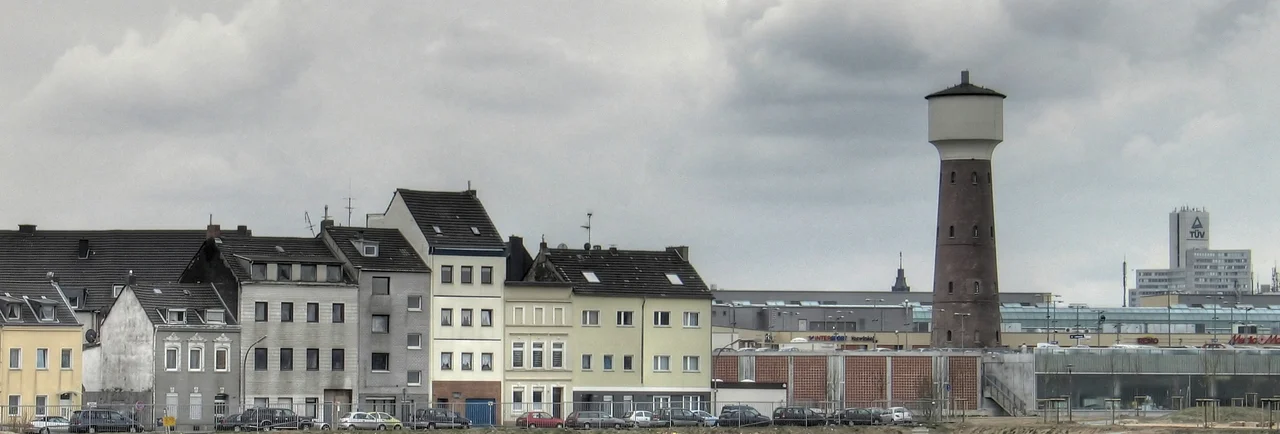

Chemische Fabrik Kalk
The water tower is what survives. Squat, brick, octagonal, it stands in a small park on Vietorstraße in the Cologne district of Kalk - and from its base, if you knew where to look in 1958, you could see twenty hectares of pipework, three soaring chimneys, the perpetual yellow-white plume of sulfurous exhaust, and 2,369 workers walking in and out of the gates each day. They made soda ash and fertilizer and, twice in the twentieth century, raw materials for explosives. The Chemische Fabrik Kalk dominated the right bank of the Rhine for 135 years. In December 1993, the last shift clocked out. The chimneys came down. On the cleaned-up ground today sit a police headquarters and the Köln Arcaden shopping mall, where teenagers buy sneakers above what was once a sulfuric acid plant.
Two Men, 20,000 Thalers, a Doctoral Thesis
On 1 November 1858, the merchant Julius Vorster put up 15,000 Thaler and Hermann Julius Grüneberg, a 31-year-old chemistry doctoral student, put up 5,000. They bought a defunct iron foundry in the small village of Kalk, on the right bank of the Rhine across from Cologne - a village that would not be absorbed into the city until 1910. Three months later they were producing potassium nitrate from Russian potash, with a byproduct of soda ash that no one yet realized would become their main product for the next century. Grüneberg, the chemist, was the engine; he developed methods to extract potassium chloride from the strange double salt called carnallite, which had been discovered in the salt mines of Staßfurt by the Prussian mining engineer Rudolf von Carnall. Within five years their output of potassium nitrate had multiplied tenfold.
What the Wind Carried
By the company's fiftieth anniversary in 1908, the catalog read like a chemistry textbook: ammonium hydroxide, ammonium chloride, ammonia, sodium hydroxide, sodium sulfate, nitric acid, hydrochloric acid, sulfuric acid, sodium carbonate, fertilizers. Twelve hundred workers handled 600,000 metric tons of product per year. The site sprawled across the heart of Kalk, with satellite plants in Cologne-Nippes, Cologne-Ehrenfeld, and Euskirchen. The smell, by all accounts, was monumental. Even after the Salzdetfurth takeover of 1960 built a 120-meter chimney specifically to lift the sulfurous emissions higher into the sky, residents complained about the air. Kalk in those decades was a worker's district - close to the factory, cheap to live in, and saturated with what the chimneys exhaled. Generations grew up calling that smell home.
The Wars and the Hands That Were Forced
Both world wars rerouted the factory into explosives. In World War I, with most male workers conscripted, the company concentrated on saltpeter for ammunition; an explosives research laboratory opened in 1916. The Versailles Treaty shut that line down. Then came 1933, and the company gradually returned to raw materials for explosives. From 1940 onward, Chemische Fabrik Kalk used approximately 460 forced laborers - people deported from occupied Poland and the Soviet Union and made to work under armed guard. They lived where they could and worked where they were told. They are largely absent from the company's own surviving records, present mainly as a single number in a footnote. The Allied bombing of Cologne reduced the plant; on 6 March 1945, the founder's grandson Fritz Vorster Jr. closed what was left of it. The forced laborers who survived went home to nothing they recognized.
The Slow Closing
Three months after the war ended, the factory was burning lime again - bartering for food, cannibalizing one section to repair another. By 1950 production had reached pre-war levels. In 1960 the Salzdetfurth AG bought it outright; in 1971 Salzdetfurth merged into what would become K+S, a BASF subsidiary. Through the 1970s and 1980s, the writing slowly appeared on the chimneys. The sodium carbonate plant was outdated. Raw materials had to be trucked to and from the Rhine port, an expense competitors did not bear. The factory occupied densely populated land that the residents increasingly resented. A new bromine plant burned down two weeks after opening in 1985. An antitrust fine from the European Commission for participating in a soda ash cartel with Solvay and Imperial Chemical Industries arrived in the early 1990s. On 23 December 1993, all remaining production was shut down and the last 700 workers were laid off.
Walking the Ghost
The Köln Arcaden mall opened in 2005 on roughly half the old plant site, the new police headquarters on the other half. The decontamination took years - 135 years of dumped sulfates and nitrates do not flush out quickly - and the cleanup is part of why the site became prime urban real estate rather than a brownfield in perpetuity. The Kalk water tower remains the most visible relic, repurposed as a neighborhood landmark. The name Chemische Fabrik Kalk GmbH still exists, but it now belongs to a small wholesale distributor inside K+S, with annual revenues of around eight million euros and no smokestacks. If you walk Vietorstraße in the morning, past the tram stop and the discount supermarkets, the air smells like coffee and exhaust. It is, by every measure, an improvement. It is also a particular kind of loss - of work, of skill, of a district built around a single noisy, smelly, dangerous enterprise that for five generations told everyone in Kalk what time it was.
From the Air
The former factory site, today's Köln Arcaden mall and Cologne police headquarters, sits at 50.9408 N, 6.9958 E in the Kalk district on the east bank of the Rhine, about 2.5 km east of Cologne Cathedral. From cruising altitude, look for the Deutzer Bridge crossing the Rhine and trace east along the railway corridor; Kalk is the dense district immediately south of that line. Cologne Bonn Airport (EDDK / CGN) is 8 km southeast; CGN approaches frequently overfly this area. Best viewing 2,500 to 6,000 ft.
Nearby Stories
- Diamond Interchange: How a Simple Idea Reshapes Towns Like Julich 2.8 km away
- Dusseldorf-Unterbach 6.1 km away
- Baumwollspinnerei Ermen & Engels 11 km away
- RAF Bruggen 15 km away
- Hagen Open-air Museum 21 km away
- Belgium 130 km away
- Marcinelle Mining Disaster 173 km away
- Zwingenberg Castle 178 km away