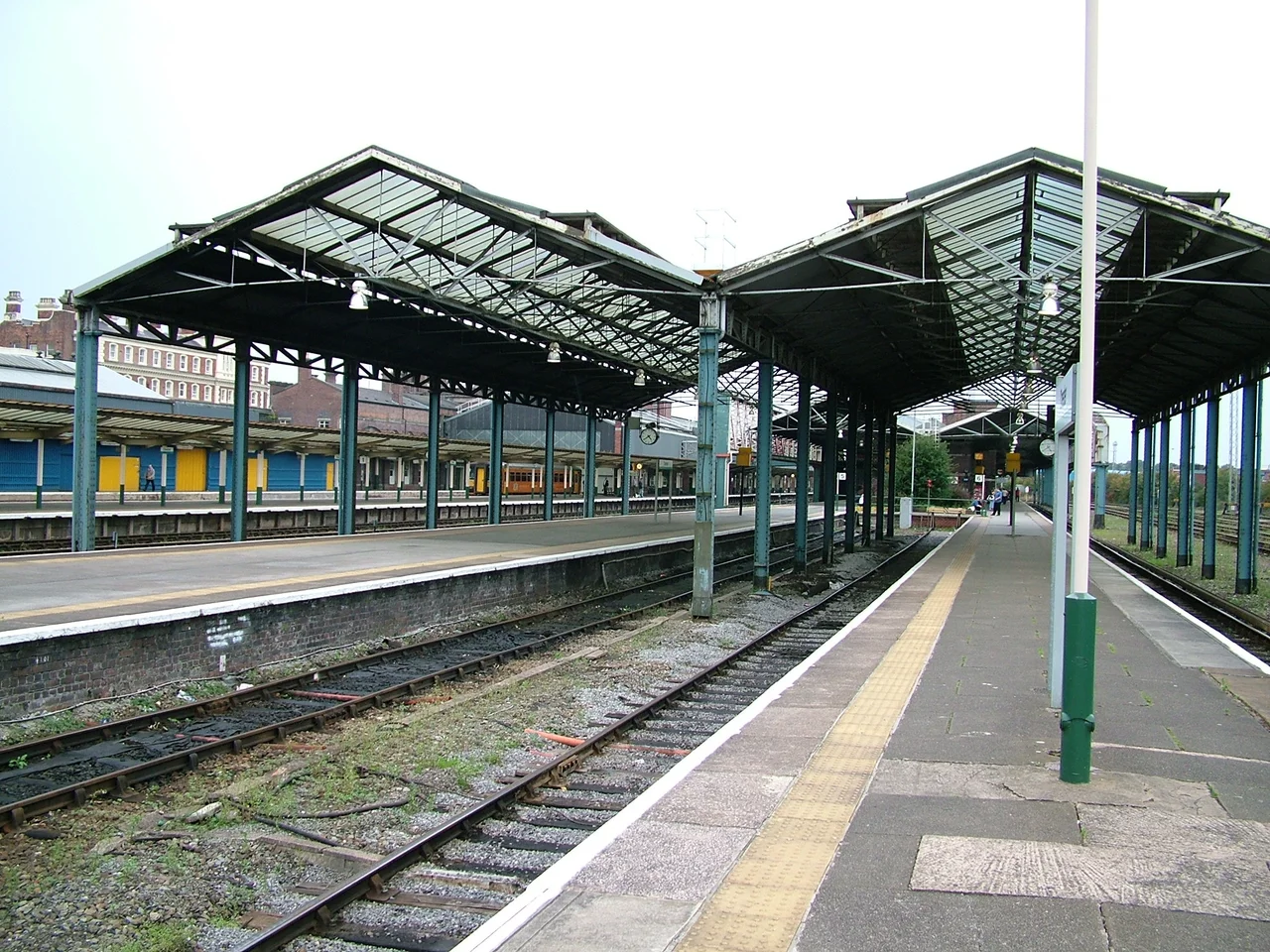

Chester General Rail Crash
The driver jumped. There was nothing else he could do. The 19:31 freight from Ellesmere Port was rolling toward Chester General station at twenty miles an hour with thirty-eight wagons behind it - five of them tank cars full of petrol, kerosene, and gas oil - and the brakes were not working. He had run past a signal at danger. The points ahead were set for bay platform number 11, where an empty diesel multiple unit was sitting. He could see, as the engine came down the falling gradient, that he was going to hit it. So he jumped onto the platform with the train still moving and watched what he had been driving plough into a passenger train and erupt. By the time the fire was out three and a half hours later, the trains were write-offs, the station roof was gone, and nobody had died. It is the only thing about 8 May 1972 in Chester that nobody can quite believe.
The Forgotten Pipe
The cause was small. Earlier that evening, after the train had left Ellesmere Port, it had to stop at Helsby and reverse direction - the line layout required the locomotive to be uncoupled and re-attached at the other end. When the guard reattached, he forgot to reconnect the vacuum brake pipe between the locomotive and the first wagons. On partially-fitted freight trains, the first few wagons normally have their brakes linked to the engine; when the driver brakes, those wagons brake too, helping to slow the whole train. Without that connection, only the locomotive itself was braking against the weight of thirty-eight wagons - many of them heavy tank cars - rolling downhill into a station. The driver had also failed to carry out a brake test before leaving Helsby, which would have caught the error. It was the kind of small human mistake that happens on busy railways every day. On the 1-in-100 gradient down into Chester General, with twenty thousand gallons of flammable liquid as cargo, it became catastrophic.
What Happened on Platform 11
At about 20:50, the driver realised the train was not stopping. He fought it as long as he could, then jumped clear. The locomotive - a Class 24 diesel, number 5028 - hit the empty diesel multiple unit standing at platform 11 squarely and at speed. The first coach of the DMU was completely destroyed. The second was lifted clean off its bogies and thrown sideways onto the platform, where it demolished the wall of the station refreshment room. Inside the refreshment room, staff threw themselves under counters and sheltered as the masonry came down around them. There were very few people on that part of the station - it was approaching nine at night - which was the first piece of luck. The fuel tanks of the lead wagons burst on impact and ignited almost immediately. Chester's fire station happened to be nearby, and the first fire crews were on scene within a couple of minutes. That was the second piece of luck. They rescued a trapped postal worker from somewhere in the wreckage. They evacuated passengers from another lightly-loaded train standing on an adjacent platform just before the flames reached it.
The Long Burn
The petrol in the tank wagons did what petrol does. It boiled. Pressure built inside the tanks until the relief valves opened, and the escaping vapour caught on the fires already burning around them. The fire became sustained and intense and would not yield to anything the brigade could throw at it. Crews fought it through the night. The blaze was not finally extinguished until 00:20 the following morning - more than three hours after impact. By dawn, all the trains involved were declared write-offs. A section of the elegant overall roof of Chester General, the canopy that had stood since the station opened in 1848, was so badly damaged that it had to be removed entirely. It was never replaced. Today's photographs of Chester railway station show a missing tooth in the roofline where the 1972 fire ate through Italianate ironwork in a single night.
The Inquiry
The investigation found exactly what everyone suspected. Human error, compounded by an omitted brake test, compounded again by a steep gradient and a heavy load. There was no equipment failure. The vacuum brakes worked perfectly; they simply had not been connected. The inquiry's recommendations focused on procedure: rigorous brake testing after any locomotive uncoupling, regardless of how short the stop. The British railways had been making this transition for decades, slowly moving from partially-fitted freight - where only some wagons could brake - to fully fitted air-braked freight, where every wagon could be controlled from the cab. Chester General gave that transition a hard push. By the end of the 1970s, runaway freight trains of the kind that ploughed into platform 11 were becoming impossible by design rather than by procedure.
The Quiet Truth of It
Walk through Chester railway station today and there is no obvious sign that anything happened. The platforms have been resurfaced. The refreshment room has been rebuilt. The station has been substantially renovated in the years since, most recently around 2007. Only the missing section of the overall roof remains as a mark, and even that is invisible to anyone who does not know to look for it. The train driver, whose name does not survive in the public record of the accident, lived. The postal worker lived. The refreshment room staff lived. Five tank wagons exploded into fire in a busy urban railway station and the death count, in the official accounting, was zero - though seven people were injured. Whether you put that down to luck, to the fire station's location, to the fact that it was a quiet evening, or to the speed and skill of the response - it remains one of the most extraordinary outcomes in the history of British railway accidents.
From the Air
Located at 53.20 degrees north, 2.88 degrees west, just northeast of Chester city centre. Best viewed from 2,000 to 3,000 feet. Chester railway station and the long curve of platforms are visible from the air against the surrounding Victorian terraces of Hoole. Hawarden (EGNR) is 4 nautical miles west, Liverpool John Lennon (EGGP) is to the north, RAF Shawbury (EGOS) to the south.
Nearby Stories
- Goodison Park 1.5 km away
- First Battle of Middlewich 2.4 km away
- Whittington Castle 4.2 km away
- Worsley 9.5 km away
- Gwrych Castle 14 km away
- Lilleshall Abbey 22 km away
- Cymer Abbey 31 km away
- Celtic Array 70 km away