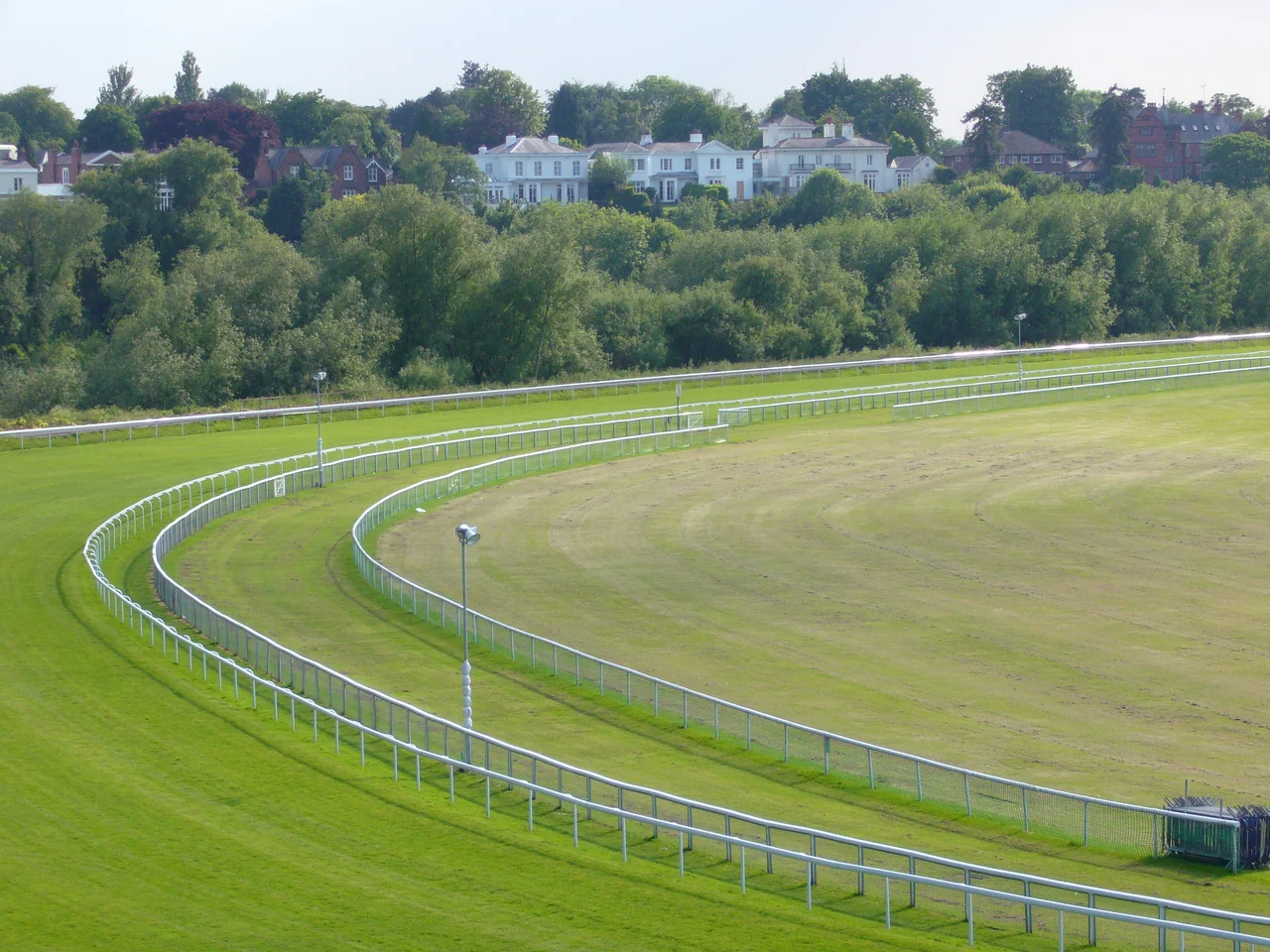

Chester Racecourse
The Romans moored their boats where the horses now run. That is the strange thing about the Roodee. Before it was a racecourse - before it was the oldest still-operating racecourse in the world, certified by Guinness - it was a Roman harbour. Cargo ships from Gaul tied up here, their crews unloading wine and oil onto a quay that has long since vanished under turf. Then the Dee silted up, the harbour closed, and the flat ground inside the river's bend became something else entirely. A medieval nunnery's boundary marker. A bloody football pitch. And then, in the spring of 1539, a horse race - the first of nearly five hundred years of horse races still continuing today, run on the smallest racecourse of any significance in England.
The Roodee's Strange Name
The course gets its name from a small stone cross that still stands on a raised mound near the centre of the track. The cross is called a rood - an Old English word for the wooden cross of the Crucifixion, surviving in modern usage in words like rood-screen. The flat ground inside the river-bend was the Rood Eye, the Island of the Cross. Over centuries the name softened to Roodee. An 1840 report identified the stone obelisk on the mound as the base of a cross marking the boundary of the Benedictine nunnery that occupied this land from the mid-twelfth century until its dissolution in January 1540. But Chester has a more dramatic story, and Chester prefers it. Local legend says the cross marks the burial site of a statue of the Virgin Mary that was put on trial for murder.
The Statue That Stood Trial
The legend goes like this. Lady Trawst, wife of the Governor of Hawarden, went to church to pray for rain during a drought. Her prayers were answered with a tremendous thunderstorm, and during the storm a statue of the Virgin came loose from its mounting and fell on her, killing her. The town faced a problem. The statue was a holy object - hanging or burning it would be sacrilege. So the people left it at the bank of the river instead, and the tide carried it down the Dee to Chester. There a jury of twelve men formally found the statue guilty of Lady Trawst's death and sentenced it to be buried, with the cross set above it as a marker. If the legend is even partly true, this would be the earliest recorded use of a jury in an English court, predating the formal establishment of the jury system by centuries. An alternate version says the statue was carried to St John's Church instead, where it stood until the Reformation - when it was thrown down as a relic of popery, used as a whipping post for schoolboys, and finally burned. Either way, no one ever quite settled where the Virgin Mary went.
From Football to Horses
Before there were races there was the Goteddsday football match - an annual game so violent that the city banned it in 1533. Six years later, in 1539, the Roodee got its first horse race, by all accounts to replace the football. Some sources push the first race back to 10 January 1511 or 1512, but the most cited date is 9 February 1539, with the consent of Mayor Henry Gee. His surname is said to have given English the affectionate term gee-gee for a horse - though linguists are sceptical, and it may simply be one of those city stories that everyone in Chester tells whether they believe it or not. What is certain is that the racing kept going. Through Tudor monarchs, the Civil War, the Restoration, the Industrial Revolution, the world wars - through every shift in English fortune over the next five centuries - horses ran on the Roodee. Oliver Cromwell did temporarily ban the associated Chester Midsummer Watch Parade, but the racing itself survived even him.
A Course That Should Not Work
Chester Racecourse is exactly one mile and one furlong long - barely 1,800 metres - making it the smallest racecourse of any significance in England. The track is a tight oval squeezed into the sixty-five acres of the Roodee, with horses running almost perpetually on a curve. Trainers and jockeys consider it a specialist's track. A horse that wins at Chester does not necessarily win anywhere else. Drawn positions matter more here than at most courses because the rail favours the inside on those tight bends. The crowd watches from three grandstands and from the city walls themselves, which abut directly onto the eastern edge of the course. The walls were once used to moor Roman trading vessels - the same stones that look down on the finishing line today were tying ships in the second century. Spectators on the walls watch races for free, an arrangement that has presumably annoyed the course's commercial managers since the eighteenth century but cannot really be changed without taking down a Grade I listed monument.
What Race Day Looks Like
The major fixtures are the May Festival and the Chester Cup, both run in early May, when the city fills with hats and white tents and the racecourse becomes the centre of a long noisy weekend. Ladies Day, the second day of the festival, draws crowds that overflow the grandstands and spread across the centre of the course onto the grass inside the rail. A pub called The White Horse opened in the middle of the course in 2013. From the air the Roodee at race time is unmistakable - a green oval inside the curve of the Dee, packed dense with people, the city walls rimming the east side and the mansions of Curzon Park dominating the west. The Grosvenor Bridge, once the longest single-arch stone bridge in the world, crosses the south-east corner. The North Wales Coast Line runs over the river at the north end. And in the middle, the rood, the small stone cross of legend, still stands on its mound where the horses run past it every May.
From the Air
Located at 53.19 degrees north, 2.90 degrees west, immediately west of Chester city centre inside the bend of the River Dee. Best viewed from 2,000 to 3,500 feet, where the distinctive tight oval of the track is unmistakable inside the river's curve, with the city walls running along its eastern edge. The Welsh border is only about a mile west of the racecourse. Hawarden (EGNR) is 3 nautical miles southwest, Liverpool John Lennon (EGGP) to the north, RAF Shawbury (EGOS) to the south. Major race meetings draw heavy traffic; the racecourse is best viewed mid-week when the green oval is uncluttered.
Nearby Stories
- Goodison Park 1.5 km away
- First Battle of Middlewich 2.4 km away
- Whittington Castle 4.2 km away
- Worsley 9.5 km away
- Gwrych Castle 14 km away
- Lilleshall Abbey 22 km away
- Cymer Abbey 31 km away
- Celtic Array 70 km away