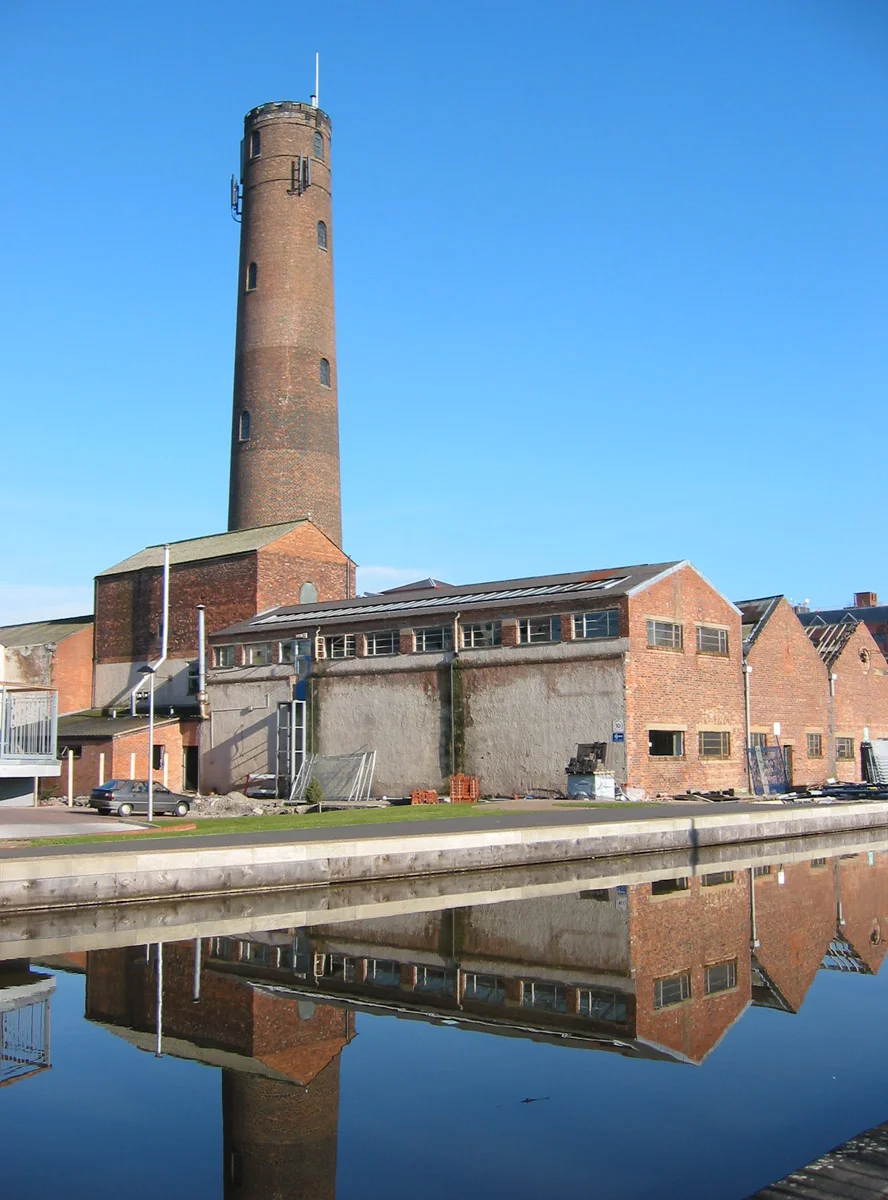

Chester Shot Tower
Drop molten lead from a great height and physics will make it round. That is the entire principle of the shot tower, and in 1799 it was almost the newest industrial idea in Britain. The Bristol inventor William Watts had patented the process less than two decades earlier, drilling holes through the floors of his own house and dropping lead from the attic into a water tank in the basement to test it. By the time Walkers, Parker and Company built their tower in the Boughton district of Chester, the technique had become an industrial standard - and the 168-foot brick tower they raised beside the Shropshire Union Canal was one of the first generation of true shot towers in the world. Today, more than two and a quarter centuries later, it still stands. It is the oldest surviving shot tower in the world, and the only one in the United Kingdom that predates the twentieth century.
How Lead Becomes Round
The Watts process works because of surface tension. Molten lead, poured from the top of a tall tower through a perforated sieve, forms droplets. As those droplets fall, they pull themselves into perfect spheres - the most efficient shape for surface area, the same physics that makes raindrops bead - and by the time they reach the bottom of a 168-foot drop they have cooled enough to hold the shape when they hit water. The water tank at the base of the tower stopped the spheres without deforming them. Lead shot for muskets, pistols, and shotguns - millions of small near-perfect spheres - emerged from the tank to be dried, sorted by size through graduated sieves, and shipped. Before Watts, lead shot had been cast in moulds, one pellet at a time. The tower method replaced an enormous amount of labour with a single tall building and the force of gravity.
Why Chester
Lead was already moving through Chester. From the Roman period onwards, lead from mines in north-east Wales - including the major workings at Minera - had been smelted near the city and shipped from the port of Chester out into the Irish Sea trade. When the Chester Canal opened in the 1770s, it created a new industrial corridor east of the old city, and Walkers, Parker and Company moved in. Their leadworks rose on the canal bank in the 1790s, with the shot tower completed in 1799 as one of the first major additions. The location was logical: Welsh lead came in, finished shot went out, and the canal handled both directions of traffic. The timing was also crucial. The Napoleonic Wars were starting. British soldiers, marines, and sailors needed enormous quantities of lead shot for muskets and pistols, and a tower in Chester turning Welsh lead into Royal Navy ammunition was the kind of small private industrial victory that helped keep an empire at war for two decades.
The Building Itself
The tower is a circular brick column, 168 feet tall, 30 feet in diameter at the base, tapering to 20 feet at the top. Small arched windows let in just enough light to work by but not enough to disrupt the temperature of the falling lead. The red brick is honest Georgian-industrial brick - laid in long courses, the kind you see in mill chimneys across northern England. Inside, the open shaft would have run the full height of the tower. A workman at the top tipped molten lead into a perforated copper plate. The droplets fell through air for nearly the height of a fifteen-storey building. A workman at the bottom tended the water tank and the sieves. The tower had to be tall because the lead needed enough fall-time to cool. It had to be narrow because every brick of width was money spent. It is, in its way, a perfect minimal industrial structure - just tall enough, just wide enough, doing exactly one thing for exactly the time it takes a drop of lead to fall.
What Happened to the Other Towers
Walkers, Parker and Company built more than one. The 157-foot tower at Elswick in Newcastle-on-Tyne, completed in 1797, operated until 1951 and was demolished around 1968. The two London shot towers that appear in John Constable's painting of Waterloo Bridge - both eventually owned by Walker, Parker - were demolished in the twentieth century. The Lambeth tower of 1826 came down with the rest of the South Bank redevelopment. The Bristol original, the one William Watts had built in his own house, was demolished in 1968 and replaced with a reinforced-concrete tower at Cheese Lane in 1969. Across the Atlantic, the Jackson Ferry Shot Tower in Wythe County, Virginia (around 1807) and the Sparks Shot Tower in Philadelphia (1808) both still stand, but both are younger than Chester's. The Chester Shot Tower is the only surviving British example built before the twentieth century. By the slimmest of margins, in the longest of industrial relays, it is the oldest in the world.
After the Lead Stopped Falling
The Chester Leadworks ran into the late twentieth century but eventually closed, and the tower fell silent. It is Grade II*-listed and protected, but redevelopment proposals for the surrounding leadworks site have generated regular controversy - notably featuring in the 2013 BBC Two documentary The Planners, which covered a long-running disagreement over what should happen to the abandoned industrial complex. The tower itself, the brick column with its small arched windows, still stands beside the Shropshire Union Canal in the Boughton district just east of the city centre. From the air it is unmistakable: a tall thin red cylinder, far too thin to be a chimney, surrounded by canalside grass and the remains of demolished workshops. Inside, the shaft is empty now. The water tank is gone. But the brickwork is sound, and the small arched windows still let in just enough light to remember how the lead used to fall.
From the Air
Located at 53.19 degrees north, 2.88 degrees west, in the Boughton district immediately east of Chester city centre, beside the Shropshire Union Canal. Best viewed from 1,500 to 2,500 feet, where the slender vertical brick tower is unmistakable against the surrounding canalside flatlands. It is the tallest standing structure in Chester. Hawarden (EGNR) is 4 nautical miles west, Liverpool John Lennon (EGGP) to the north, RAF Shawbury (EGOS) to the south.
Nearby Stories
- Goodison Park 1.5 km away
- First Battle of Middlewich 2.4 km away
- Whittington Castle 4.2 km away
- Worsley 9.5 km away
- Gwrych Castle 14 km away
- Lilleshall Abbey 22 km away
- Cymer Abbey 31 km away
- Celtic Array 70 km away