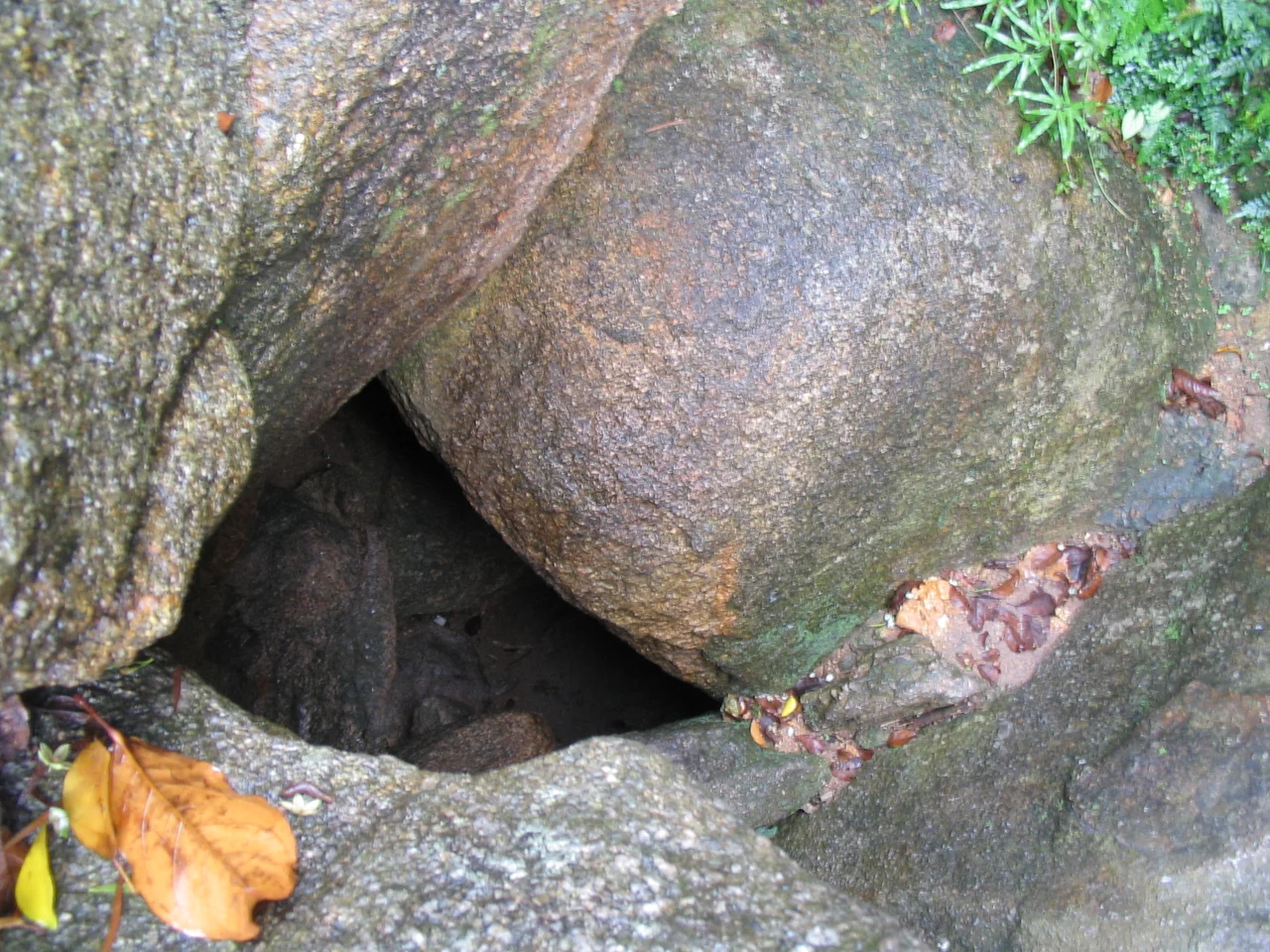

Cheung Po Tsai Cave
No treasure has ever been found in Cheung Po Tsai Cave. The cave is named for a real person — Cheung Po Tsai, a pirate who operated in the South China Sea during the Qing Dynasty — and legend has him hiding both himself and his fortune in this crack in the granite of Cheung Chau's southern headland. The legend is the attraction. The cave itself is a 90-metre passage that goes 10 metres underground, and visitors descend into it one at a time.
The Pirate and the Battle
Cheung Po Tsai was not a minor figure. He commanded one of the most powerful pirate fleets in the Pearl River Delta during the early 19th century, and his legend has accumulated considerable embellishment over the generations. The cave on Cheung Chau is said to have been his refuge during the Battle of the Tiger's Mouth, a naval engagement that marked a turning point in the campaign against piracy in the region. Whether he actually used this particular cave is impossible to verify — the legend attaches his name to several sites across Hong Kong — but the cave on Cheung Chau is the one most visited, and the story has proven durable. The South China Morning Post has compared his cultural status to that of Jack Sparrow, the fictional pirate, which suggests something about how legend operates: the more time passes, the less the facts constrain the story.
Descending Into the Dark
Entering the cave requires climbing down a ladder. The passage is roughly 90 metres long and 10 metres deep at its lowest point, narrow enough that visitors must move in a single file line throughout. The walls are slippery. Little natural light penetrates. Bats live inside; mosquitoes do too, drawn by the dark and damp. A strong flashlight is recommended. Despite all of this, no serious accidents have been reported at the site as of 2018. The cave is not long by caving standards, and it is not technically demanding, but its atmosphere is particular — the close granite walls, the sounds of things living in the dark, the strange intimacy of a space that has been entered by thousands of tourists who all came looking for something that was never there.
The Cave That Was Destroyed
There is a second Cheung Po Tsai Cave, on Lamma Island, that tells a different story. That cave was far larger — nine storeys deep, by some accounts — and was presumed destroyed in 1979 when the Lamma Power Station was built on land adjacent to the site. For decades it was considered gone. But weathering has since revealed an entrance again, making it partly accessible to those who know where to look. The Lamma cave's near-disappearance under an industrial development, and its slow re-emergence, has the structure of a legend itself: something buried, rediscovered, not quite what it was.
What the Legend Holds
Cheung Chau built no museum around Cheung Po Tsai, no interpretive centre, no souvenir shop at the cave entrance. The attraction is simply the cave: granite, dark, damp, bats, the story. Visitors hike out from the main settlement past the temples and beaches to reach it, crossing the island's southern headland on a trail that offers views back toward the harbour. The cave exit opens on the far side of the headland, facing water. The treasure, if it ever existed, has not been found. The cave has been visited, written about, filmed, and featured on reality television — it was a location in the American series The Amazing Race — without producing any evidence that resolves the legend. This is, in its way, what makes it last.
From the Air
Cheung Po Tsai Cave is located at 22.200°N, 114.018°E on the southern headland of Cheung Chau island, approximately 10 km southwest of Hong Kong Island. From the air at 1,500–3,000 feet, the southern tip of Cheung Chau's dumbbell shape is visible — the cave itself is not distinguishable from altitude, but the rugged granite coastline of the headland is. VHHH (Hong Kong International Airport) is approximately 20 km to the northwest. Lamma Island lies to the northeast; the open water of the South China Sea opens to the south.
Nearby Stories
- Lok Ma Chau Loop 2.3 km away
- Portas do Cerco 2.3 km away
- Kweilin Incident 17 km away
- Wanshan Archipelago Campaign 34 km away
- Nanxiong Formation 115 km away
- Battle of Nanpeng Island 148 km away
- Heyuan 169 km away
- Cape Maobitou 632 km away