.jpg)
Chiayi Old Prison
The cells still smell faintly of concrete and time. Walk through the iron gate at 140 Wei Hsin Road in Chiayi's East District and you step into a place that was, for seven decades, one of the most controlled environments in Taiwan — a colonial prison where men and women lost years of their lives to Japanese and later Nationalist incarceration. The Chiayi Old Prison opened in 1922 as the Tainan Prison Chiayi Branch. It closed as an active facility in 1994, when the prison relocated to Lucao Township in Chiayi County. What remained was a rare, largely intact complex of cell blocks, corridors, and administrative halls that told a story most governments prefer to demolish. Taiwan designated it a historic monument in 2005 and reopened it as the Chiayi Prison Museum in 2011.
Built to Hold, Designed to Watch
The architectural logic of the Chiayi Old Prison is worth pausing over, because it was not the architecture of total surveillance. Prison designers in the nineteenth century often reached for the panopticon — a radial arrangement in which a central guard tower could observe every cell simultaneously, the theory being that the permanent possibility of being watched would discipline inmates into compliance. Chiayi was built on a different model. Its cell blocks do fan outward in a radial pattern from a central hall, and a staff member stationed in that hall can see the entrances to each block. But they cannot see inside the cells themselves without entering the individual block corridors. The design has more in common with Pennsylvania-style separate-system prisons — the approach used at Hokkaido's Abashiri Prison — where the emphasis was on isolation and silence over continuous visual surveillance. Prisoners lived in individual cells, separated from one another, a regime intended to prevent the social bonds that administrators feared would sustain solidarity or resistance.
Seven Decades of Incarceration
From 1922 through 1994, the Chiayi facility held prisoners under three distinct political regimes: the Japanese colonial government, the brief transitional period at war's end, and the Republic of China under both martial law and its aftermath. These were not abstract historical phases for the people inside. Prisoners here included political detainees, criminal defendants, and those caught in the machinery of colonial and authoritarian governance. The walls of the cell blocks, the narrow corridors, the workshops where inmates performed forced labor — all of these spaces were sites of real confinement, real deprivation, and real suffering for real people over seven decades. When the prison finally moved to its new location in 1994, it left behind a complex that had witnessed more human anguish than most sites in Chiayi City. The decision to preserve and open it was not obvious. It required someone to argue that the discomfort of remembering is preferable to the comfort of forgetting.
The Museum Inside the Walls
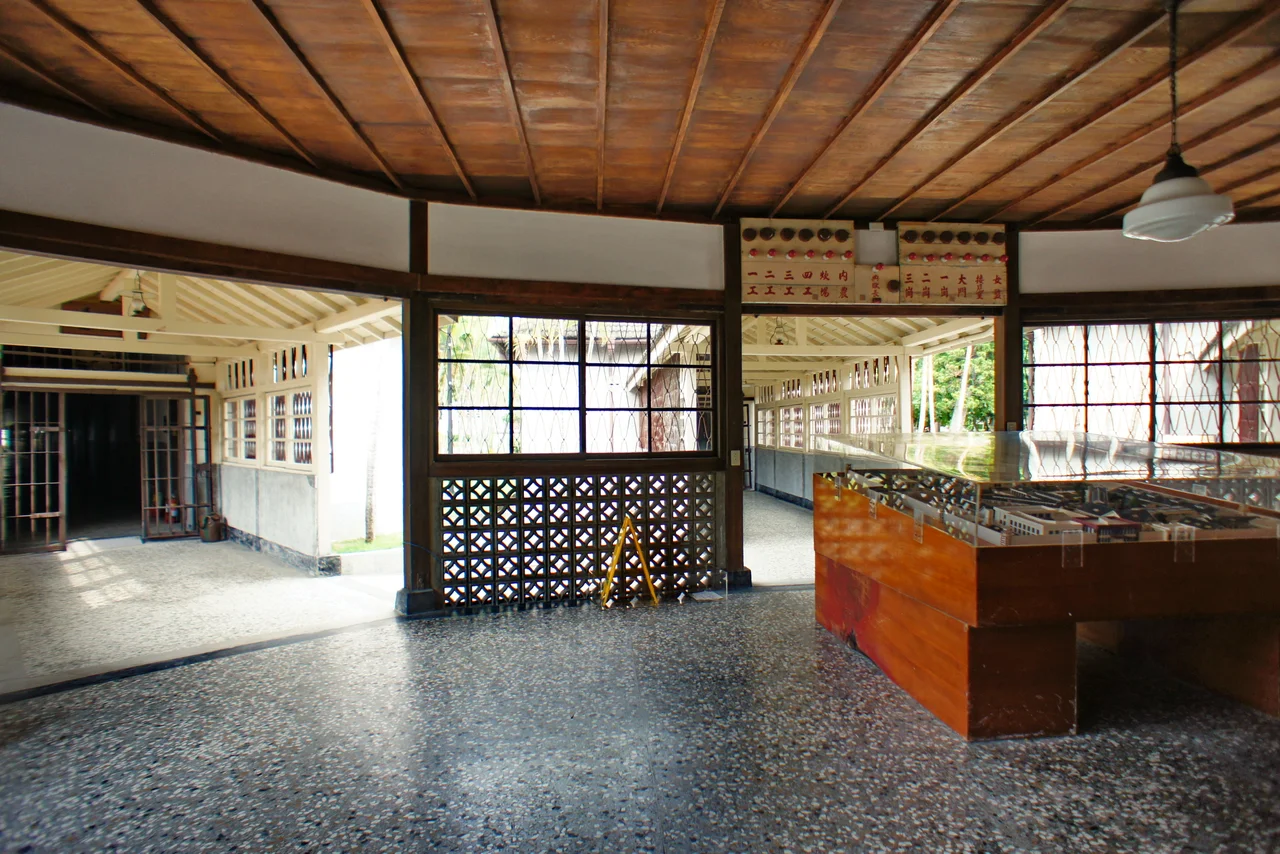
Restoration work on the complex was completed and the Chiayi Prison Museum opened to the public in 2011. The experience is deliberately unsoftened. Visitors can walk the cell block corridors, stand inside individual cells, and trace the path that prisoners would have walked from intake to daily routine. The original radial layout is preserved, allowing visitors to understand the spatial logic of confinement — how the arrangement of buildings determined who could see what, who could speak to whom, and who remained invisible. Workshop One, where inmates performed labor, is open to visitors. So is the upper corridor that runs above the cell block ceilings — an inspection route that gave guards a vantage point over the blocks without entering them. The museum does not sentimentalize the space or turn incarceration into spectacle. It asks visitors to reckon with what happened here, and with the institutions that made it happen.
A Short Walk from the Forest Railway
The Chiayi Old Prison sits within easy walking distance east of Beimen Station on the Alishan Forest Railway — the narrow-gauge line that climbs from Chiayi City into the mountains toward Alishan. This proximity to the forest railway is not coincidental. The Japanese colonial government that built the prison also built the railway, starting in 1906, to extract timber from the high-altitude cypress forests of the Alishan range. Both projects reflect the same colonial logic: the prison administered labor and punishment in the city while the railway moved wealth from the mountains. Standing at Beimen Station and walking the short distance to the prison walls, you traverse a geography that the Japanese administration shaped deliberately, and that modern Chiayi has chosen to preserve as testimony rather than erase as inconvenience.
Reckoning with Stone and Steel
Taiwan's designation of the Chiayi Old Prison as a national historic monument in 2005 placed it in distinguished and difficult company — a building valued not despite what happened inside but because of it. Prison museums occupy an uncomfortable category in cultural heritage: they ask visitors to recognize the state's capacity for cruelty as part of the historical record, not a footnote to it. Chiayi's prison museum joins a global network of such sites — Alcatraz, Robben Island, Abashiri — where the building itself is the artifact and the artifact demands moral attention. What distinguishes Chiayi is its layered history: colonial rule, wartime transition, postwar authoritarian governance. The walls held prisoners across all of it. That continuity is the hardest part of the story to absorb, and the most important one to carry out through the gate.
From the Air
The Chiayi Old Prison is located at approximately 23.486°N, 120.459°E in the East District of Chiayi City, Taiwan. From the air at 2,000 to 3,000 feet, the radial layout of the prison's cell blocks is visible — a distinctive fan-shaped footprint amid the city's urban grid. The nearest airport is Chiayi Airport (RCKU), roughly 3 km to the southwest. The Alishan mountain range rises visibly to the east on clear days, with the forest railway corridor running northeast from the city toward the mountains. Approach from the west over flat coastal plain for the clearest view of the city center and prison complex.
Nearby Stories
- Paiyun Lodge 1.2 km away
- Wushantou Reservoir 4.3 km away
- 1999 Jiji Earthquake 6.5 km away
- Xiluo 7.4 km away
- Bunun Cultural Museum 27 km away
- TransAsia Airways Flight 222 28 km away
- Mudouyu Lighthouse 29 km away
- Daya Bay 551 km away