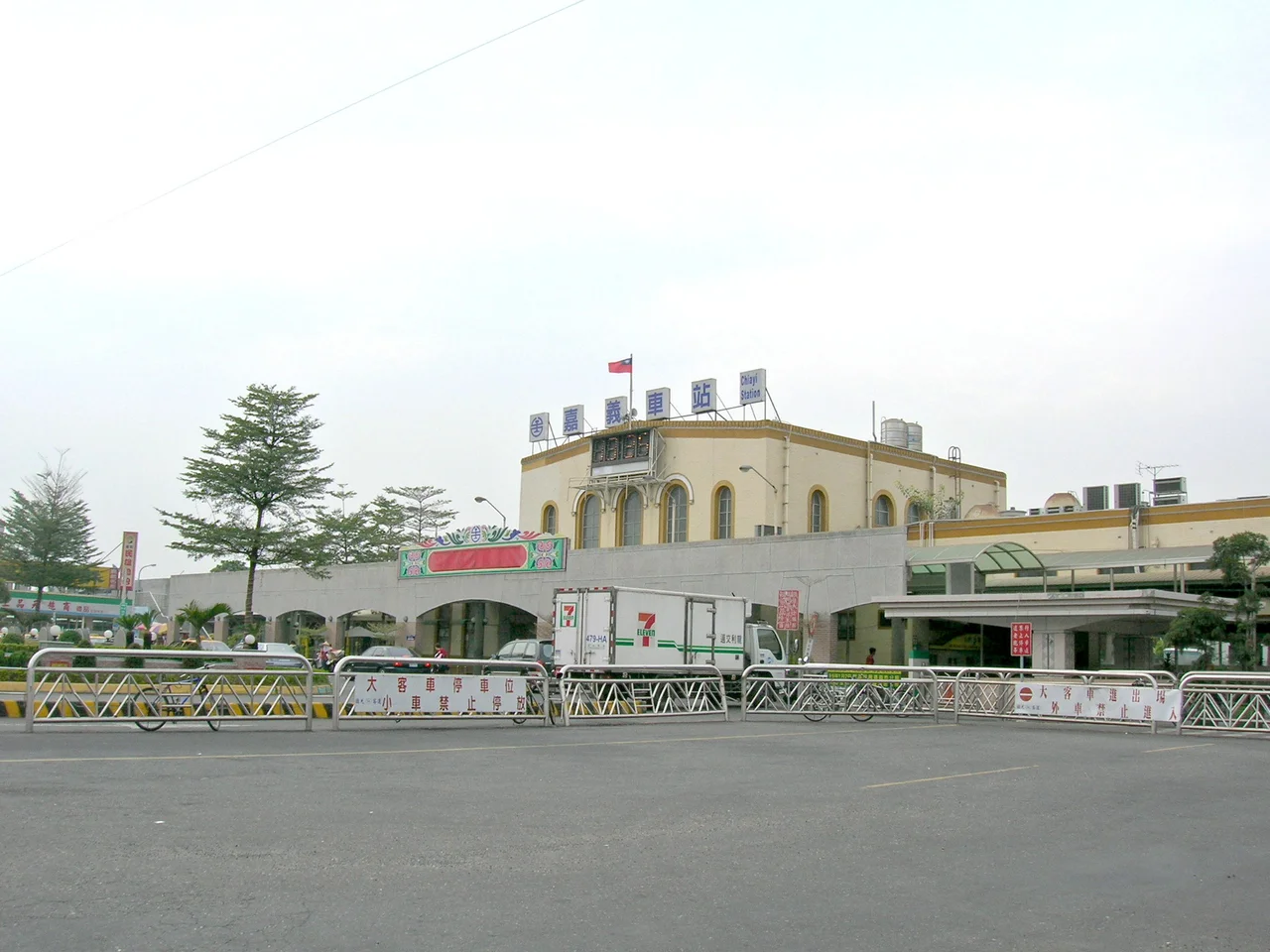

Chiayi
The Alishan Forest Railway is a narrow-gauge line that climbs from Chiayi's train station into the Central Mountain Range, gaining roughly 2,200 meters of elevation in 71 kilometers through a series of switchbacks and spiral loops. Typhoon Morakot damaged it severely in 2009, and for years after that the line ran only as far as Fencihu, the section above still closed for repairs. The railway's truncation says something about Chiayi's relationship with the mountain above it: the city has always been partly defined by what lies behind it, the forests and cloud sea and sunrise views that draw visitors from across Taiwan and beyond. But Chiayi is not merely a waystation. Walk Culture Road at dusk, stop at a sidewalk stall for a bowl of turkey rice, sit in Chiayi Park at six in the morning as the seniors do their tai chi by the koi ponds. The city has its own pace, its own pleasures, and they are worth a day even if Alishan is the destination.
The Gateway and the Mountain
Alishan is one of Taiwan's best-known scenic areas: a high-altitude plateau with ancient cypress and cedar forests, a famous sea of clouds, and a sunrise that draws thousands of visitors each March for the cherry blossom season. Chiayi is where you start the journey. Buses to Alishan depart from the station area at a frequency that makes lingering in Chiayi optional rather than necessary—a round-trip bus ticket costs around NT$236-250 and the ride takes two to two and a half hours. The High Speed Rail station is over 15 kilometers outside the city at Taibao, connected to downtown Chiayi by the BRT system; the HSR link to Taipei runs an hour and a half. That combination—quick access from Taipei, straightforward connection to the mountain—has made Chiayi a logical stop rather than a destination in itself. The city's laid-back residents seem largely unbothered by this status. A city of 270,000 moves at a different rhythm than the capital, and Chiayi has had centuries of practice at doing so.
Turkey Rice and the Culture Road Night
Chiayi's most famous dish is not photogenic. A bowl of turkey rice (火雞肉飯) is exactly what it sounds like: thin-sliced turkey strips and a savory sauce ladled over white rice, served at a sidewalk stall or a small indoor shop for NT$20-40. It is cheap, fast, filling, and widespread—available at dozens of places around the city center, each with its own loyal regulars and its own ratio of sauce to meat. The dish became Chiayi's signature for reasons that are more historical than gastronomic: turkey farming took hold in the area during the mid-20th century, and the local cooks found ways to make the most of the meat. It has outlasted the circumstances that created it and become civic identity. Culture Road—the main shopping street and site of the Wunhua Road Night Market—runs through the center of Chiayi and is the place to eat it, surrounded by the standard Taiwan night market inventory: scallion pancakes, oyster omelets, shaved ice, bubble tea. The market is livelier than the daytime city suggests, and it runs late.
The 1931 Team
In 1931, a high school baseball team from Chiayi Agricultural and Industrial Senior High School traveled to mainland Japan to compete in the Koshien national tournament. The team—known as KANO, after the school's Japanese abbreviation—was composed of Han Taiwanese, indigenous Taiwanese, and Japanese players, and it advanced to the championship game, finishing as runner-up. In an era when Taiwanese were colonial subjects of Japan, KANO's achievement carried weight beyond sport. The 1931 Kano Baseball Museum in Chiayi houses photographs and artifacts from that season. The story was adapted into a 2014 Taiwanese film, directed by Umin Boya and produced by Wei Te-sheng, which brought the KANO story to a new generation. The museum is a small space dedicated to a specific moment, but it illuminates something larger: the way sport can carry the aspirations of people who had few other forums for them.
The Park, the Gardens, and the Slow Morning
Chiayi Park sits near the city center and opens its gates before dawn. By five in the morning the paths are already occupied: seniors walking in pairs, groups doing tai chi, occasional cyclists cutting through on their way somewhere else. The Botanical Gardens adjoining the park weave through a varied collection of subtropical and temperate plants, their paths shaded by canopy. The ponds hold Japanese koi, turtles, and frogs. It is the kind of public green space that a city maintains not for tourists but for itself, and the best time to visit is early, before the heat builds and while the people who use it every day are still there. The Hon-too Bookstore on Culture Road carries a selection of English-language magazines. Two movie theaters show both Western and Chinese-language films. These are details rather than attractions, but they add up to a city that sustains a full life and not just a transit function. Chiayi exists for its residents first, and visitors who understand that tend to enjoy it more.
From the Air
Chiayi sits at 23.48°N, 120.450°E in the Chiayi Plain of southwestern Taiwan, roughly midway down the island between Taipei and Kaohsiung. From altitude the city appears as a compact grid bordered by flat agricultural land, with the terrain rising sharply to the east toward the Alishan range and the Central Mountain Range beyond. Chiayi Airport (CYI / RCKU) lies adjacent to the city center and handles domestic routes. Tainan Airport (TNN / RCNN) is approximately 50 km to the south; Taichung Airport (RMQ / RCMQ) approximately 90 km to the north.
Nearby Stories
- Paiyun Lodge 1.2 km away
- Wushantou Reservoir 4.3 km away
- 1999 Jiji Earthquake 6.5 km away
- Xiluo 7.4 km away
- Bunun Cultural Museum 27 km away
- TransAsia Airways Flight 222 28 km away
- Mudouyu Lighthouse 29 km away
- Daya Bay 551 km away