
Chimelong Ocean Kingdom
The single acrylic panel is 39.6 meters wide — wider than a 12-story building is tall — and behind it, a whale shark glides through 22.7 million liters of seawater. This is the number that stops people cold when they first encounter Chimelong Ocean Kingdom: not the RMB 10 billion construction cost, not the five Guinness World Records, not the 12.68 million visitors who passed through its gates in 2024. It's that window. One piece of acrylic, one enormous fish, one vertiginous sense that the ocean and the land have traded places. The park opened on Hengqin Island in early 2014, and within a year it had won the Thea Award for Outstanding Achievement — the first Chinese theme park ever to receive the honor.
A Kingdom Built from Records
Chimelong Ocean Kingdom was designed by PGAV Destinations, the American firm behind several of SeaWorld's landmark attractions, and it shows. The park broke ground on November 28, 2010, and soft-opened on January 28, 2014 — a construction timeline of just over three years for what is, by total water volume, the largest aquarium complex on Earth. The 48.75 million liters distributed across its tanks and exhibits dwarf any comparable facility. Eight themed zones radiate outward from the central Ocean Beauty area, each built around a different marine environment: Amazon river systems, polar horizons, tropical dolphin coves, coastal hero islands. At the center of it all is the whale shark tank, visible through that record-breaking acrylic window, and accessible by a submarine ride that actually passes through the aquarium itself. The 5D Castle Theatre, added in 2015, cost ¥300 million to build and features a 1,500-square-meter curved screen — another world record — showing a 13-minute animated film. The Journey of Lights nighttime parade won the 2018 Thea Award. The records have accumulated like barnacles.
The Animals Behind the Glass
Attendance figures tell one story. The animals tell another. Samuel Hung Ka-yiu, chairman of the Hong Kong Dolphin Conservation Society, was blunt in his assessment: the park was doing everything wrong. Polar bears confined in small enclosures showed signs of psychological distress — the repetitive pacing, swaying, and head-bobbing that animal welfare researchers call stereotypic behavior, a recognized indicator of suffering in captive wildlife. Penguins housed in a subtropical climate developed skin disorders. Conservation groups monitoring international wildlife trade documented that in 2013, Russia captured wild orcas in the Sea of Okhotsk, and CITES permits were subsequently issued for two of them to be exported to China. Chinese white dolphins and spotted dolphins inhabit purpose-built exhibits that allow guests to watch from both above and below the waterline — a design that raises questions about whether visibility for visitors translates to wellbeing for the animals. The park's attendance numbers — which recovered to 12.52 million in 2023 after pandemic lows of 4.4 million in 2022 — suggest the public appetite for these encounters has not diminished.
Hengqin's Unlikely Shore
Hengqin Island sits in the Pearl River Delta, administratively part of Zhuhai but physically adjacent to Macau — separated from the peninsula by a narrow channel. Before Chimelong arrived, it was largely undeveloped wetland and farmland, a quiet counterpoint to the casino towers visible from its northern shores. The park has a rail connection at Zhuhai Changlong Station on the Zhuhai–Zhuhai Airport intercity line, and the greater Chimelong resort complex has continued to expand around the original Ocean Kingdom. In 2015, the year attendance hit 7.48 million, it ranked 13th globally among theme parks. By 2019, with 11.74 million visitors, it had climbed to 8th. The trajectory is clear. What began as an ambitious bet on a mostly-empty island has become one of the most-visited theme parks on Earth, reshaping Hengqin's identity as decisively as the reclaimed land itself reshapes the Pearl River Delta's geography.
Scale and Its Discontents
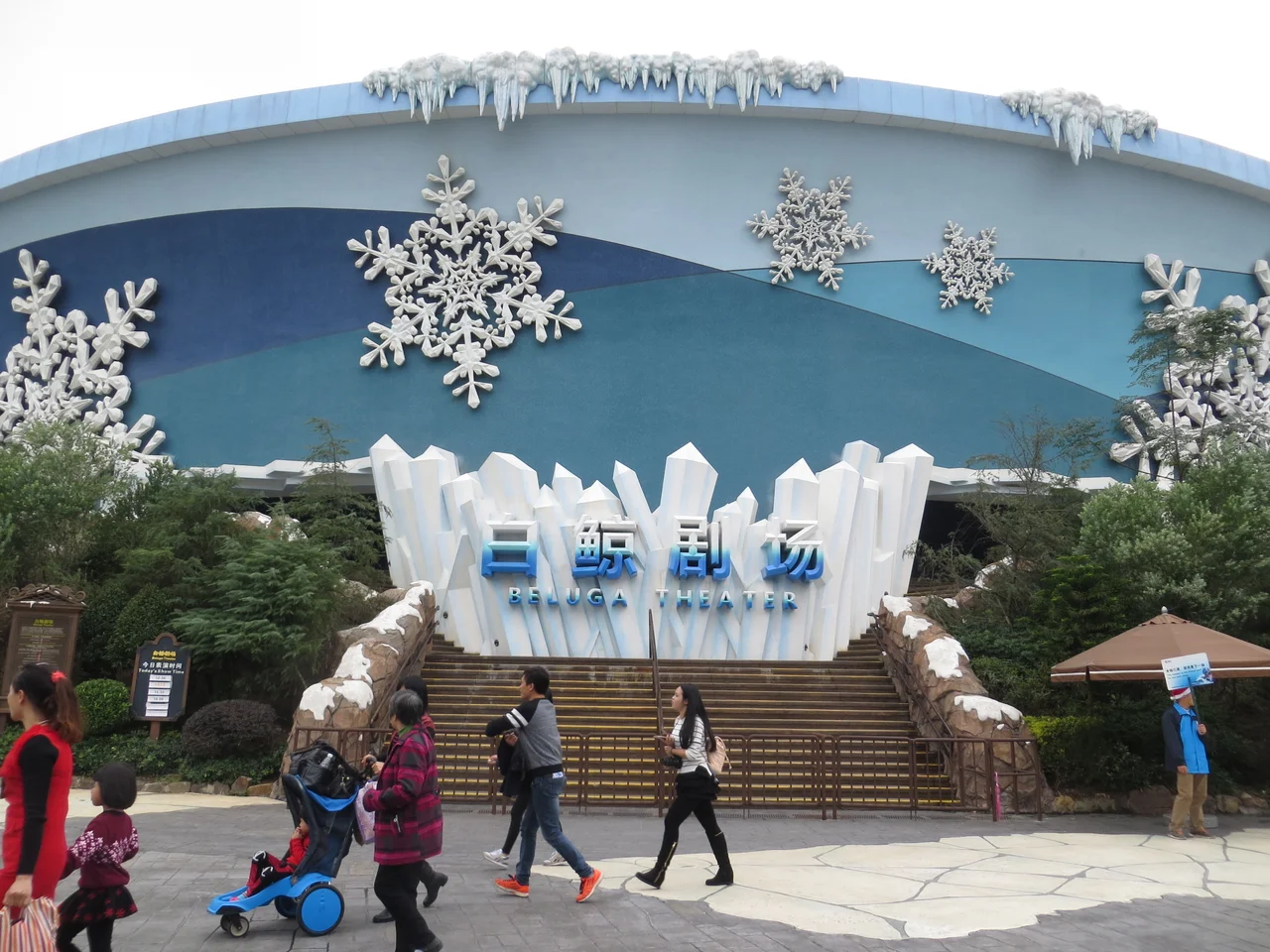
There is something genuinely impressive about the scale of what Chimelong built. Walking the 5D Castle Theatre's curved screen or watching a beluga through underwater glass, it's easy to understand the appeal. The problem is that the same ambition that produced those records also produced those polar bears pacing their enclosures. The park's defenders point to its dolphin conservation center for Chinese white dolphins — an endangered species — and its freshwater Amazon exhibits as evidence of educational value. Critics note that wild capture, not captive breeding, stocked many of the flagship exhibits. The tension is not unique to Chimelong; it runs through every large marine attraction on Earth. What is unusual is the concentration: five world records, one institution, one island, and a question the attendance figures alone cannot answer — whether the ocean is better understood by bringing a few of its creatures, at great cost to them, within arm's reach of 12 million people per year.
From the Air
Chimelong Ocean Kingdom sits at 22.10°N, 113.53°E on Hengqin Island, just southwest of Macau. Approaching from the north at 3,000–5,000 feet, you can see the island's low profile against the Pearl River Delta's maze of waterways. The park's large footprint and distinctive blue-roofed structures are visible in good visibility. Zhuhai Sanzao Airport (ZGSD) lies about 30 km to the west. Macau International Airport (VMMC) is roughly 8 km to the northeast. The Lotus Bridge border crossing between Hengqin and Macau is a useful visual reference on approach.
Nearby Stories
- The Brothers Islands, Hong Kong 6.3 km away
- Tai A Chau 11 km away
- Kaiping 18 km away
- Cuiheng 21 km away
- Taishan City 22 km away
- Battle of Nanpeng Island 73 km away
- Temple of the Five Lords 372 km away
- Mavulis Island 836 km away