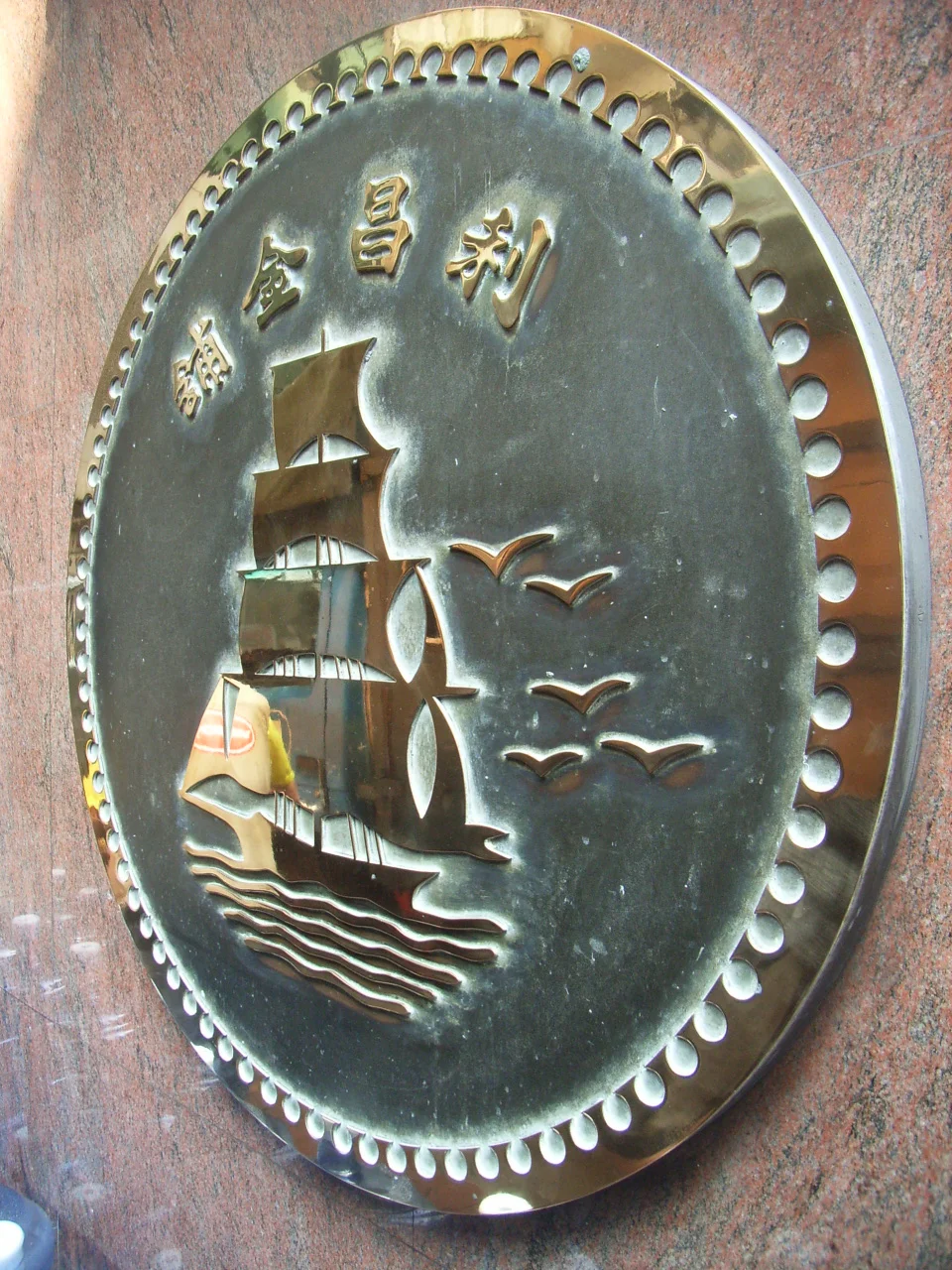

Chinese Gold and Silver Exchange Society
On a single day in January 1980, the price of gold swung by HK$1,200 inside the Chinese Gold and Silver Exchange Society's trading hall in Sheung Wan, Hong Kong. The Soviet Union had just invaded Afghanistan. Gold markets in London, New York, and Zurich shuttered for the day, unable to manage the volatility. The exchange on Hong Kong's western waterfront stayed open. That moment of stubborn resilience, almost a century into the institution's life, captures something essential about the organization and the city it grew from.
Immigrants and the First Exchange
The Chinese Gold and Silver Exchange Society was formally established in 1910 by immigrants from mainland China who had settled in Hong Kong and recognized that the colony — positioned at the intersection of global trade routes and Chinese commerce — needed a proper venue for precious metals trading. Originally called the Gold and Silver Exchange Company, the organization renamed itself to its current form in 1918. In its early decades, the exchange dealt not only in gold and silver but in a range of currencies including US dollars, Japanese yen, Vietnamese dong, Filipino pesos, and Mexican gold nuggets, reflecting the extraordinary breadth of commercial relationships that flowed through Hong Kong's harbour. Among the founding institutions were Hang Seng Bank and Tai Seng Bank, names that would go on to significant prominence in Hong Kong's financial history.
Open Outcry and One Million Ounces a Day
For decades the exchange operated through open outcry — traders signaling prices through a system of hand gestures and shouted bids across the trading floor. The exchange remains one of the few precious metals markets in the world that still maintains both an open outcry platform and an electronic trading system, treating the two as complementary rather than one obsolete and one modern. Gold trading grew significantly after 1974, when the Hong Kong government loosened legal restrictions on gold dealing. By 1979, the exchange was handling roughly one million ounces of gold per day, placing it among the world's four largest gold trading centres alongside London, New York, and Zurich. That position was earned not through size or regulatory privilege but through market practice: the exchange operated with a flexibility and a willingness to remain open under conditions that caused more cautious institutions to close. The 1983 test came during plummeting oil prices, tightening US Federal Reserve policy, and volatile gold prices. American and Singaporean gold markets suspended trading. The Chinese Gold and Silver Exchange Society stayed open.
More Than a Trading Floor
The exchange built something beyond a market. In 1948, it constructed a Kam Ngan Swimming Shed for workers and the public — later closed during government land reclamation. A school opened in 1949, offering fully subsidized education including tuition, books, supplies, and meals for children in the community. In March 1967 that school was transferred to become the government-subsidized Po Leung Kuk Gold and Silver Exchange Society Pershing Tsang School, which still operates. A clinic was founded in 1952, providing outpatient healthcare to members including gynecology, dentistry, X-ray services, and laboratory testing. These institutions reflect a tradition common among Hong Kong's immigrant merchant communities: building the social infrastructure that government did not always provide, tying commercial success to communal obligation.
Gold, Politics, and Survival
The exchange occupies a distinctive position in Hong Kong's political economy. Members entitled to vote at CGSE general meetings are eligible to register as Financial Services functional constituency electors, giving the exchange a formal channel into Hong Kong's Legislative Council and Election Committee — a legacy of the city's complicated constitutional arrangements. The exchange now has 171 corporate members drawn from banks, jeweler groups, bullion merchants, gold refineries, and financial institutions. It operates a modernized assay centre, the Hong Kong Precious Metals Assay Centre, accredited under international ISO/IEC 17025 standards. It remains Hong Kong's only government-approved physical gold and silver exchange, operating under a specific exemption in Chapter 82 of Hong Kong law. More than 110 years after its founding, the institution built by mainland Chinese immigrants in a British colony still prices gold by hand signal in a trading hall in Sheung Wan — and still, when conditions demand it, stays open.
From the Air
The Chinese Gold and Silver Exchange Society is located in Sheung Wan, on the northwestern shore of Hong Kong Island, at approximately 22.285°N, 114.152°E. Flying along the northern coast of Hong Kong Island at 2,000–4,000 ft, Sheung Wan appears as a dense concentration of commercial buildings west of the Central district's taller skyline. Victoria Harbour lies to the north, with the Kowloon Peninsula visible across the water. Hong Kong International Airport (VHHH) is approximately 25 nm to the west. The nearby ICAO code for the former Kai Tak Airport (VHHH until 1998) is no longer active; all traffic routes through the current VHHH at Chek Lap Kok.
Nearby Stories
- Lok Ma Chau Loop 2.3 km away
- Portas do Cerco 2.3 km away
- Kweilin Incident 17 km away
- Wanshan Archipelago Campaign 34 km away
- Nanxiong Formation 115 km away
- Battle of Nanpeng Island 148 km away
- Heyuan 169 km away
- Cape Maobitou 632 km away