.jpg)
Chinese Temple and Settlement Site, Croydon
The law said they were not supposed to be here. Under a Queensland act of 1878, Chinese miners were barred from a new goldfield for three full years unless they had made the discovery themselves - a deliberate effort to keep them off the richest ground. Yet when Croydon's gold was reported in 1885, Chinese settlers came anyway, and within two years some 300 of them lived on the town's northwestern fringe. What remains of them now is a set of concrete foundations in the grass: the floor of a temple that was the beating heart of their settlement, and one of the largest Chinese communities in all of regional Australia.
The Men Who Fed the Goldfield
Barred from holding claims, the Chinese of Croydon made themselves indispensable in another way: they fed everyone. The majority worked as market gardeners on 172 acres set aside in the town plan, coaxing custard apples, mandarins, watermelons and lemons out of the dry north Queensland soil and becoming the goldfield's chief source of fresh fruit and vegetables. Others worked as cooks, as carriers hauling goods across the savannah, and on tribute for other miners. In an isolated settlement that could grow little for itself, these were not marginal jobs. The gardens kept the diggings alive, and the diggers knew it.
A Temple at the Centre
On the northwest edge of town, the community built what they needed to live as a community: houses, ovens, and at its centre a temple. It was never only a place of worship. People came to meet, to consult a horoscope before some new venture, to honour their ancestors, and on festival days to gather, feast and process through the settlement. Temples of the era also did the work of welfare, grounded in a Confucian ideal of universal care - provision for the aged, work for the able, and a path forward for the young. Tellingly, the Croydon temple was substantial - its floor plan slightly larger than the surviving temple at Atherton, where the Chinese population topped a thousand. For a goldfield expected to be fleeting, they built something meant to last.
Welcome and Violence Both
The truth of race relations here was not simple, and it should not be smoothed over. Anti-Chinese feeling ran hot across north Queensland in these years, and Croydon was no exception. In September 1886 a "roll-up" turned into a riot: a mob, by later accounts some 200 strong, destroyed two Chinese buildings and most of the Chinese were temporarily driven off the field. In 1888 the miners' association demanded that all "aliens" leave. And yet, between these eruptions of hostility, the daily record suggests a great deal of ordinary commerce and coexistence - the gardeners selling their produce, neighbours trading with neighbours. The community endured both the welcome and the violence, and stayed.
What Remains, and Who
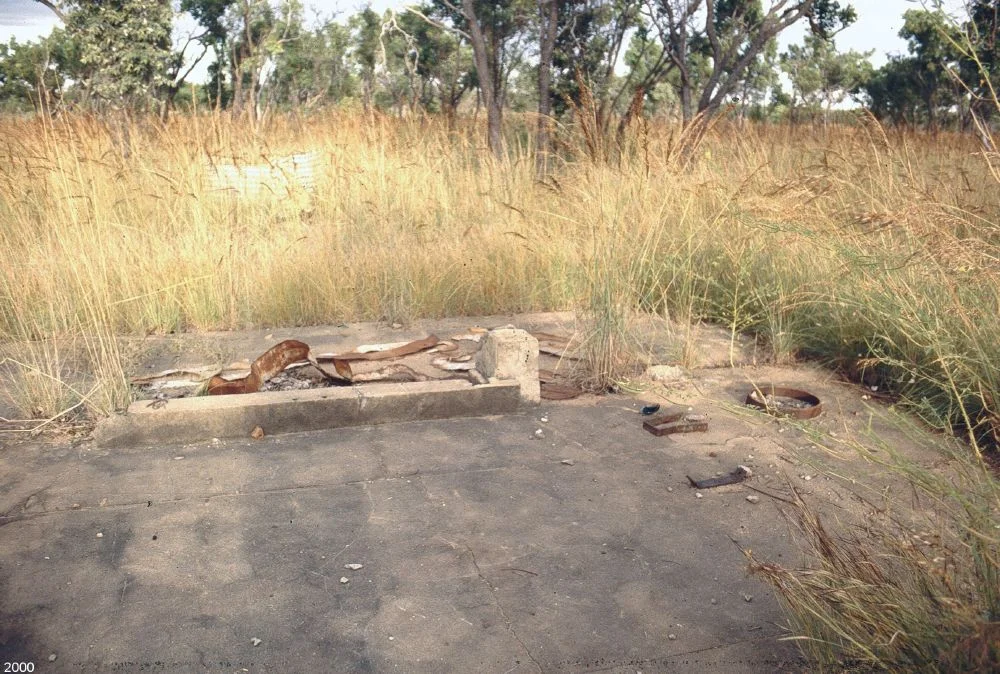
Croydon's gold gave out fast. Production peaked in 1900, drought and falling yields followed, a cyclone battered the town in 1906, and by 1918 the crushing had stopped for good. Most of the settlement faded with the field. But walk the town block bounded by Charles, Kelman, Nicholas and Edward Streets and the past surfaces underfoot: the temple's concrete foundations with their carved sandstone bases shaped like lotus flowers, the remains of a rare stone "pig" oven bound with mud and crushed termite mound, scatters of broken crockery and patterned roof metal. Two of these ovens survive - found nowhere else on a Chinese site in Queensland. And the community itself did not entirely leave. Their graves lie in the Croydon cemeteries, and several local families today descend from those early Chinese settlers. The Queensland Heritage Register listed the site in 2000, protecting not a curiosity but the ground where a community made a home against the odds.
From the Air
The Chinese Temple and Settlement Site lies just northwest of Croydon township at about 18.20 S, 142.25 E, off the Gulf Developmental Road on flat ground below low hills - the goldfield town and the long straight highway are the landmarks here, as the foundations themselves are too low to see from altitude. Croydon Airport (YCDO) sits by the town; Normanton Airport (YNTN / NTN) lies about 150 km northwest, the nearest with regular service. The dry season (May-October) brings clear skies and firm ground; the wet season can flood surrounding country and close roads.
Nearby Stories
- Normanton to Croydon Railway Line 28 km away
- Georgetown: The Piece of North America in the Outback 87 km away
- Burns Philp Building, Normanton 123 km away
- Millungera Station 156 km away
- Mungana Archaeological Area 199 km away
- Augustus Downs Station 247 km away
- Great Northern Railway (Mt Isa line) 254 km away