.png)
Choragic Monument of Nikias
Look closely at the Beulé Gate, the stone entrance that funnels every visitor toward the Acropolis, and you are looking at a monument that was never meant to be a gate at all. Carved into its masonry is an inscription dedicating it to a man named Nikias, son of Nikodemos, who had nothing to do with fortifications. He paid for a chorus. In Athens, in the late fourth century BCE, that was an act worth building a temple to commemorate.
Buying a Place in the Festival
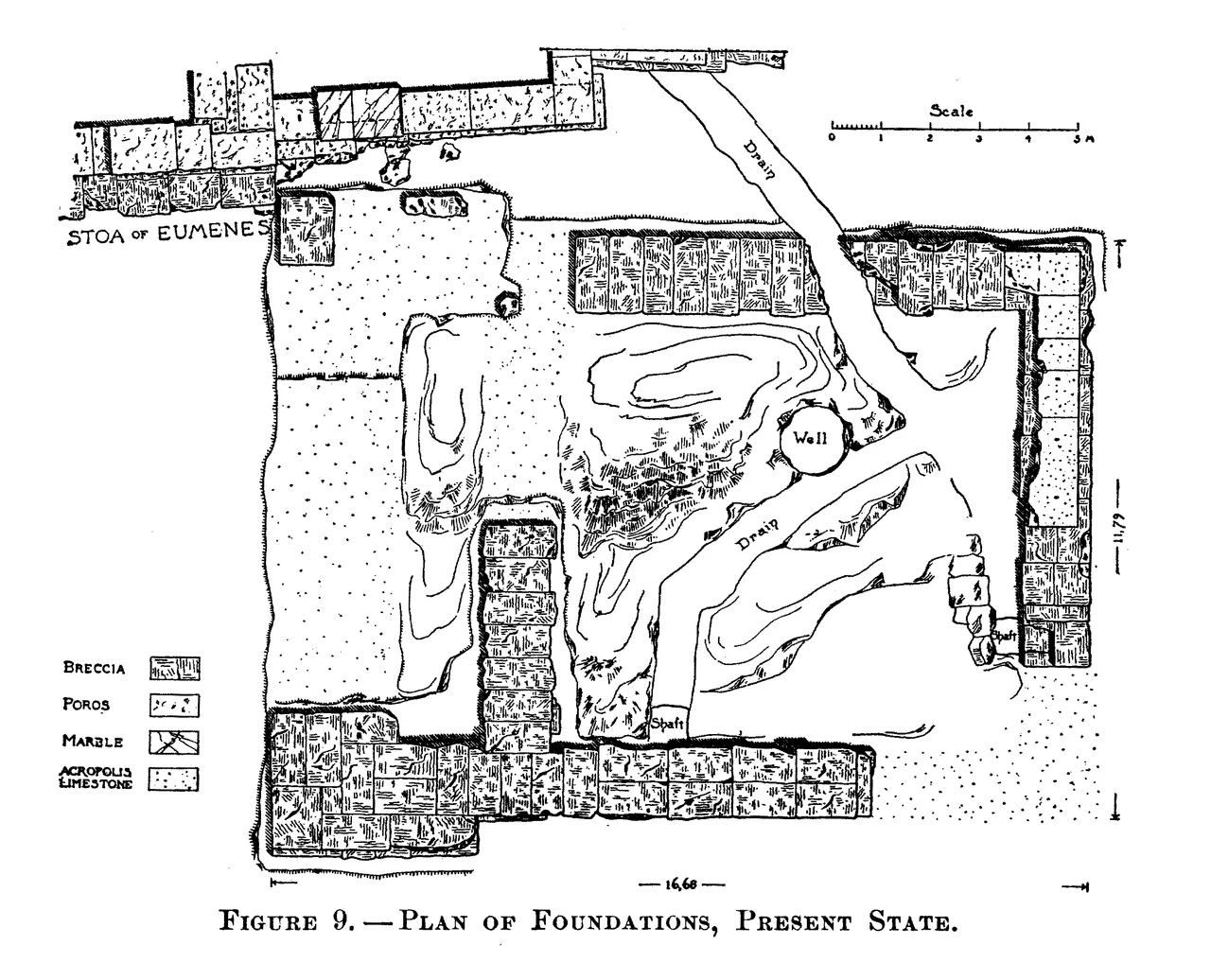
To understand why a temple stood here, you have to understand the choregia. Athens funded its great dramatic festivals not through taxes but through wealthy citizens, who took on the cost of training, costuming, and feeding a chorus as a public duty. The role was called the choregos, the chorus-leader, and it could be ruinously expensive. But there was a prize: at the City Dionysia, the festival honoring the god of wine and theater, the winning production earned its sponsor a bronze tripod. Nikias won. To display his prize, he commissioned a substantial building in 320 to 319 BCE, set on the south slope of the Acropolis between the Theatre of Dionysos and the long colonnade of the Stoa of Eumenes.
A Temple to a Stage Victory
This was no modest plaque. The Monument of Nikias took the form of a full Doric temple, hexastyle, meaning six columns stood across its front, with a square inner chamber. It is the largest known structure of its kind in Athens. Atop it, in all likelihood, sat the winning tripod itself, gleaming bronze above the white marble. Two of the grandest surviving choregic monuments, this one and the nearby Monument of Thrasyllos, both date to the same brief window of oligarchic rule under Macedonian influence. Neither stood on the Street of the Tripods, where such trophies usually clustered. The conspicuous display of private wealth was political, a campaign in marble, and it provoked the lawmaker Demetrios of Phaleron to pass laws curbing exactly this kind of extravagance.
Dismantled, Then Reborn as a Wall
The monument did not survive intact, but it did not entirely vanish either. Sometime in the third century CE, with the Roman Empire bracing against invasion, Athenians took the building apart with care and carried its dressed stone uphill. Some scholars tie the demolition to defensive preparations under the emperor Valerian; others to the aftermath of the devastating Herulian sack of Athens in 267 CE. Either way, the marble of Nikias was rebuilt into a fortification wall guarding the western approach to the Acropolis. Centuries of celebration were folded into a single act of survival.
Hidden in Plain Sight
For a long time, no one knew where the monument had stood. In 1852 the French archaeologist Charles Ernest Beulé uncovered the Late Roman gate that now bears his name, and embedded in its central section he found ancient blocks, including the dedicatory inscription naming Nikias. It took until 1910 for William Dinsmoor to pin down the original site on the slope below. Today the foundations and a few fragments remain where Nikias built them, while the heart of his trophy stands reassembled in the gateway above. Every visitor to the Acropolis passes through a chorus victory without knowing it.
From the Air
The Choragic Monument of Nikias sits on the south slope of the Acropolis of Athens at 37.9703 N, 23.7269 E, with its reused masonry visible in the Beulé Gate at the western entrance. The Acropolis hill is an unmistakable visual landmark from the air, best viewed at low altitude in clear conditions. Nearest major airport: Athens International (LGAV), roughly 30 km east-southeast. Watch for controlled airspace over central Athens.
Nearby Stories
- Great Sand Beach 5 km away
- Battle of Delium 7.7 km away
- Tower of Aliartos 9 km away
- HMHS Britannic 10 km away
- Saronic Gulf 15 km away
- Sousaki Volcano 17 km away
- Sanctuary of Apollo Maleatas 24 km away
- Skyros 66 km away