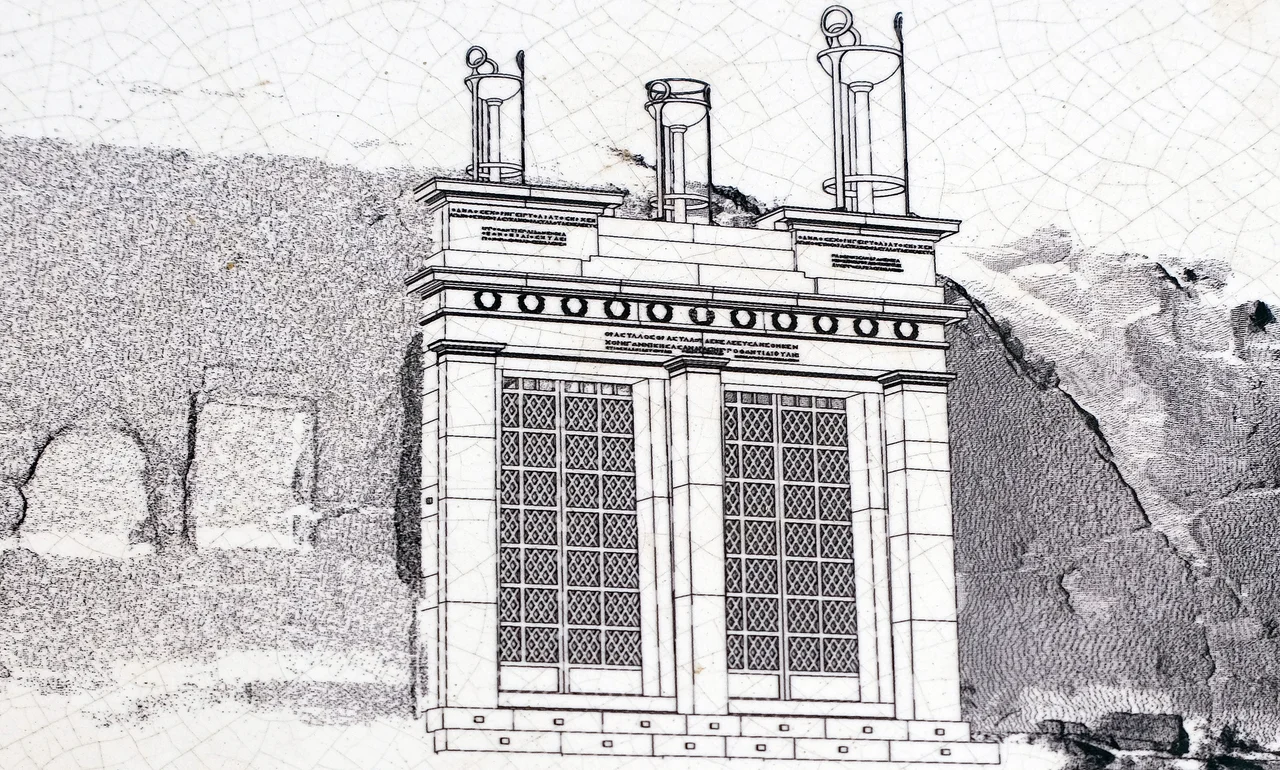

Choragic Monument of Thrasyllos
High on the south face of the Acropolis, where the rock has been cut into an artificial cliff above the Theatre of Dionysos, a natural cave opens in the limestone. In 320 to 319 BCE, a wealthy Athenian named Thrasyllos walled across its mouth with marble and turned the dark hollow into a monument. It was his receipt for a victory at the theater, and over the next two thousand years it would become a Christian shrine, a casualty of war, and the inspiration for architects who never saw Athens.
A Trophy in the Cliff
Thrasyllos had served as a choregos, one of the wealthy citizens who paid to train and stage a chorus at Athens's great dramatic festivals, the Dionysia. Winning earned a bronze tripod, and the right to display it. Rather than raise a freestanding temple, Thrasyllos closed the cave with a facade that echoed the nearby Propylaea, the monumental gateway of the Acropolis itself: two tall doorways flanking a central pillar, framed by architrave, frieze, and cornice in marble drawn from local quarries. The frieze carried ten carved olive wreaths, five to each side of a central wreath, and the cornice held bases for the tripods. Decades later, in 271 to 270 BCE, Thrasyllos's son Thrasykles updated the monument with fresh inscriptions to mark his own role as a festival official.
The Cave Remembers Its Gods
The cave was sacred long before Thrasyllos. The ancient traveler Pausanias recorded that it held a depiction of Apollo and Artemis slaying the children of Niobe, the myth of a mother punished for her pride. In the Christian centuries, the hollow took on a new sacred life as a chapel dedicated to the Panagia Spiliotissa, Our Lady of the Cave, and it remained in use into the late twentieth century. Inside survive some of the finest post-Byzantine wall paintings on the Acropolis slopes, the prayers of one faith layered over the marble of another in the same patch of living rock.
Stripped, Then Shattered
By the time the monument fell, its great statue had already left. In 1802, Lord Elgin removed a Hellenistic figure of Dionysos from the site as part of the collection that became the Elgin Marbles, now in the British Museum. It was an act of removal that, by chance, became an act of preservation. In 1827, during the siege of the Acropolis in the Greek War of Independence, an Ottoman cannon found the monument and brought it down. The statue Elgin had carried off was spared the bombardment that destroyed everything around it. Some of the scattered marble was later recut and built into the Byzantine church of Soteira Lykodimou nearby, the stones migrating once again.
A Drawing That Outlived the Stone
What kept the monument alive was paper. In the eighteenth century, the British antiquarians James Stuart and Nicholas Revett measured and drew it with exacting care, and their plates, alongside Julien-David Le Roy's 1758 study of Greek ruins, carried the building's image across Europe. The simple post-and-lintel logic of Thrasyllos's facade caught the eye of nineteenth-century architects: both Karl Friedrich Schinkel in Berlin and Alexander Thomson in Glasgow drew on it in their work. When restoration on the Acropolis began again in 2002, it leaned heavily on those same eighteenth-century drawings. A trophy for a forgotten chorus had become a textbook of how to build.
From the Air
The Choragic Monument of Thrasyllos occupies a cave in the south cliff of the Acropolis of Athens, above the Theatre of Dionysos, at 37.97102 N, 23.727695 E. The Acropolis hill is a dominant landmark from the air, best viewed at low altitude in clear weather. Nearest major airport: Athens International (LGAV), about 30 km east-southeast. Expect controlled airspace and sightseeing traffic over the historic center.
Nearby Stories
- Great Sand Beach 5 km away
- Battle of Delium 7.7 km away
- Tower of Aliartos 9 km away
- HMHS Britannic 10 km away
- Saronic Gulf 15 km away
- Sousaki Volcano 17 km away
- Sanctuary of Apollo Maleatas 24 km away
- Skyros 66 km away