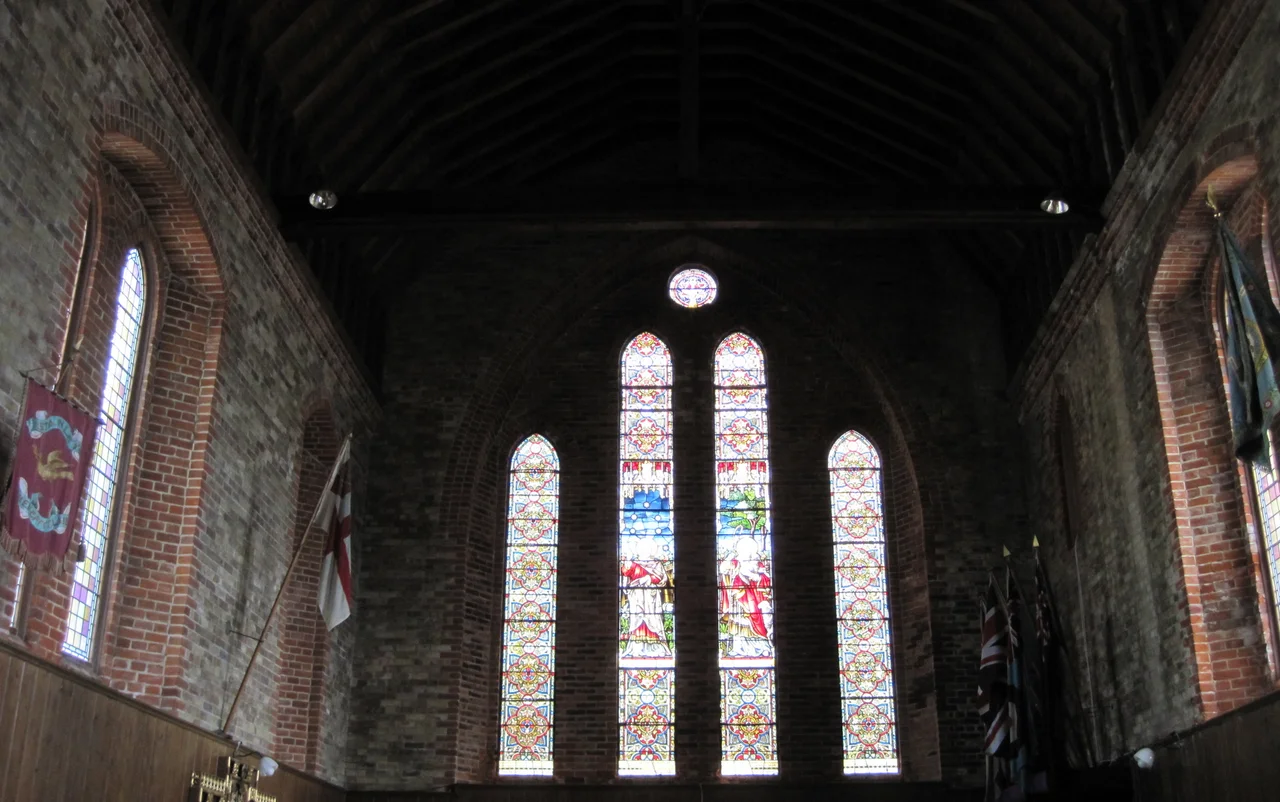

Christ Church Cathedral
Most cathedrals are remembered for their spires. This one is remembered for its bones. On the grass in front of Christ Church Cathedral in Stanley stands an arch made from the jaws of two blue whales - the largest animals ever to live - rising pale against the red-roofed church behind it. The whalebone arch has become the postcard image of the Falklands, the thing every visitor photographs first. But the modest building it frames carries its own quiet distinction: at nearly 52 degrees south, this is the southernmost Anglican cathedral on Earth, a parish that stretches from these wind-scoured islands all the way to the edge of Antarctica.
Built on a Landslide
The cathedral exists because its predecessor did not survive. In 1886 a peat slip - a slow, suffocating slide of waterlogged ground - tore through part of Stanley and destroyed Holy Trinity Church, which had stood on this spot. The Falklanders rebuilt, and on 21 February 1892 Bishop Waite Stirling consecrated the new Christ Church Cathedral on Ross Road. It is a homely thing by cathedral standards: brick and local stone, a squat tower holding a ring of five bells, stained glass spanning the nineteenth and twentieth centuries, and a two-manual pipe organ that travelled all the way from Ireland to reach the bottom of the world. The scale is human, not heavenly - a building meant for a few thousand islanders rather than a great city, and all the more affecting for it.
The Arch of Two Whales
The whalebone arch went up in 1933 to mark a hundred years of British rule in the Falklands. Its four great jawbones came from two blue whales, hauled south from the whaling stations of the sub-Antarctic and set on end to form a gateway taller than the people who pass beneath it. There is something fitting and something haunting in it at once: the Falklands and South Georgia were once a hub of an industry that hunted these animals to the brink of extinction, and the arch is a monument built quite literally from that history. Today blue whales are protected and slowly recovering, and the bleached arch stands as both a landmark and an unintended memorial - a reminder of just how vast the creatures of the Southern Ocean really are.
A Church That Remembers
Step inside and the cathedral turns into a chronicle of the South Atlantic. On the south wall hangs a White Ensign flown by HMS Achilles at the Battle of the River Plate in December 1939, when Royal Navy cruisers cornered the German raider Graf Spee off the coast of Uruguay. The cathedral also holds the Garter banner of Lord Shackleton, son of the great Antarctic explorer, which once hung in St George's Chapel at Windsor Castle. The calendar here is stitched from the islands' battles. Services mark Liberation Day on 14 June, the day the Falklands War ended in 1982; Battle Day on 8 December, recalling a naval clash fought in these waters in 1914; and Remembrance Sunday each November. For a town this small, the cathedral carries an outsized weight of memory.
From the Air
Christ Church Cathedral stands on Ross Road along the Stanley waterfront at 51.69 degrees south, 57.86 degrees west, facing the sheltered inner harbour. From the air the cathedral's tower and the bright metal roofs of Stanley are unmistakable against the treeless surrounding hills, with the whalebone arch on the grass directly in front. Recommended viewing altitude is 1,500 to 3,000 feet for a clear look at the town and harbour. Stanley Airport (ICAO SFAL, IATA PSY) lies just east on the Cape Pembroke peninsula, only a few nautical miles away; RAF Mount Pleasant (ICAO EGYP, IATA MPN) is about 25 nautical miles to the southwest. Conditions are typically windy with quick-moving cloud, though the harbour setting often gives good low-level visibility over the town.
Nearby Stories
- Volunteer Point 3.8 km away
- Argentine Military Cemetery 40 km away
- Sea Lion Island 67 km away
- Pebble Island raid 89 km away
- HMS Sheffield (D80) 118 km away
- Sinking of ARA General Belgrano 447 km away
- South Georgia Island 1404 km away
- Villa Gesell 1585 km away