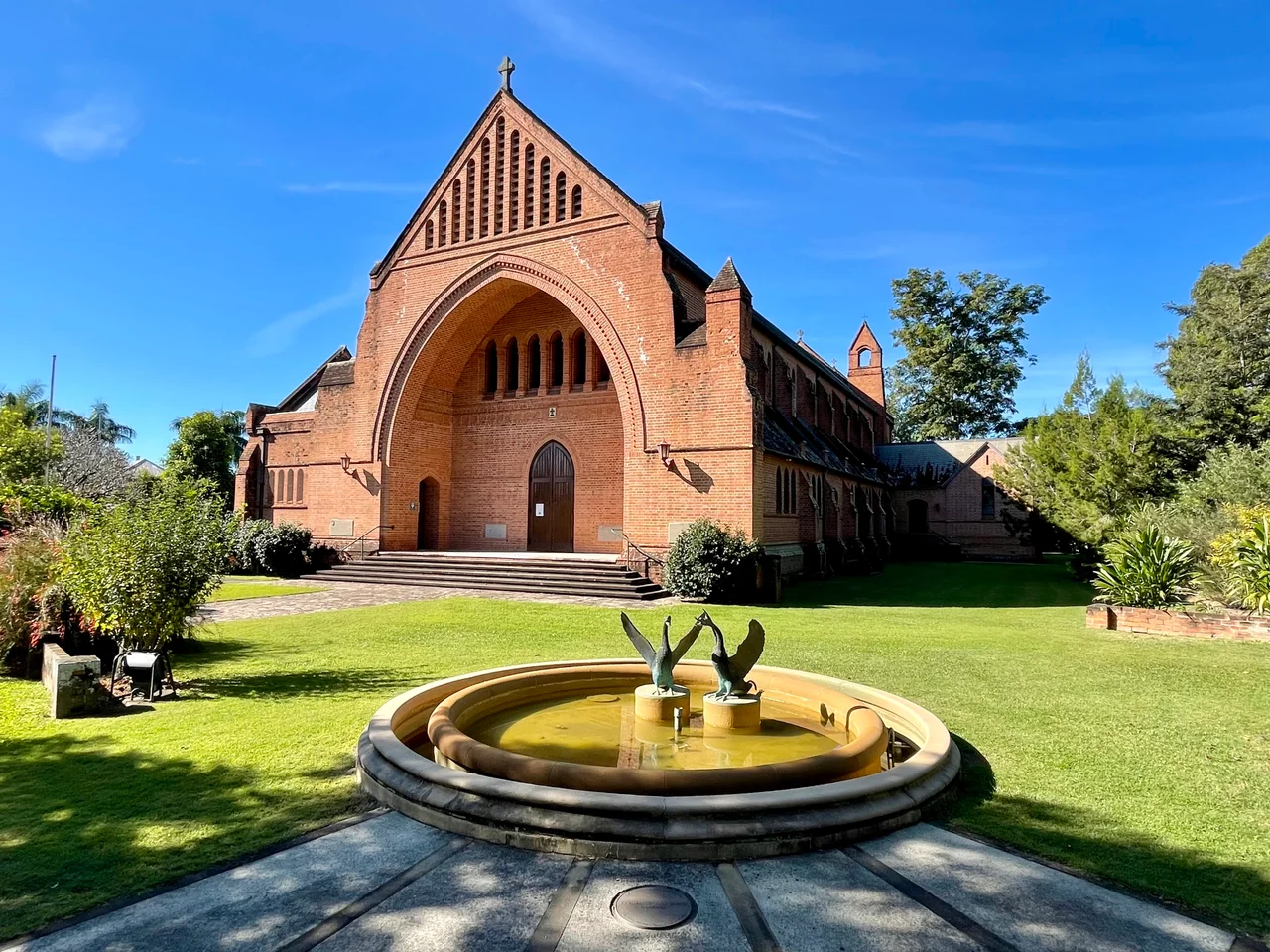

Christ Church Cathedral, Grafton
The bricks are the colour of the local clay - a soft salmon-pink, fired from the Clarence Valley earth and laid with such care that more than a century later architects still travel to Grafton just to study the bonding. Christ Church Cathedral does not soar; it broods, low and powerful, its great western archway opening onto Duke Street and the famous jacarandas beyond. This is the work of John Horbury Hunt, an architect who handled brick the way a sculptor handles clay, and it is widely regarded as his masterpiece in masonry.
The Architect and His Brick
When Bishop James Turner first sought a cathedral for Grafton, he commissioned designs from the firm Carpenter and Slater - then abandoned them and turned to John Horbury Hunt instead. It proved an inspired choice. Canadian-born and famously difficult, Hunt designed in the Gothic Revival idiom, but his genius was material: he built almost entirely in local brick, laid mainly in English bond and exploiting its colour, texture and the play of light across ornamental coursing. The result reads as a heavy, deliberate transition between the Early English and Decorated Gothic styles, all asymmetrical balance and structural honesty, culminating in that mighty western arch. Where many architects of the day would have reached for imported stone, Hunt made humble brick monumental. His original drawings even called for a spire, though it was never built - the cathedral's power comes not from height but from sheer, grounded mass.
A Building That Learned to Breathe
Hunt did something else here that mattered far beyond Grafton. Rather than filling certain openings with glass, he fitted them with adjustable and fixed wooden louvres - a deliberate attempt to let a large public building shed the punishing subtropical heat. It is held to be the first such effort in any public building in Australia: a cathedral designed not just to inspire but to stay cool, an early answer to the problem of European architecture transplanted to an Australian climate. The idea was so unusual that it remains one of the building's most-cited features.
Half a Cathedral, Then a Whole
Great churches are rarely built in one breath, and Christ Church was no exception. It was dedicated by Bishop Turner on 25 July 1884, but only part of Hunt's design then stood. The nave was not finished until 1937, when the final bays and the western porch at last completed the form Hunt had drawn decades earlier. The Diocese of Grafton itself came into being in 1914, splitting from the older Diocese of Grafton and Armidale. And it was not until 1959 - seventy-five years after that first dedication - that the cathedral was finally paid off and formally consecrated. Stone by stone, generation by generation, the town finished what it had started.
Living Heritage on Duke Street
Added to the New South Wales State Heritage Register in March 2003, the cathedral is a working church, not a museum piece. Its list of deans and rectors reads like a thread of local history, complete with the human strangeness that real history always carries. Among the early clergy was Charles Capel Greenway, son of the celebrated convict-architect Francis Greenway who shaped colonial Sydney. One nineteenth-century rector, Henry Stafford Needham, was famously horsewhipped in the street by the brother of a woman whose engagement he had broken off. Another, Willoughby Flower, went on to a Sydney parish and a tragic end. The line of clergy runs unbroken to the present, where Naomi Cooke was installed as dean in 2023. Today the cathedral still anchors Grafton's grand, wide streets, framed each spring by the purple haze of the jacarandas that made the city famous - a building that has watched the town grow up around it for nearly a century and a half.
From the Air
Christ Church Cathedral stands in central Grafton, near 29.69 degrees south, 152.93 degrees east, on Duke Street a short distance from the Clarence River. From the air, look for the long brick cathedral and its dominant western front set within Grafton's distinctive broad, tree-lined grid; in spring the surrounding jacarandas wash whole streets in purple, a striking visual marker. The Clarence River and Grafton Bridge lie just to the south, with Susan Island in the river. The nearest field is Grafton Airport (ICAO YGFN); Coffs Harbour Airport (ICAO YCFS) lies to the southeast. Best viewed at low altitude in clear conditions.
Nearby Stories
- Gibraltar Range National Park 26 km away
- Woolgoolga, New South Wales 27 km away
- History of New Italy, New South Wales 29 km away
- Guy Fawkes River National Park 31 km away
- Tenterfield School of Arts 64 km away
- Cape Byron Marine Park 75 km away
- Cape Byron Light 109 km away
- SS Elingamite: Gold, Fog, and a Captain Wrongly Blamed 1796 km away