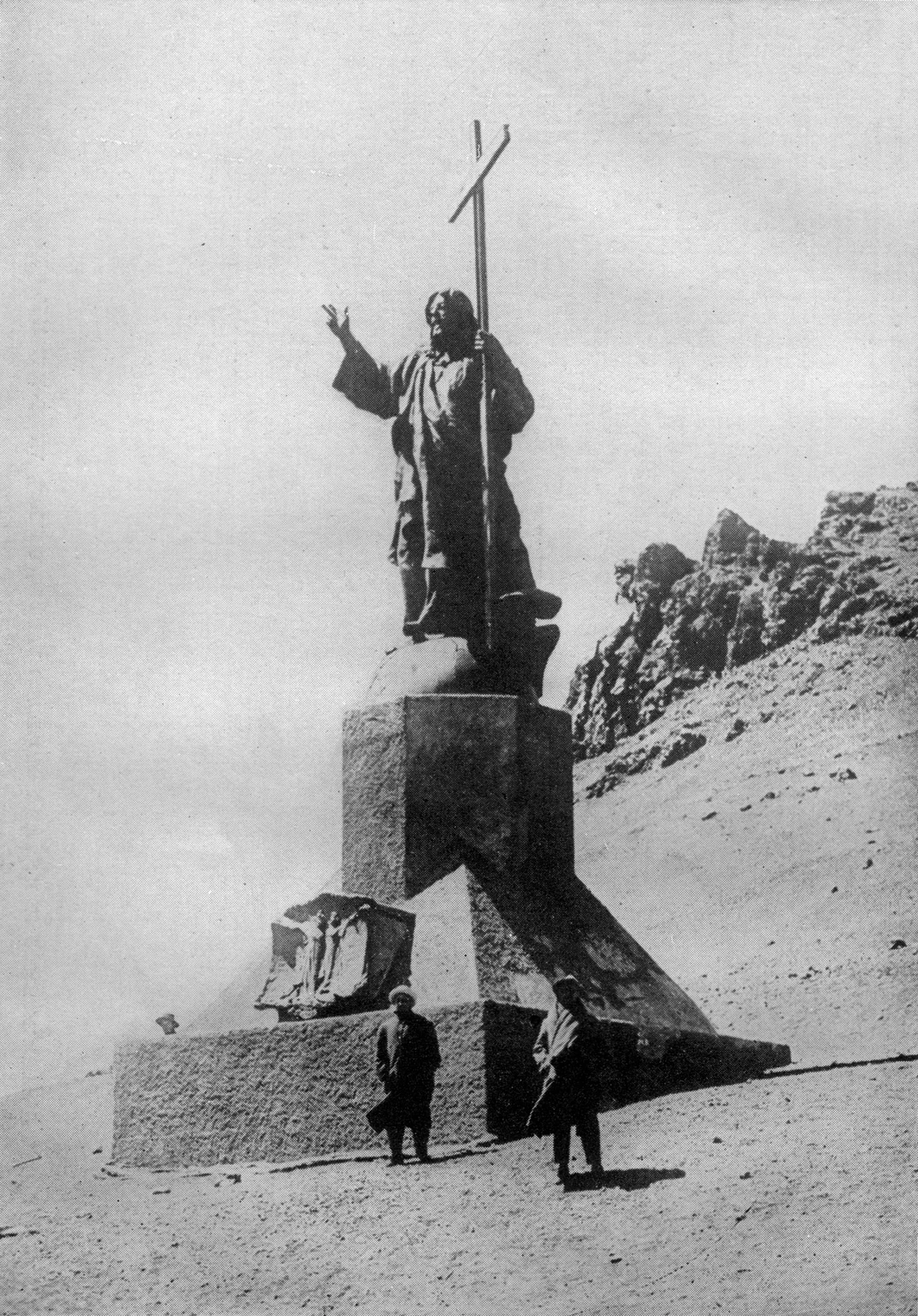

Christ the Redeemer of the Andes
In 1904, three thousand people climbed to a windswept pass nearly 3,832 meters up in the Andes to watch two armies fire their guns in salute - not at each other, but together, in celebration. Only a short time before, Argentina and Chile had been preparing to fight over their shared border. Now, on the exact line that divided them, they unveiled a seven-meter bronze figure of Christ, one hand raised in blessing, facing the frontier. They called it Christ the Redeemer of the Andes, and at its feet they swore an oath in iron and stone.
A Statue Looking for a Mountain
The bronze came first, and the peace came later. As the new century opened, Pope Leo XIII was calling for harmony among nations, and the bishop of Cuyo, Marcelino del Carmen Benavente, vowed to raise a statue of Christ the Redeemer to remind Argentina and Chile of a message of peace. The Buenos Aires sculptor Mateo Alonso cast the figure, and for a time it simply stood in a school patio in the capital. Then a well-connected woman named Angela Oliveira Cezar de Costa had an idea that would change its fate. Her own brother was an Argentine general preparing for war at the frontier. If peace came, she argued, the statue should be carried to the Andes and placed on the border as a symbol of unity. A friend of the Argentine president, she won the interest of both governments - and was later nominated for the Nobel Peace Prize.
Hauled to the Heights
A diplomatic breakthrough in 1902 pulled the two countries back from the edge. Now the statue had to reach its mountain. The bronze was moved some 1,200 kilometers by train, then broken into pieces and carried the final, brutal stretch up the cordillera by mule. The chosen site was a pass that José de San Martin had crossed in 1817 to liberate Chile from Spanish rule - a place already heavy with the memory of armies. A six-meter granite pedestal was finished in February 1904, and Alonso himself directed the reassembly of his figure on the roof of the continent, standing on a globe with South America turned outward, where both nations could see it.
Sooner Shall These Mountains Crumble
It is often said the statue was cast from melted-down cannons - old bronze guns from the wars of independence - though some historians doubt the detail. The promise carved at its base is not in doubt. In Spanish, it reads: 'Sooner shall these mountains crumble into dust than Argentines and Chileans break the peace they have sworn at the feet of Christ the Redeemer.' On 13 March 1904, foreign ministers, archbishops, and three thousand ordinary citizens stood together in brutal cold to hear it, while the two armies fired their joint salute. The promise has held for more than a century.
The Lonely Outpost of Peace
Up here the climate is merciless. Winters bury the pass in snow, temperatures drop toward minus thirty, and the original bronze cross had to be remade in 1916 after the weather destroyed it. The statue has needed rescue more than once, most seriously a major restoration by Mendoza Province in 1993. For most of the year the old road to the monument is closed entirely; through traffic now slips beneath it through the Cristo Redentor tunnel far below. But each summer the road reopens, and travelers still climb to stand beside the weathered Christ at the top of the world, where two countries once chose a blessing over a battle. In 2004, the presidents of both nations returned for the centenary to renew the vow.
From the Air
Christ the Redeemer of the Andes stands at approximately 32.83 degrees south, 70.07 degrees west, directly on the Argentina-Chile border at 3,832 meters in the Principal Cordillera, at the historic Uspallata / La Cumbre pass above the village of Las Cuevas. The monument is small against the immense terrain; the surrounding peaks dominate, including 6,961-meter Aconcagua, the highest mountain in the Americas, roughly 20 km to the north. Below the statue runs the modern Cristo Redentor road tunnel linking Chile Route 60 and Argentina Route 7. Nearest airports are Santiago's Arturo Merino Benitez (ICAO: SCEL) to the west and Mendoza's El Plumerillo / Governor Francisco Gabrielli (ICAO: SAME) to the east. Best viewed at lower altitude in clear summer conditions; expect snow, fierce winds, and rapid weather changes most of the year.
Nearby Stories
- Cerro El Plomo 22 km away
- Battle of Chacabuco 23 km away
- Uspallata 37 km away
- 1965 La Ligua earthquake 42 km away
- Museum of Memory and Human Rights 44 km away
- Bodega Catena Zapata 66 km away
- El Leoncito National Park 83 km away
- Battle of Papudo 123 km away