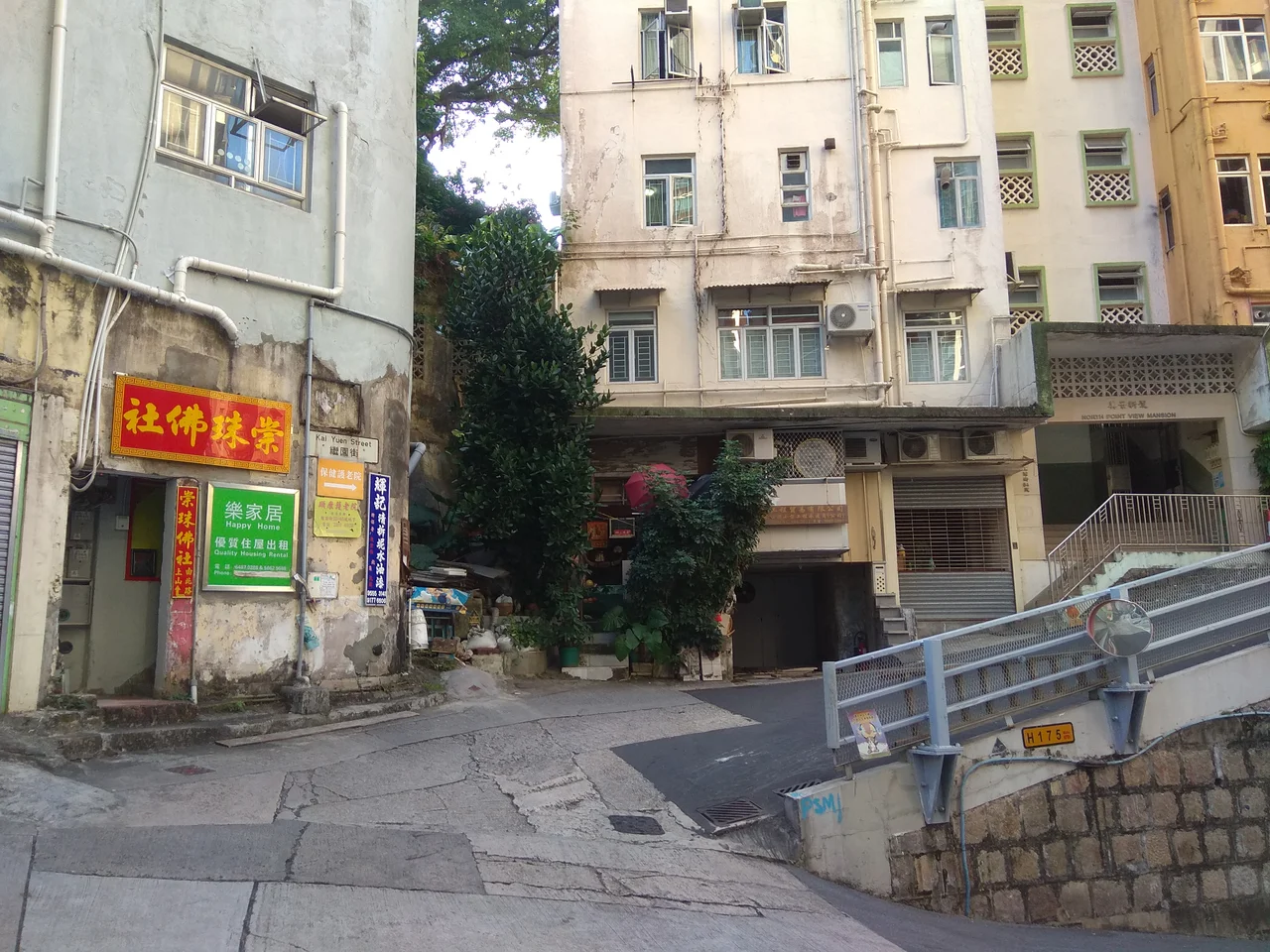

Chun Chu Temple
In the 1950s, when North Point was one of the most densely settled refugee neighbourhoods in Hong Kong, a group of Hakka and Hainan immigrants built a temple on Kai Yuen Street. They were new to the city, far from their ancestral homes on the mainland, and they built a place to practise. What they created was unusual: a temple that held Vajrayana Buddhism, Mahayana Buddhism, and Taoism together under one roof, a combination rare enough in Hong Kong that scholars still note it. Seventy years later, Chun Chu Temple stands as the last building in the Kai Yuen Hill area that connects to the neighbourhood's post-war origins — and everything around it has been demolished.
A Community Built From Elsewhere
Chun Chu Temple was constructed in 1955, founded by Lam Wing Fai (藍榮輝) and Li Yuk Yuen (李鈺圓) alongside other members of the Hakka and Hainan communities who had settled in North Point. North Point in the 1950s was a neighbourhood of arrivals — migrants from Fujian, Shanghainese refugees who had fled the civil war, Hakka and Hainan families building new lives in a British colonial city. The temple was affiliated in its early decades with Kai Yuen Mansion, a residential complex that served as a social anchor for the neighbourhood, and with the Chan Wai Chow family who occupied it. That family's connections were substantial: Chan Wai Chow was related to Chen Jitang, a senior general in the Nationalist Chinese army who served as governor of Guangdong province from 1929 to 1936. Another family member, Seaker S.K. Chan, held a doctorate from Columbia University and founded several schools in Hong Kong, including what is now Chan's Creative School.
Three Traditions, One Altar
The temple's doctrinal range sets it apart from most of Hong Kong's religious institutions. Vajrayana Buddhism — the Tibetan and tantric branch of the tradition — sits alongside Mahayana Buddhism, the broader East Asian school, and Taoism, the indigenous Chinese spiritual tradition. This combination was rare in Hong Kong in 1955 and remains rare today. The altar features the Three Buddhas. In the 1950s and 1960s the temple was an active fixture of the Kai Yuen community: it hosted lantern lighting ceremonies during the Lantern Festival, distributed free tea to residents during the hot months — at the busiest periods reportedly more than a thousand buckets of tea per day — and conducted fuji sessions, the Taoist practice of using a suspended tray and stick to write Chinese characters into sand or incense ash, allowing the kai fong (local residents) to seek guidance from the gods. Around 300 disciples are registered today.
The Demolition Decade
From 2010 onward, the Kai Yuen Hill area entered a long cycle of clearance. The tong laus — the shophouse-style tenement buildings that defined Hong Kong's mid-century urban fabric — came down one after another. In 2011, the buildings along upper and lower Kai Yuen Lane, including tong laus from the 1970s, were demolished for redevelopment. A decade later, in 2021, a row of tong laus at 60–74 Kai Yuen Street, built in 1957 to a design by architect Yam Koon Seng (任冠生) with a distinctive curved perimeter, was also razed. The tempo of loss accelerated as property values in North Point climbed and as the legal protections for post-war vernacular architecture remained limited. Scholar Fan Chi Wai has argued that Chun Chu Temple is now the only surviving structure in the entire Kai Yuen area with a direct historical link to Kai Yuen Mansion and the Chan Wai Chow family — making it, in his assessment, not simply a place of worship but an irreplaceable physical record of how the neighbourhood came to be.
What Remains
The temple at 1B Kai Yuen Street is a registered institution under Hong Kong's Chinese Temples Ordinance, which provides a degree of formal recognition but does not automatically guarantee preservation. Residents and heritage activists in North Point have raised concerns about its future as redevelopment pressure continues across the hill. The temple's significance is layered: it is a functioning place of worship with an active congregation, a building tied to the political and educational history of one of Hong Kong's influential mid-century families, a site where three religious traditions have been practised together for seven decades, and — increasingly — a sole survivor. The incense still burns at the altar. The question of how long the building will stand to hold it is one the neighbourhood has not yet answered.
From the Air
Chun Chu Temple is located in North Point on the northern shore of Hong Kong Island at approximately 22.289°N, 114.203°E. From the air at 2,000–3,000 ft approaching from the east along Victoria Harbour, North Point appears as the northeastern tip of Hong Kong Island — a dense residential and commercial district where the MTR's Island Line terminates. The Kai Yuen Street area sits slightly inland from the harbourfront. Hong Kong International Airport (VHHH) is approximately 28 nm to the west. The former Kai Tak Airport was approximately 2 nm to the north, across the harbour in Kowloon — its runway peninsula has been redeveloped but the outline remains visible from altitude.
Nearby Stories
- Lok Ma Chau Loop 2.3 km away
- Portas do Cerco 2.3 km away
- Kweilin Incident 17 km away
- Wanshan Archipelago Campaign 34 km away
- Nanxiong Formation 115 km away
- Battle of Nanpeng Island 148 km away
- Heyuan 169 km away
- Cape Maobitou 632 km away