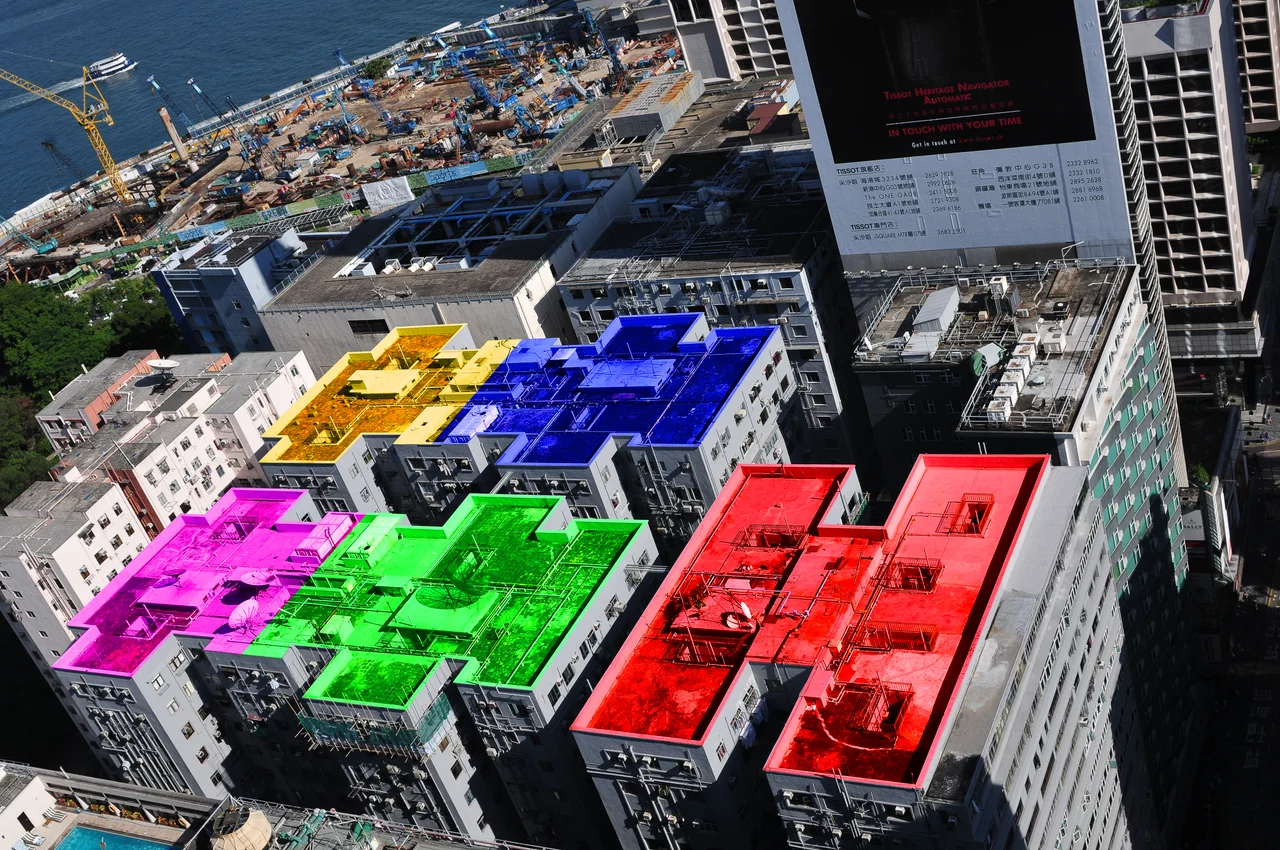

Chungking Mansions
Anthropologist Gordon Mathews spent years studying Chungking Mansions and eventually titled his book about it Ghetto at the Center of the World. The paradox is deliberate. Stand at the main entrance on Nathan Road — the Peninsula Hotel gleaming across the street, luxury boutiques lining the block — and then step inside. The smell shifts to cumin and cooking oil. Merchants call out in Urdu, Cantonese, French, and Amharic. Staircases funnel residents upward into narrow corridors lit by bare fluorescent tubes, where the television in one room might be tuned to Nigerian news while the next door plays Bollywood. Completed in 1961 by Jaime Tiampo, a Chinese-Filipino developer who named the building after Chongqing's wartime role as China's provisional capital, Chungking Mansions was never supposed to become what it became. It was meant to be residential. Instead, it evolved into something the city planners of 1961 could not have imagined: a self-organizing engine of low-cost global trade.
A World That Built Itself
Tiampo financed the construction by selling individual strata-title units off the plan, drawing buyers from overseas from the very beginning. That multicultural ownership structure set the tone for everything that followed. By the time the building aged past its first decade, the cheap rents that resulted from fragmented, absentee ownership had become a magnet for traders who could not afford the rates elsewhere on Nathan Road. South Asian merchants arrived first, establishing curry restaurants and textile stalls on the lower floors. West African traders followed, drawn by Hong Kong's position as a gateway for electronics and grey-market goods destined for Lagos, Accra, and Nairobi. Today the building holds over 110 guesthouses across its five blocks — A through E — providing roughly 1,200 rooms at prices ranging from under 100 HK dollars to 600 or 700. The guests share something with the traders: both are making their way in a city that was never built for them, using a building that suits that purpose perfectly.
The Traders at the Center
Mathews estimated that up to 20 percent of all mobile phones recently in use in sub-Saharan Africa had passed through Chungking Mansions at some point. That figure, striking when first published, makes more sense when you walk the floors. The ground-floor arcade teems with electronics stalls, money changers, and import-export offices. Deals are negotiated in fractured English, sealed with handshakes, and dispatched in shipping containers across two continents. The people doing this work are not curiosities or statistics. They are businesspeople — many of them running operations that have kept families fed and children in school for generations. Many traders from South Asia and West Africa built entire livelihoods here, cycling between Hong Kong and home, using Chungking Mansions as their operational base. Time magazine recognized this in 2007, naming the building the "Best Example of Globalization in Action" in its Best of Asia issue — a designation the residents received with some amusement, since they had always known what the building was.
Danger and Its Contexts
Chungking Mansions accumulated a genuine safety record over the decades. Outdated electrical wiring, blocked staircases, and overcrowding created real hazards. A fire on 21 February 1988 killed a Danish tourist who became trapped inside. The building received eight maintenance orders from the government between 1997 and 1998, and was subsequently renovated four times in the 2000s: granite tiles replaced the old rubber flooring in 2004, the elevators were refurbished in 2005, and the façade was repainted and fitted with LED lighting in 2010. Police raids over the years arrested people for immigration violations and other offenses, and those operations were sometimes described in press accounts with a luridness that flattened the complexity of the building's population. The people questioned in those raids were overwhelmingly workers and travelers trying to get by. They deserved, and mostly received, no more than administrative scrutiny. The gap between Chungking Mansions' reputation and its reality has always been wide — wider, perhaps, than anywhere else in Hong Kong.
Solidarity in the Square
In October 2019, during Hong Kong's sustained protest movement, something unexpected happened. Jeffrey Andrews — a social worker who runs the Christian Action Centre for Refugees in the building — organized residents, traders, and community members to bring water and food to protesters on the streets outside. South Asian and African residents of Chungking Mansions, who had often been viewed with suspicion by Hongkongers, showed up alongside them. The moment shifted something. Tours of the building, organized by ethnic minority residents who wanted to show the city what they had built here, began attracting local visitors who had never stepped inside despite living minutes away. The building has always been a gathering place. Now it was also, briefly and visibly, a place of belonging — not just for those who lived there, but for the city that surrounds it.
Screen and Page
Wong Kar-wai filmed much of Chungking Express here in 1994, and the building's sensory chaos — the crush of bodies, the overlapping languages, the dim corridors opening onto unexpected vistas — gave the film its texture. The Economist compared it to the Mos Eisley cantina from Star Wars in 2011, while quoting Mathews' corrective: "whereas the illegalities in Chungking Mansions are widely known, the wondrousness of the place is not." Michael Connelly's detective Harry Bosch, arriving here in the novel Nine Dragons, hears it described as a "post-modern Casablanca — all in one building." All three comparisons reach for the same quality: a place that exists outside the normal taxonomy of cities, where the rules are different and the population is drawn from everywhere. The comparisons are imperfect, as such comparisons always are. The people who live and work in Chungking Mansions are not characters in someone else's story. It is theirs.
From the Air
Chungking Mansions sits at 22.2964°N, 114.1728°E on Nathan Road in Tsim Sha Tsui, Kowloon — the densely packed southern tip of the Kowloon Peninsula. From the air at 3,000 feet, the building is identifiable as part of the Nathan Road corridor running north from the waterfront, flanked by the green rectangle of Kowloon Park to the west. Hong Kong International Airport (VHHH) is approximately 25 km to the northwest on Lantau Island. The building is visible on approach to VHHH from the east, as the flight path crosses over Kowloon's urban grid. The Star Ferry pier and the MTR Tsim Sha Tsui station are both within a few hundred meters, making this a central navigation reference in any low-altitude pass over Kowloon.
Nearby Stories
- Lok Ma Chau Loop 2.3 km away
- Portas do Cerco 2.3 km away
- Kweilin Incident 17 km away
- Wanshan Archipelago Campaign 34 km away
- Nanxiong Formation 115 km away
- Battle of Nanpeng Island 148 km away
- Heyuan 169 km away
- Cape Maobitou 632 km away