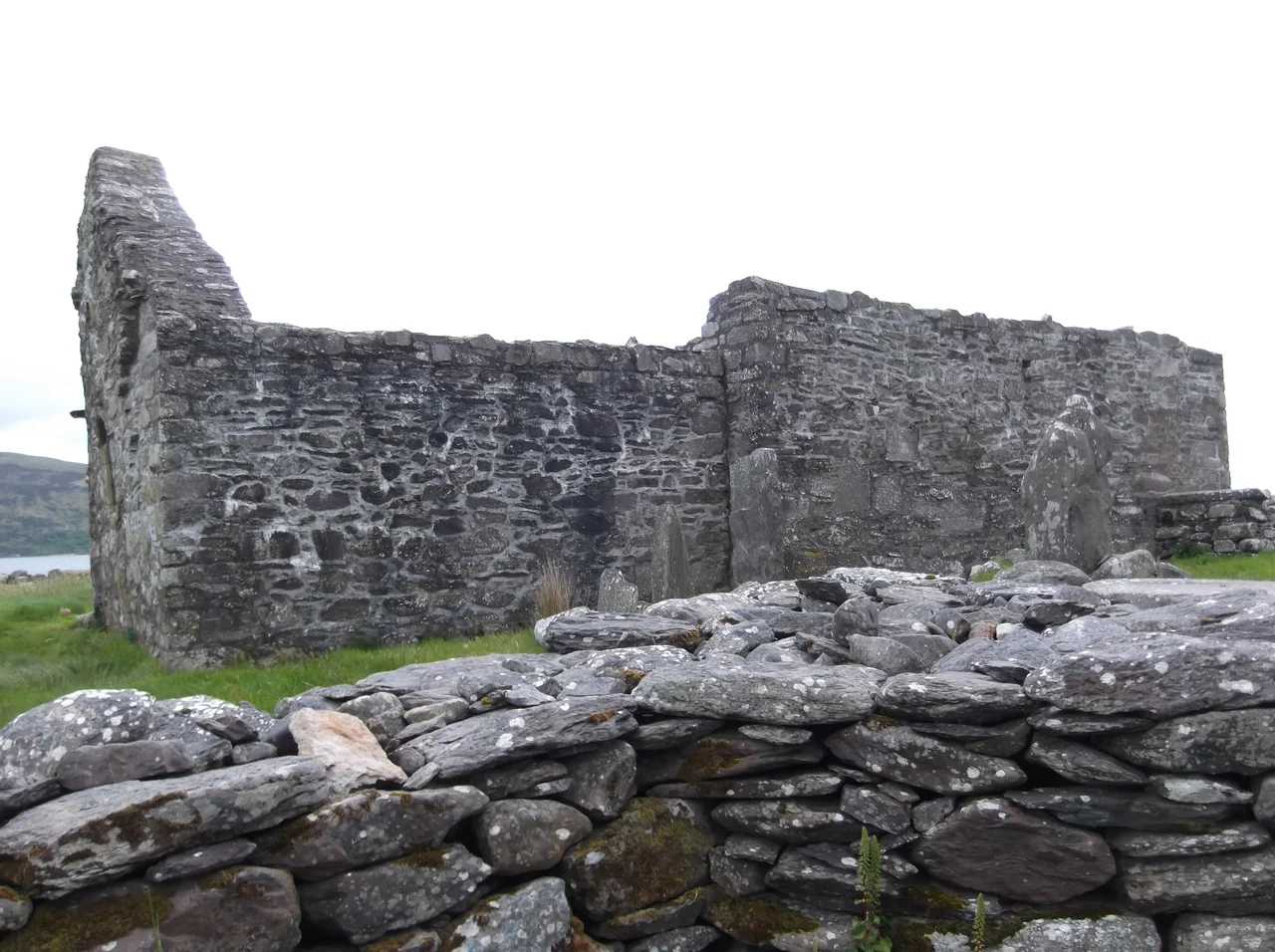

Church Island (Lough Currane)
On a sandstone slab on a small island in a lake in southwest Ireland, someone in the twelfth century carved a musician playing a bowed lyre. Nobody knows his name. Nobody knows the tune. What they do know is that the slab sits inside a roofless Romanesque church, on an island that locals once called Inis na bFer Naemh - Island of Holy Men - and that the saint buried somewhere beneath the cairns was reportedly important enough to give his name to Skellig Michael as well.
The Noble Island
Lough Currane stretches just inland from the Atlantic, a long, deep lake fringed with reeds and grazing land. About two and a half kilometres east of Waterville, near the lake's eastern end, a small island rises just above the surface - all of 1.8 hectares, a green hump barely tall enough to merit the name. The islet's older Irish name was Inis Uasal, the Noble Island. It is reachable today only by boat. In the seventh century, Saint Finan - in Irish Fionan Cam, Finan the Crooked - chose this remote, half-submerged place to establish a monastery. Wooden church, beehive cells, monks willing to row out into a freshwater lake to spend their lives in prayer. By the period between 800 and 1100 AD, Church Island had become an important ecclesiastical centre of the medieval kingdom of Corcu Duibne.
Stone, Saint, and Slab
Around the third quarter of the twelfth century, the wooden church was replaced by the small Romanesque stone church whose ruins still stand. Three arched windows survive, miraculously intact, facing toward the lake. Eleven cross-inscribed grave-slabs lie within the surrounding cemetery - the largest such group anywhere in County Kerry - many of them recumbent eleventh- and twelfth-century stones, likely commemorating clergy and their patrons. Two slabs carry inscriptions; one combines an Irish blessing for a monk named Anmchad with the Greek letters alpha and omega. Three leachta - low stone cairns sometimes used for outdoor liturgies or to mark burials - dot the cemetery. Saint Finan himself is believed to lie under one of them, though no one knows which. He is the same Finan credited with founding the monastery on Skellig Michael, the famous beehive-cell community that rises 218 metres straight out of the Atlantic twelve kilometres offshore.
The Musician on Sandstone
Inside the ruined church, set into the wall, is a rectangular block of sandstone bearing a twelfth-century relief: a small figure playing a bowed lyre, the bow held with the seriousness of someone who has practised. Bowed string instruments are rare in early medieval Irish iconography. The carving is one of the earliest surviving Irish depictions of one. It hints at a religious community where music was not incidental but cultivated - a stone whisper of the chants and praise-songs that must once have rolled out of the church and over the lake. Bells from the Early Christian era, and a bronze staff, were once recovered from the area. They have since been lost. The musician, mute, remains.
Still There, Still Watched
Today Church Island is a National Monument in state care. It is not open in any formal sense: there is no jetty, no signage, no ticket. Local fishermen and the occasional curious visitor ferry across when the weather and water allow. From the surrounding road and from the village of Waterville, the island registers only as a low green pile in the middle of the lake. You would never guess it was once the earliest known church of a Kerry kingdom, founded by a saint who would also stamp his name on the most famous monastic island in Ireland. It is a place that rewards slowing down - a small lake, a small island, a small church, a small stone musician, all of them holding their meaning lightly. Eleven hundred years is a long time to keep your bearings.
From the Air
Church Island lies at 51.8352 deg N, 10.1305 deg W in Lough Currane, 2.8 km east of Waterville on the Iveragh Peninsula. From 1500-3000 feet AGL on a clear day the island is a small dark-green spot near the lake's eastern shore; the lake itself is a long, deep blue ribbon parallel to the coast. Nearest airport is Kerry (EIKY), 65 km north-east. Coastal weather changes quickly; lake-effect mist can form on still mornings.
Nearby Stories
- Farranfore–Valentia Harbour line 3.3 km away
- Heir Island 4.1 km away
- Inishvickillane 4.4 km away
- Kealkill stone circle 8.7 km away
- Headford Ambush 10 km away
- Dunlough Castle 13 km away
- SM U-68 27 km away
- Sao Miguel 1923 km away