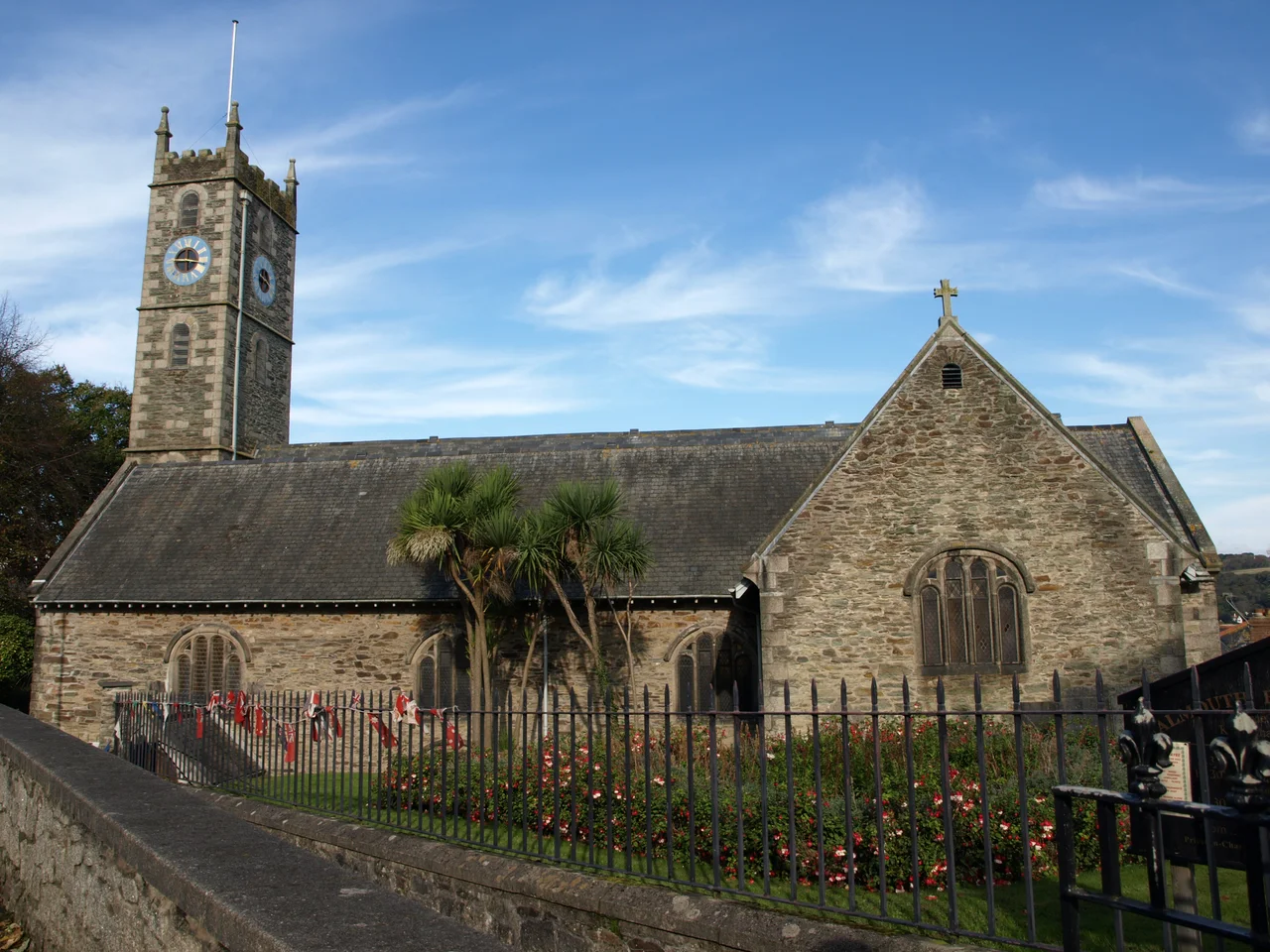

Church of King Charles the Martyr, Falmouth
Of all the things you could name a brand-new English church in 1664, you probably wouldn't pick the man whose execution had ended the English Civil War fifteen years earlier. Unless you were Sir Peter Killigrew, in which case naming your church after Charles I was less an act of piety than a piece of immaculate political theatre. Charles I had been beheaded in 1649. His son Charles II had just been restored to the throne in 1660. Killigrew wanted a royal charter for the brand-new town of Falmouth, and dedicating a parish church to 'King Charles the Martyr' was as good a way as any of asking the king to remember a Cornish loyalist in his prayers.
A Town Named for a King
Sir Peter Killigrew was the heir to Arwenack Manor, just along the shore from where the church now stands. The Killigrews had spent the Civil War on the losing side, and Pendennis Castle a mile away had been one of the last Royalist fortresses to surrender in 1646. When the king came back, the Killigrews wanted Falmouth, then a scatter of houses around the Carrick Roads anchorage, raised to a chartered town. Killigrew sent an emissary to London in 1660 asking for a royal grant. He offered land for a church, a parsonage and a churchyard if the king would sponsor the project. He laid the church's foundations on 29 August 1662, dedicated it to the king's martyred father, and waited. The flattery worked. Charles II and his brother the Duke of York contributed generously to the building, and Falmouth got its charter.
Consecration and First Sermon
John Bedford, then Rector of Gerrans on the Roseland Peninsula across the estuary, preached the first sermon at the new church on 21 February 1664. Eighteen months later, on 22 August 1665, it was consecrated. Bedford's son Francis was appointed the first rector by Seth Ward, Bishop of Exeter. The original building was a simple square, about 66 feet on each side, and Falmouth's earliest residents paid for its upkeep through a parish rate. Many of them resented it. The town in the late 17th century had a large Nonconformist population, mostly Quakers and Methodists, who saw no reason to fund an Anglican parish church. Later rectors, the records observe drily, were 'glad to make arrangements for its final extinction.'
More Alterations Than Any Other
One historian remarked that Falmouth Parish Church has probably undergone more alterations and additions than any other church in the United Kingdom. In 1684 the chancel was added at the east end. In 1686 a gallery went up at the west end. North aisle gallery in 1699, south aisle gallery in 1702. The first organ arrived that same year, built by John Russell of London for £200. In 1738 the tower was raised to take a 12-hundredweight bell. By 1813 the town had grown so much that the 1684 chancel was demolished and the whole church lengthened by a third. In 1896 the pitched roofs and the galleries were ripped out and the walls raised for three new barrel-vaulted ceilings with ornamental plasterwork. Electric lighting in 1907. New organ chamber in 1915. Baptistery in 1936. The historian Charles Henderson, surveying it all in 1925, described the building as 'interesting for its curious mixture of the Gothic and Classical styles' and remarked that a Wren steeple 'would have been far more suitable to the situation.'
The Organ Wars
The church's organ history reads like a small comedy of musical taste. The first instrument, installed in 1703, was not met with universal acclaim. A local lampoonist wrote of organist Ned Kendall's playing: 'Their bass and their treble, comparatively speaking, are like old pigs grunting and little pigs squeaking.' After 95 years of minimal maintenance, that organ was sold and replaced by a new one in 1798. That one lasted to 1881, when Hele and Co. of Plymouth built a three-manual replacement, which was tinkered with steadily for the next century: Posaune stops added in 1910, Vox Humana and Tubular Pneumatic action in 1914, the whole thing rebuilt in 1979 and again in 1993 by Lance Foy of Truro. The current instrument is the largest organ in Cornwall, having six more stops than the Father Willis at Truro Cathedral. It sits where the old galleries once stood, and on a quiet Sunday it can fill the church with a sound that would have astonished Sir Peter Killigrew.
The Politics of Names
Three centuries after the dedication, the name still carries a curious charge. To call Charles I a martyr is to take a position. He was executed by his own Parliament after losing a civil war he had largely started. To his enemies he was a tyrant who got what he deserved. To his supporters, and to the Church of England that still includes him in its calendar, he was a king who died defending the divine right of monarchy and the integrity of the Anglican church. The church on Church Street, Falmouth, picks a side. It picks the side of the Killigrews, of Pendennis Castle, of the Royalist Cornwall that gave shelter to the future Charles II before he fled into exile. The building itself, much altered, still stands at the centre of Falmouth, around the corner from the harbour where the Killigrews launched a town and a project that, somehow, never quite stopped being political.
From the Air
The church sits in the heart of central Falmouth at 50.153°N, 5.068°W, on Church Street a few hundred yards back from the harbour front. From the air at 2,000 feet AGL it appears as a long rectangular structure with a square west tower, set among the tight grid of streets between Arwenack Street and The Moor. Pendennis Castle is one nautical mile east on the headland; the National Maritime Museum Cornwall is half a mile southeast on the docks. Newquay Cornwall Airport (EGHQ) is 19 nm north-northeast; Land's End (EGHC) is 23 nm west. Carrick Roads, the harbour, is among the deepest natural anchorages in Europe and is unmistakable from cruising altitude as a great inland bay of dark water dotted with moored ships.
Nearby Stories
- Morvah 2.9 km away
- Carnewas and Bedruthan Steps 6.1 km away
- Liskeard 7.5 km away
- Battle off Lizard Point 14 km away
- Polperro 17 km away
- MV Cita 47 km away
- HMS Affray 86 km away
- 1979 Fastnet Race 96 km away