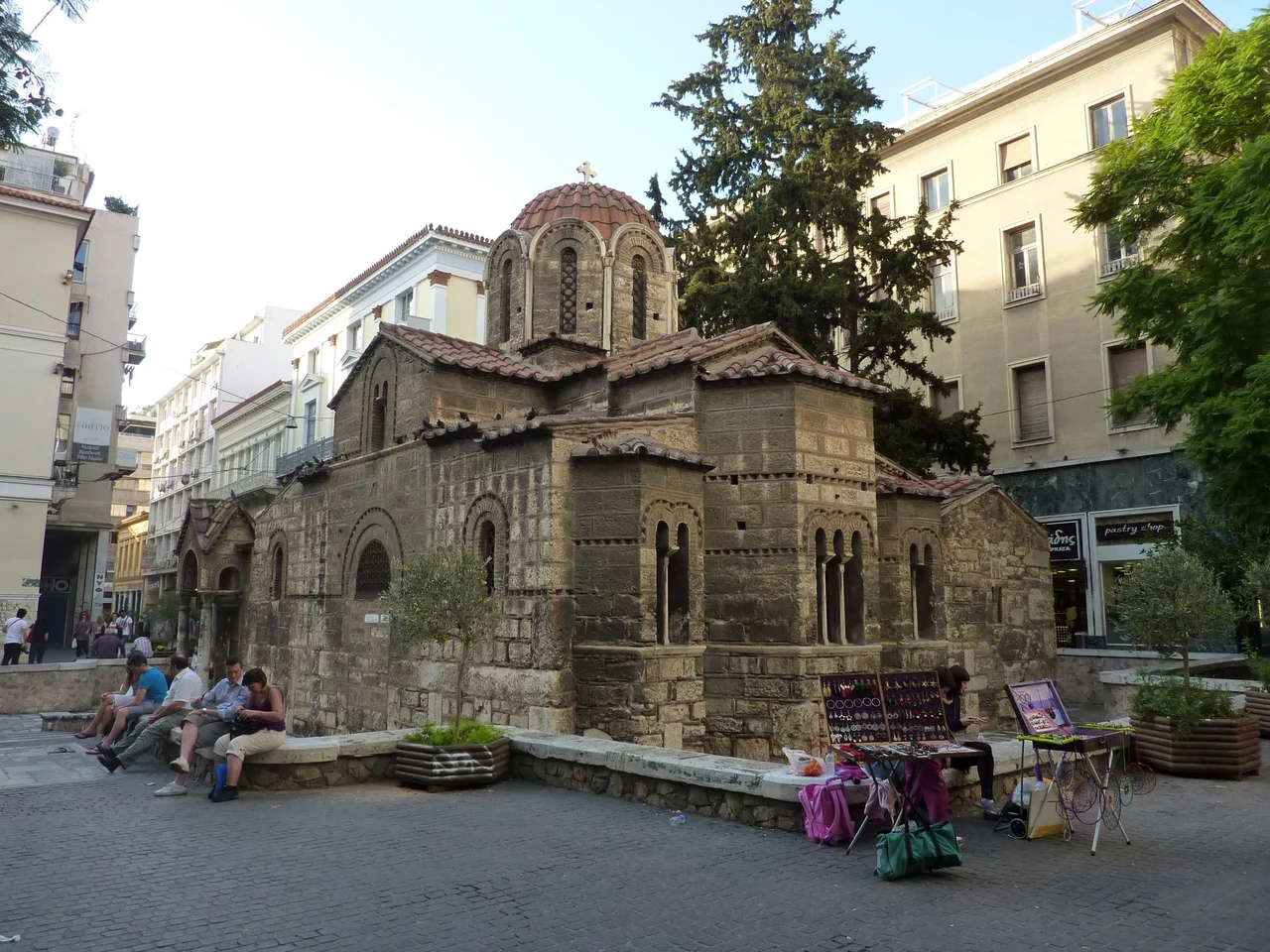

Church of Panagia Kapnikarea
Ermou Street is where modern Athens comes to shop, a pedestrian river of storefronts, sale signs, and hurrying crowds. And then, partway down, the river splits. The traffic of shoppers parts around a small, ancient stone church that sits squarely in the middle of the street, its weathered dome and tiled roofs roughly a thousand years older than anything around it. This is Panagia Kapnikarea, and the fact that you can still walk into it is the result of one stubborn objection.
Older Than the City Around It
Kapnikarea is one of the oldest churches in continuous use in Athens. It was built in the eleventh century, most likely around 1050, in the cross-in-square form that defines Middle Byzantine architecture: a compact, domed core where the arms of a cross meet beneath a central cupola. Like many early Christian churches, it rose on older sacred ground, raised over the site of an ancient Greek temple that may have honored Athena or Demeter. The building may originally have served as the katholikon, the main church, of a monastery, and it grew over time into a complex of three joined parts: the larger south church dedicated to the Presentation of Mary, a chapel of St Barbara on the north side, and a western porch added later still.
The King Who Said No
By the 1830s, Athens was being reinvented. The newly independent Kingdom of Greece had crowned a young Bavarian prince, Otto, as its first king, and his planners set about imposing a modern grid on the ancient town. The architect Leo von Klenze drew up a new city plan, and when the surveyors laid out Ermou Street, Kapnikarea stood directly in its path. The order came down to demolish it. The church was saved from an unexpected quarter: Ludwig I, King of Bavaria and Otto's father, objected to the destruction. His intervention spared the building, and the new street was routed around it rather than through it. That is why, to this day, the church sits on what amounts to a stone island in the flow of commerce.
A Quiet Interior Amid the Noise
Step through the door and the shopping street falls away. Inside, the small domed space gathers a hush that feels impossible given what waits outside. Above the south portico, a mosaic shows the Panagia, the Virgin, with the infant Christ, glinting in the dim light. Generations of Athenians have ducked in here to light a candle between errands, the same way their ancestors did when this church was new and the surrounding city was a fraction of its present size. The contrast is the whole experience: a building made for eternity, standing fast in a place built for the rush of the moment.
A Survivor's Place in Plaka
Kapnikarea anchors the upper edge of Plaka, the old neighborhood that climbs toward the Acropolis. To find a Byzantine church here at all is a reminder of how many layers Athens has shed and kept. The classical city is famous, the modern one inescapable, but the centuries between them, the long Byzantine middle age, are easy to overlook. This little church, named for reasons now lost to history, is one of the clearest survivors of that vanished Athens. It outlasted the empire that built it, the Ottoman centuries that followed, and the bulldozers of a brand-new nation eager to look forward.
From the Air
Panagia Kapnikarea stands in the middle of Ermou Street in central Athens, at the edge of the Plaka district, at 37.9764 N, 23.7286 E, roughly 500 meters north of the Acropolis. The dense historic core and the Acropolis hill just to the south are the key visual references from the air. Nearest major airport: Athens International (LGAV), about 30 km east-southeast. Expect controlled airspace over the city center.
Nearby Stories
- Great Sand Beach 5 km away
- Battle of Delium 7.7 km away
- Tower of Aliartos 9 km away
- HMHS Britannic 10 km away
- Saronic Gulf 15 km away
- Sousaki Volcano 17 km away
- Sanctuary of Apollo Maleatas 24 km away
- Skyros 66 km away