.jpg)
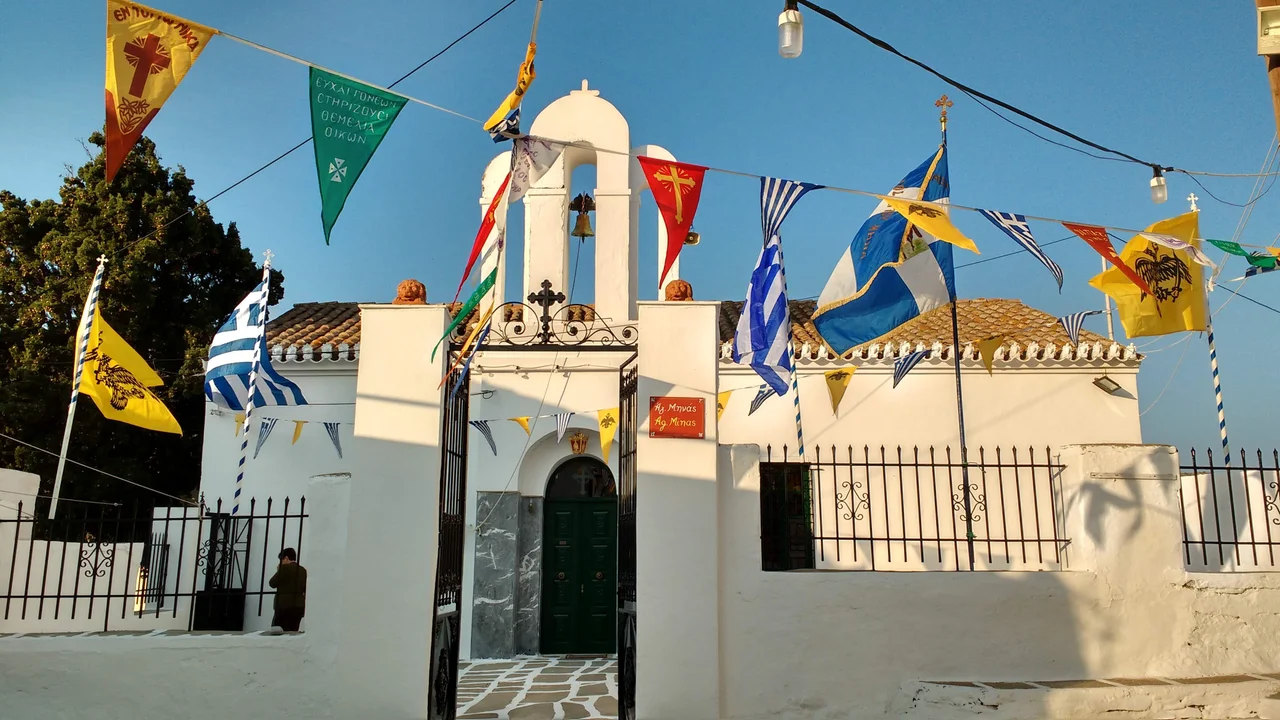
Church of Saint Minas
There is a small puzzle at the heart of the Church of Saint Minas in Dryopida. The carved wooden altarpiece inside — dense with ornament, darkened by generations of candle smoke — is too elaborate, too large, and too old to have been made for this particular church. Scholars believe it was transferred here from another, smaller church that no longer exists, saved from oblivion by being moved to more permanent shelter. The altarpiece found a new home. So did its mystery.
A Church in the Neighborhood of Galatas
Saint Minas sits in the Galatas quarter of Dryopida, the older of Kythnos's two main villages. Dryopida is an unusual place by Cycladic standards: where most island villages run to flat-roofed whitewash, Dryopida's rooftops are pitched and tiled, giving the hillside settlement a look closer to mainland mountain towns than to the Aegean norm. The church fits its setting — modest on the outside, a single-aisled structure with a two-pitched, tile-covered roof, the kind of building that announces itself quietly rather than with drama. What it holds inside is another matter. The wooden altarpiece — the carved screen that separates the nave from the sanctuary — is an object of real artisanal ambition. The central section is old, intricate, and of confident Byzantine craftsmanship; newer additions fill the extremities, probably added when the piece was adapted to its current setting. Despite those later modifications, the whole remains in good condition, a minor miracle given the age of its oldest sections.
The Feast of November 11
Every year on November 11, the Church of Saint Minas holds its principal celebration — the feast day of Saint Menas of Egypt, the martyr to whom the church is dedicated. Menas was an Egyptian soldier who, according to Orthodox tradition, converted to Christianity, abandoned the Roman army, and was executed for his faith around 296 CE. His cult spread across the eastern Mediterranean during the Byzantine centuries, and churches dedicated to him appear throughout Greece, Cyprus, and Egypt. On Kythnos, the feast brings the community together in the way island saints' days always have: liturgy in the morning, followed by the kind of traditional outdoor festival that carries food, music, and conversation into the afternoon and evening. The church also preserves an ornate epitaphios — the embroidered funeral shroud used during Holy Week — and a despotic throne, both of which speak to the liturgical seriousness with which this small community has maintained its religious practice across the centuries.
Protected, Precisely Because It Almost Wasn't
In 1987 the Greek Ministry of Culture formally classified the Church of Saint Minas as a protected monument of the Byzantine and post-Byzantine period. The designation matters here in a particular way. This is not a grand cathedral or a famous pilgrimage site; it is a neighborhood church in a village of a few hundred people. The classification reflects a recognition that the ordinary fabric of Greek religious life — these small, local, quietly maintained spaces — is as worth protecting as the monumental. The altarpiece especially, with its transplanted history and its mix of old and new carving, documents something the ministry evidently judged irreplaceable: a material record of how communities on small Aegean islands have kept their traditions alive, adapting what they inherited to circumstances as they changed.
What the Wood Remembers
A doctoral thesis submitted to the Aristotle University of Thessaloniki in 2020 examined the role of wood in the cultural heritage of the Cyclades Islands, and Saint Minas's altarpiece is among the works it considers. That kind of scholarly attention — a university thesis on island woodcarving — might seem disproportionate to the scale of the object. But wood is fragile in the Aegean: salt air, humidity, insects, fire, and the sheer weight of time all work against it. The survival of fine carved woodwork from the Byzantine period in this region is not common. The altarpiece at Saint Minas, carried from an unknown smaller church to this one, and maintained across centuries in a community that clearly valued it, is rarer than it looks. The wood remembers things the written record does not.
From the Air
The Church of Saint Minas is located in Dryopida on the island of Kythnos, at approximately 37.385°N, 24.432°E. Kythnos sits in the western Cyclades between Kea and Serifos in the Aegean Sea, roughly 56 nautical miles southeast of Piraeus. From the air at 5,000–8,000 feet, the island's hilly, sparsely vegetated terrain is clearly visible, with Dryopida's distinctive tiled rooftops distinguishing it from the flat-roofed settlements typical of the Cyclades. The nearest major airport is LGAV (Athens International Eleftherios Venizelos), approximately 70 km to the northwest. Kythnos has no airport; the island is reached by ferry from Lavrio or Piraeus, with crossings taking one to four hours.
Nearby Stories
- MS Express Samina 12 km away
- Hellenic Centre for Marine Research 13 km away
- HMHS Britannic 16 km away
- Greek Cruiser Elli (1912) 26 km away
- Sifnos 29 km away
- Hydra: Fire Ships and Stone Mansions 38 km away
- Greek Islands 43 km away
- SS Slamat 66 km away