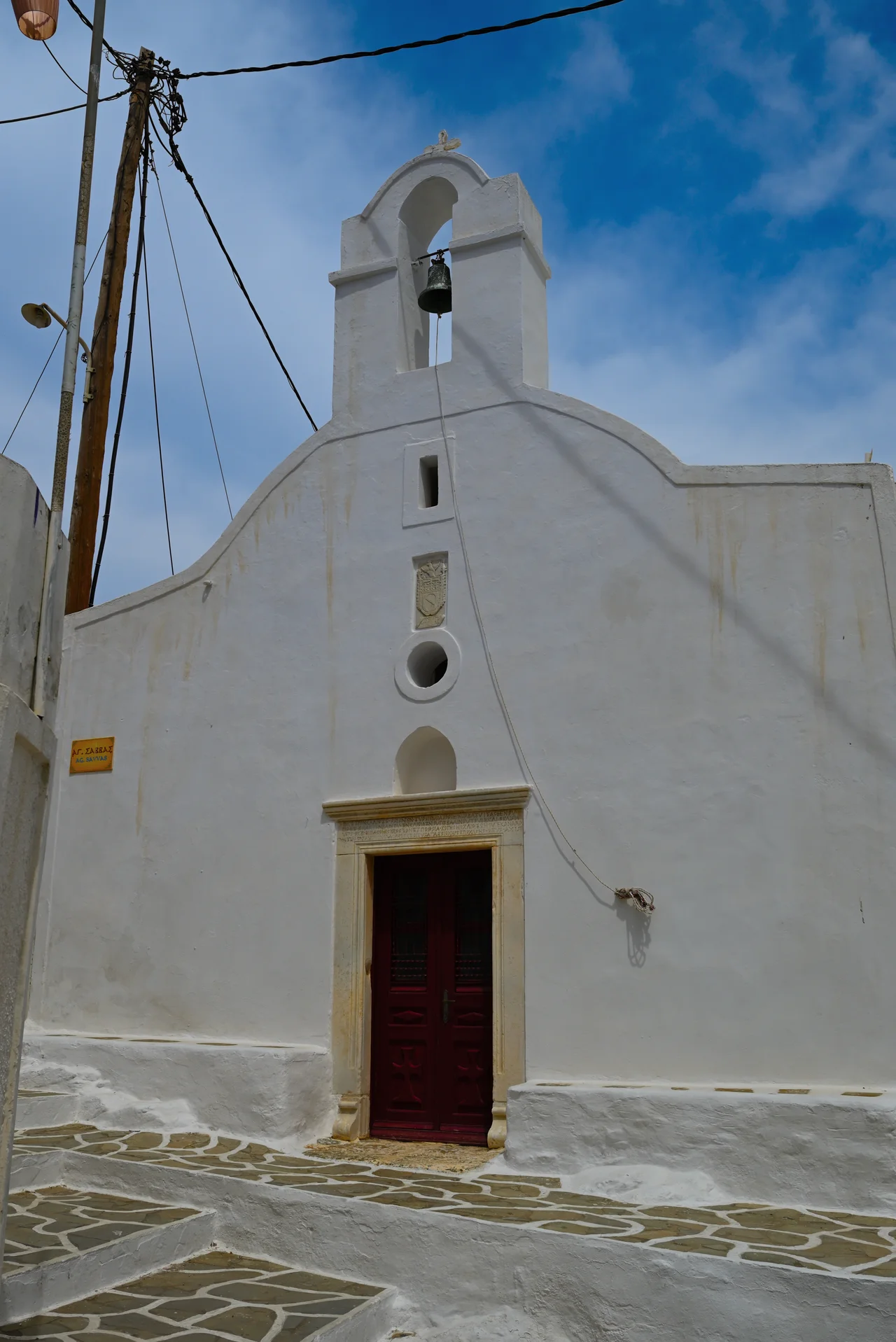

Church of Saint Savvas, Kythnos
Above the door of the Church of Saint Savvas in Chora, cut into the stone facade, is the coat of arms of the Gozzadini — a Venetian noble family that ruled Kythnos for much of the medieval period. The inscription is dated 1613. This is an unusual thing to find on an Orthodox church: a Catholic family's heraldic emblem, built into a structure dedicated to an Eastern saint. But on Kythnos, which changed hands between Byzantine, Frankish, Venetian, and Ottoman rulers across the centuries, such layering is simply how history leaves its marks.
Antonios Gozzadinos and His Commission
The church was built at the personal expense of Antonios Gozzadinos, a member of the Venetian Gozzadini dynasty that held lordship over Kythnos during the later medieval period. The family's grip on the island was ending: the Ottomans would defeat the last Venetian overlord, Angelo III Gozzadini, just four years after the inscription was carved, in 1617. Whether Antonios was making a statement of piety, of loyalty, or of cultural belonging — commissioning an Orthodox church despite his family's Catholic roots — is not fully known. What remains is the date, the coat of arms, and the church itself, a single-aisled, vaulted structure that has endured four centuries in the whitewashed lanes of Chora.
The Altarpiece, Made for This Church
Inside Saint Savvas, the carved wooden altarpiece is exceptional not only for its quality but for its origin: unlike the moved-and-repurposed altarpiece at the nearby Church of Saint Minas in Dryopida, the one at Saint Savvas appears to have been made specifically for this building, probably around 1640 — about a generation after the church itself was constructed. That specificity shows. The proportions fit. The carving suits the vault and the light. Where many island churches assembled their ritual furnishings from what was available, this one was given something made to measure, an indication of the seriousness — and probably the resources — of its early patrons. The altarpiece is well-preserved, its dense Byzantine ornamentation intact despite the intervening centuries of island life.
Saint Savvas the Sanctified
The church is dedicated to Sabbas the Sanctified, known in Greek as Agios Savvas — a Cappadocian-born monk of the 5th and 6th centuries who settled in the Judean Desert, founded the famous Mar Saba monastery there, still active today, and helped shape the liturgical practices of the Eastern Orthodox Church. His feast day falls on December 5, and in Chora each year that date is marked with a local celebration — the kind of panegyri that animates Aegean island life, gathering families and neighbors around a common ritual inherited from generations past. On a small island, these annual feasts are not marginal events; they are moments when a community reaffirms its own continuity.
A Monument in a Village of Monuments
In 1987, the Greek Ministry of Culture classified Saint Savvas as a historical monument of the Byzantine and post-Byzantine period — the same designation given to Saint Minas across the island in Dryopida. The fact that Kythnos, with a permanent population measured in the low thousands, has multiple churches warranting formal state protection is not coincidental. The island's deep religious culture — expressed in over a hundred churches and chapels scattered across its landscape — has been documented since at least the 19th century. Chora, the island's capital with its flat-roofed Cycladic architecture, is dense with them. Saint Savvas is among the oldest and best documented, its 1613 façade inscription serving as an unusually precise timestamp for a building that might otherwise be dated only by style.
From the Air
The Church of Saint Savvas is located in Chora, the capital of Kythnos, at approximately 37.412°N, 24.429°E — on the northern part of the island, a few kilometers from the port of Merichas on the west coast. Kythnos lies in the western Cyclades at about 37.4°N, 24.4°E, roughly 56 nautical miles from Piraeus. From altitude, Chora is visible as a cluster of flat-roofed white buildings on a gentle hill. The nearest major airport is LGAV (Athens International Eleftherios Venizelos), approximately 70 km northwest. Ferries connect Kythnos to Lavrio and Piraeus, with crossings taking one to four hours depending on vessel speed and sea conditions.
Nearby Stories
- MS Express Samina 12 km away
- Hellenic Centre for Marine Research 13 km away
- HMHS Britannic 16 km away
- Greek Cruiser Elli (1912) 26 km away
- Sifnos 29 km away
- Hydra: Fire Ships and Stone Mansions 38 km away
- Greek Islands 43 km away
- SS Slamat 66 km away