
Church of St Fimbarrus, Fowey
On a July day in 1899, Kenneth Grahame stood at the altar of this church and married Elspeth Thompson. Nine years later he would publish The Wind in the Willows, the book that would outlast nearly everything else he wrote. The church he chose was already six centuries old, rededicated in 1336 after Norman foundations gave way to the early Gothic building we see today. From its tower the harbour of Fowey spreads out below, a place where ships have come and gone since before the Conquest, and where the church has marked weddings and funerals through fire, French raids, and the slower kinds of change that take centuries to play out.
Stone, Fire, and the Earl of Warwick
The church is dedicated to Saint Finbarr, the sixth-century Irish bishop of Cork, an unusual dedication that hints at the old sea routes between southern Ireland and Cornwall. It replaced a Norman building, rededicated in its early Gothic form in 1336. In 1457 the French raided Fowey and damaged the church; in 1460 the Earl of Warwick paid for repairs, when the clerestory and the unusually wide north and south aisles were rebuilt. The sixteenth-century tower rises in four stages, banded with ornament and supported by buttresses. Inside, the wagon roof is one of the finest fifteenth-century examples in Cornwall, the timber barrel-vaulted ceiling typical of churches in this granite county where stone vaults were too heavy and timber was lighter to ship in. The font is Norman, carved from Catacleuze stone, identical in pattern to those at Ladock, Feock and St Mewan: a regional workshop's output, scattered across half the duchy.
Town Hall and Tomb
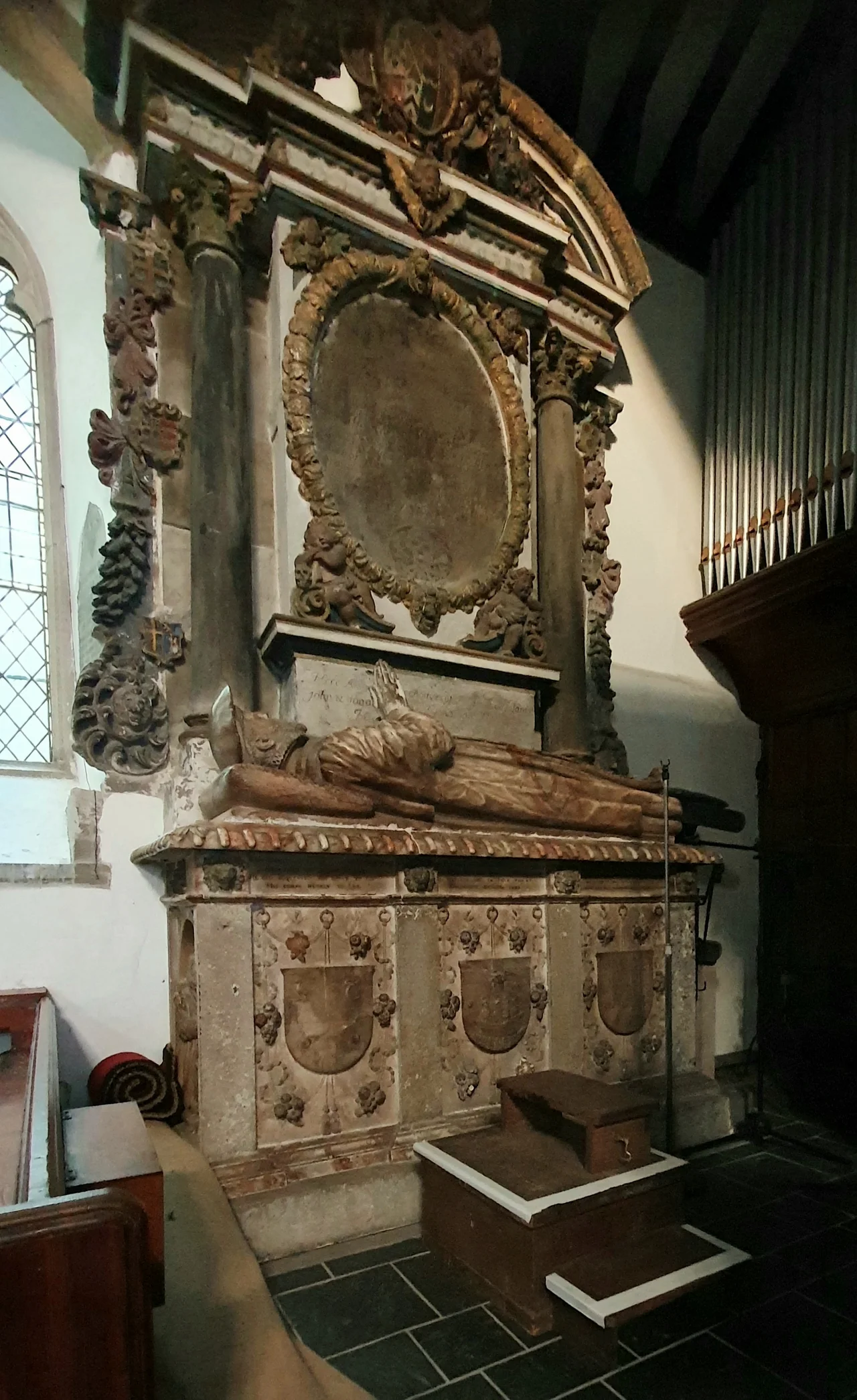
For three and a half centuries this church served Fowey as more than a place of worship. Until 1684 it doubled as the town hall, where merchants signed contracts and disputes were settled. The hexagonal pulpit was made in 1601, the south porch given its eight-ribbed vaulted roof. Inside are two fifteenth-century brasses and a sequence of monuments to the Rashleigh family, the great Fowey dynasty whose money and ships made the town. John Rashleigh in 1582, Alice Rashleigh in 1602, then later Rashleighs of 1610 and 1683. They had outfitted ships against the Spanish Armada and built Menabilly nearby, the house that would one day inspire Daphne du Maurier's Manderley. The Rashleighs lie here in stone effigy, the merchants of Fowey memorialized as gentlemen for ever.
Grahame, Q, and the Two Marriages
Kenneth Grahame, born in Edinburgh, secretary of the Bank of England, came south for his honeymoon in 1899 and stayed long enough to marry Elspeth Thomson at St Fimbarrus. His friend in Fowey was Sir Arthur Quiller-Couch, the writer and professor known to the world as Q. Quiller-Couch lived in the town from 1891 until his death in 1944, and he lies now in the churchyard of this same church, the parish he had served and written about for fifty years. The river that runs past the church, the boats and the moored craft and the bustle of the quay, would shape The Wind in the Willows: Grahame's Mole and Rat and Toad messing about in boats owe something to summer afternoons on the Fowey estuary. Q's literary criticism shaped a generation of Cambridge undergraduates. Both men remain present in the church, one by his marriage register entry, the other by his grave.
The Question of Women
In 2019 the vicar of Fowey Parish Church and roughly half of the congregation left to start a new conservative evangelical church in the town, outside the Church of England, affiliated with the global movement called GAFCON. The Parochial Church Council, which had passed a resolution refusing to accept women as vicars or bishops, was one of about a hundred and fifty parishes in England that held that position. In May 2023 the chair of the council resigned, along with two other members who had supported the resolution. A new council was elected in July 2023 and unanimously voted to rescind the resolution and open the role to women. In March 2024 the Reverend Carol Edleston arrived as Priest for Fowey, the first woman to lead worship at St Fimbarrus in its near-seven-century history. The eight bells in the tower, with a tenor of 876 kilograms, rang for her.
The Organ Lineage
Music has run through the church for nearly two centuries of documented record. A new organ arrived in 1855 with German Pedals, replaced in 1877 by an instrument built by Grover and Grover of London. Hele and Co of Plymouth worked on it in 1892; Wadsworth enlarged it to three manuals in 1905; later work in 1948, 1972, and twice more in the early 2000s brought it to its current form, three manuals and pedal with thirty-three speaking stops. The list of organists reads like a small Victorian-Edwardian community in itself: William Betty in the 1850s and 60s, George Henry Bate for twenty-five years, then Charles Edward Juleff who had played at St Petroc's in Bodmin and went on to St John the Evangelist in Taunton. The longest service belonged to Charles K. Jago, organist from 1920 to 1956. Norman Williams took over in 1957 and held the bench for sixteen years. Each Sunday for nearly two hundred years, an organ has sounded above the harbour.
From the Air
St Fimbarrus stands at 50.34 degrees north, 4.64 degrees west, on the western bank of the Fowey estuary in the centre of the old town. From altitude the church tower is a small landmark against the steep wooded valleys that funnel into the harbour. Newquay Airport (EGHQ) lies fifteen nautical miles northwest; Exeter (EGTE) is about seventy nautical miles northeast. The estuary opens to the English Channel directly south. Best viewing on a clear morning with the sun behind, when the church catches light against the dark slate of the hillside.
Nearby Stories
- Mount Edgcumbe Country Park 2.6 km away
- Tintagel 4.2 km away
- Wheal Trewavas 6.1 km away
- Tehidy Country Park 14 km away
- Battle of Plymouth (1652) 15 km away
- Okehampton Castle 19 km away
- Goonhilly Satellite Earth Station 32 km away
- Action of 17 November 1917 101 km away