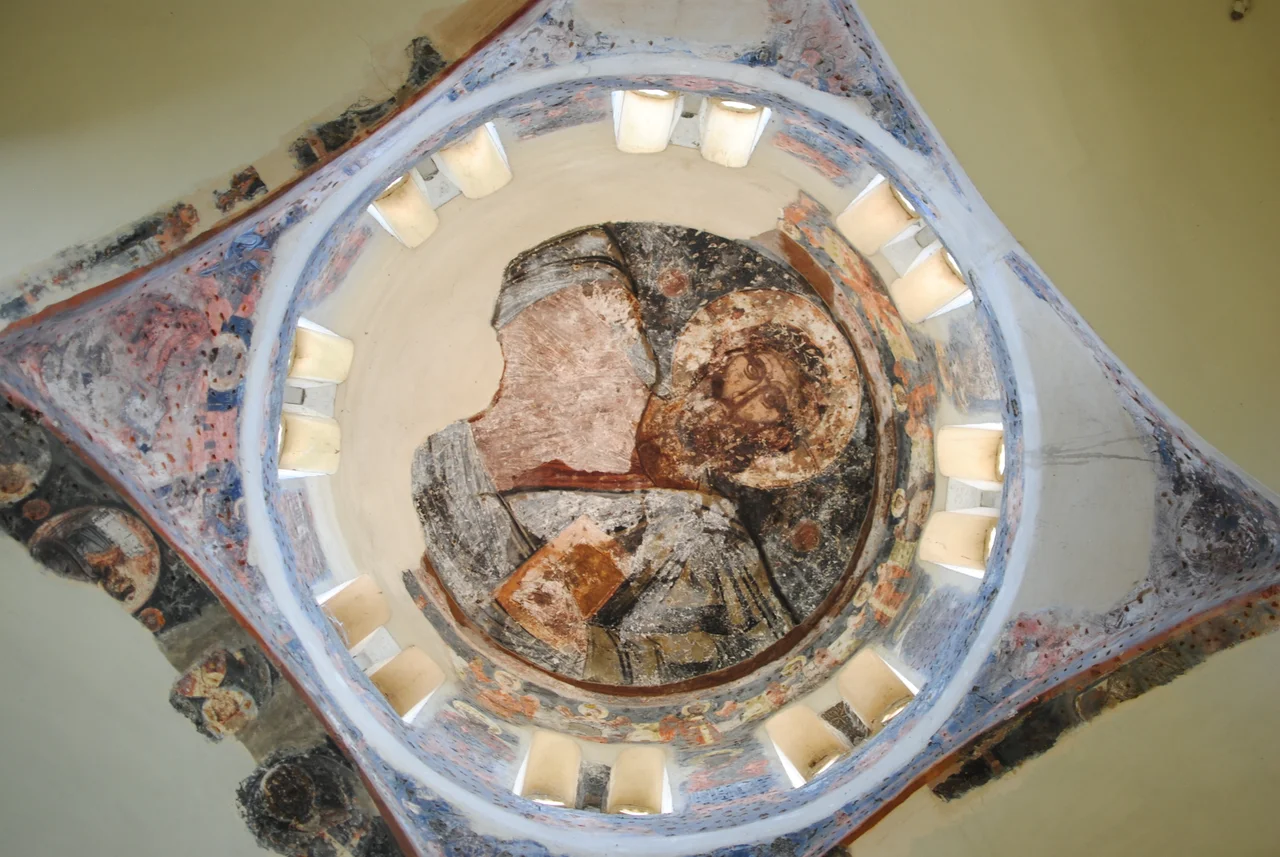

Church of the Holy Apostles, Athens
Walk the Ancient Agora of Athens, the marketplace where Socrates once argued and democracy first found its footing, and you will see mostly foundations: outlines of vanished colonnades, scattered column drums, the ghost-plan of a city that is gone. Two buildings break the rule. One is the great Temple of Hephaestus on the western hill. The other is far smaller, a compact stone church near the Stoa of Attalos, its dome low and its brickwork patterned. The Church of the Holy Apostles has stood here, intact, for over a thousand years, and it is the only other thing in this field of ruins that can say so.
The Last One Standing
Built around the late tenth century, the church earns its significance by sheer endurance. Of everything raised in the Agora across its long history, only the Temple of Hephaestus and this church have survived from their foundation to the present without falling into ruin. That alone would make it remarkable. But the Holy Apostles matters for another reason: it was the first major church of the Middle Byzantine period in Athens, and it launched a design that would define the city's churches for centuries to come, a local style scholars call the Athenian type.
A Blueprint for Byzantine Athens
The architecture is an elegant solution to an old problem: how to roof a square space with a circular dome. The builders combined two earlier approaches, the simple four-pier plan and the cross-in-square, into something balanced and new. The floorplan is a cross with apses, the rounded projections, on all four sides, a narthex entrance porch to the west, and four columns rising to support the central dome. The altar and floor were laid in marble. On the outer walls, the brickwork carries decorative bands that imitate Kufic script, the angular Arabic lettering of the medieval Islamic world, a quiet sign of how widely artistic ideas traveled even between rival faiths.
Layers in the Stone
Nothing in Athens sits on virgin ground, and the Holy Apostles is no exception. It was raised partly over a second-century nymphaion, a Roman fountain house, so beneath the Christian floor lies pagan plumbing. The building itself records its own long life in four distinct construction phases, visible to those who know how to read the joints and repairs. A handful of wall paintings survive in the central aisle, dating to the seventeenth century, and other frescoes were rescued from neighboring churches and installed here. Its name, Holy Apostles of Solaki, may come from a family that paid for an Ottoman-era renovation, or simply from Solaki, the crowded nineteenth-century neighborhood that once pressed in around it.
Restored to Its First Form
By the twentieth century, the church was buried in the clutter of a lost quarter called Vrysaki, additions and accretions hiding the original design. Between 1954 and 1957, archaeologists of the American School of Classical Studies stripped away the later layers and restored the building to the shape its tenth-century makers intended. The result is what you see today: a small, perfectly proportioned church standing in clear ground, the survivor of an entire neighborhood that was cleared to expose the ancient Agora beneath. It is both a working monument and a kind of time capsule, the oldest standing church in the heart of old Athens.
From the Air
The Church of the Holy Apostles stands in the Ancient Agora of Athens, beside the Stoa of Attalos, at 37.974 N, 23.7239 E, just north of the Acropolis. From the air, look for the Agora's open archaeological zone below the Acropolis hill and the long reconstructed Stoa of Attalos as the nearest references. Nearest major airport: Athens International (LGAV), roughly 30 km east-southeast. Expect controlled airspace over central Athens.
Nearby Stories
- Great Sand Beach 5 km away
- Battle of Delium 7.7 km away
- Tower of Aliartos 9 km away
- HMHS Britannic 10 km away
- Saronic Gulf 15 km away
- Sousaki Volcano 17 km away
- Sanctuary of Apollo Maleatas 24 km away
- Skyros 66 km away