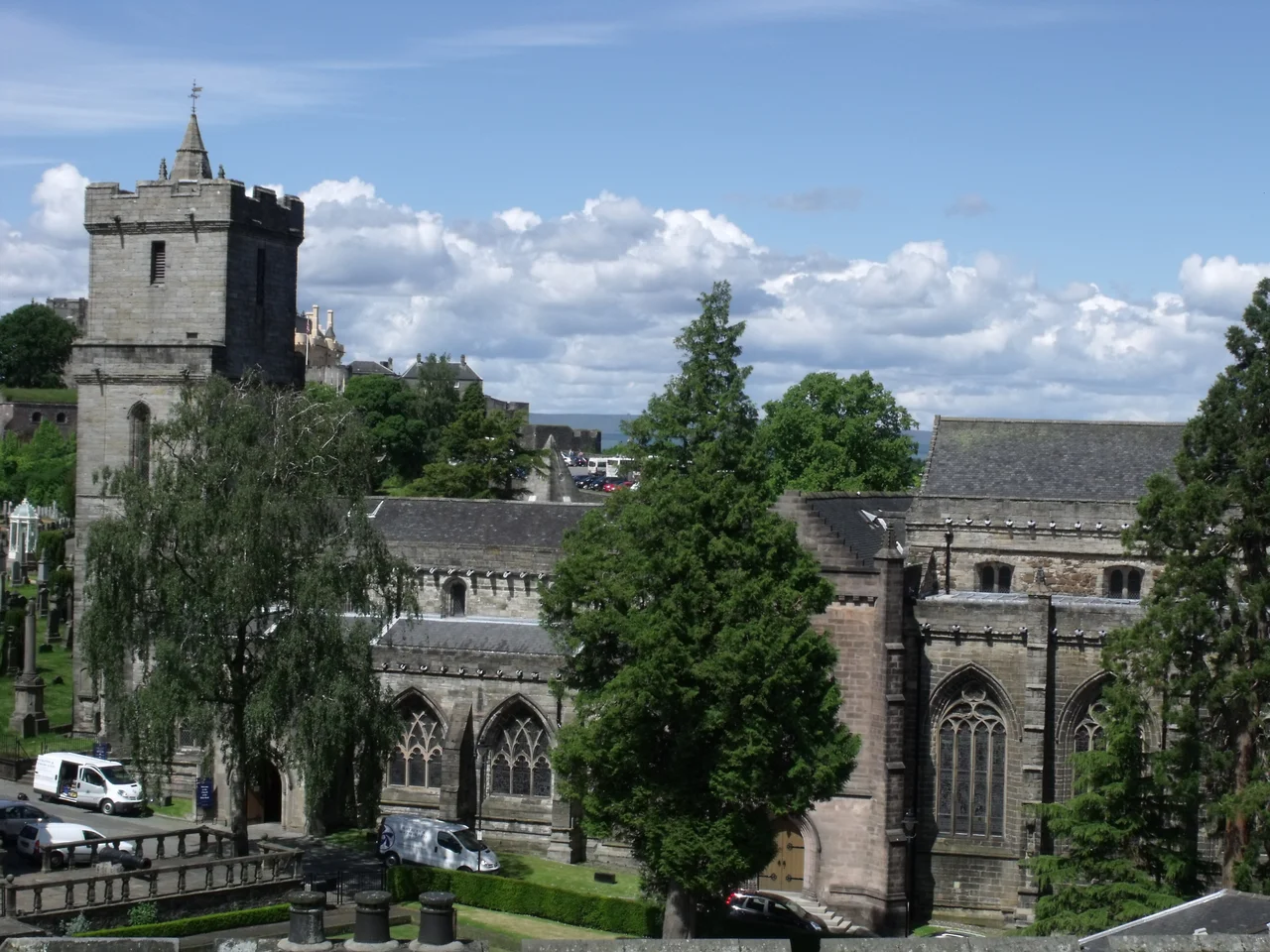

Church of the Holy Rude
On 29 July 1567, a thirteen-month-old infant was carried up the slope from Stirling Castle into a church whose nave was already a century old, and was anointed King of Scots. James VI would not remember the ceremony. He had not yet learned to walk. His mother Mary, Queen of Scots, had been forced to abdicate the week before and was a prisoner at Lochleven. Adam Bothwell, Bishop of Orkney, performed the rites. John Knox preached the sermon. The Church of the Holy Rude has hosted royalty before and would host the dead of Stirling after, but that one summer afternoon is what gave it permanence in Scottish memory: one of three churches still in active use in Britain that have witnessed a coronation.
Founded in Fire and Rebuilt in Stone
David I founded a church on this rock in 1129, naming it for the Holy Rood, the relic of the True Cross. Nothing of that first building survives. A catastrophic fire swept Stirling in 1405, and the church burned with the town. Work on a new nave was underway by 1414, and the vault was completed between 1440 and 1480, the carved heraldry in the stonework dating the work for modern researchers as precisely as a signature. The chancel followed from 1507, completed around 1530, when the west tower was raised to its current height. The result is the second oldest building in Stirling after the castle itself, its bones pure late medieval, its 200-foot length stretching along the ridge below the royal residence.
Musket Balls and Schism
The Church of the Holy Rude wears its scars. The north wall and tower are pocked with musket-ball damage, long attributed to the siege of Stirling Castle by General Monck in 1651 during the Wars of the Three Kingdoms. Closer study suggests something stranger. The damage clusters around the slot windows opposite the south rampart of the castle, not on the side an attacking force would have aimed at. The most likely explanation is that bored soldiers in the castle were making a game of trying to fire a musket ball cleanly through a slot window. James Guthrie was the minister at the time. Soon afterward Guthrie and a few elders quietly appointed Robert Rule as his successor, the congregation split into rival factions, and a dividing wall was built down the centre of the church. That wall stood from the 1650s until 1936. Guthrie himself was hanged in Edinburgh in 1661.
The Body-Snatching Stone
In the old graveyard, beside seventeenth-century slabs and the moss-softened heraldry of merchants, stands a stone unlike any other in Scotland. It carves a depiction of body-snatching directly into the granite. Mary Stevenson died in November 1822, aged 55. Two days after her burial, on the night of 16 November, the local gravedigger James McNab dug her up, helped by his friend Daniel Mitchell. They passed her body to John Forrest for anatomical dissection. The thieves were caught. Legal technicalities freed them. A riot followed. Mary's body was returned to the ground and the family carved her gravestone with the scene of the theft, so that no one walking among the stones could pretend it had not happened. The Valley Cemetery extends to the north, added in 1851 beneath the castle ramparts, set about with statues of Reformation figures by Alexander Handyside Ritchie. Together they form one of the most evocative graveyards in Scotland.
The Glass and the Oak
Inside, the building is light and architecture. The late nineteenth century filled the windows with stained glass by Ballantine and Co., Adam and Small, and Cottier and Co., colour pouring into the medieval frame. In 1940, in the middle of another war, the church was carefully restored and the original oak beam roof was re-exposed after centuries hidden above plaster. The semi-octagonal apse was beautiful enough that the builders of St Leonard's-in-the-Fields in Perth copied it. The graves in the new cemetery north of the church include the airline pilot Charles Livingstone DFM, killed in the BOAC Flight 781 Comet disaster of 1954, and the artist A R W Allan, his stone carved by sculptor Pilkington Jackson. In 2023 the church entered a partnership with Stirling District Tourism to be promoted as a destination in its own right, finally separating its identity from its more famous neighbour up the hill.
From the Air
The Church of the Holy Rude stands at 56.121N, 3.945W on the ridge just below Stirling Castle, in the heart of Stirling's medieval old town. From altitude the castle rock is the unmistakable landmark; the church sits immediately south of the castle along the same volcanic sill. Best viewed at 2,000 to 4,000 feet to discern the medieval street pattern. Nearest airports: Edinburgh (EGPH) 30 nm east-southeast, Glasgow (EGPF) 25 nm south-southwest. The Ochil Hills rise to the east and may produce mountain wave in northeasterly flows.
Nearby Stories
- Murder of Alesha MacPhail 3.1 km away
- Ben Lomond 5 km away
- Lochleven Castle 8.8 km away
- Battle of Dunsinane 15 km away
- Pentland Hills 16 km away
- Breadalbane Hydro-Electric Scheme 17 km away
- Beith 17 km away
- Rannoch Moor 24 km away