
Chyhyryn
Today it is a modest town of a few thousand souls, its economy resting on food and furniture and a nuclear plant that was never finished. But climb Chyhyryn's Castle Hill, above the loop of the Tiasmyn River near where it joins the Dnieper, and you stand on one of the pivots of Eastern European history. For two decades in the seventeenth century, this was the capital of the Cossack Hetmanate - the residence of Bohdan Khmelnytsky, the hetman whose great uprising against Poland created a Cossack state and set in motion a chain of events still felt centuries later.
A Castle on the Frontier
Chyhyryn began as a strongpoint on a contested border. The lands had passed from the Grand Duchy of Lithuania to the Kingdom of Poland, and in 1589 King Sigismund III granted a privilege allowing a town and castle to be raised on a deserted site called Czehryn. The fortress went up on a hill wrapped by the Tiasmyn, and the town gathered around its foot. In 1592 a further royal grant gave Chyhyryn Magdeburg rights - the coveted charter of self-government - along with a coat of arms bearing three arrows. It was, in those years, a frontier settlement like many others on the edge of the Wild Fields, guarding the seam between the settled world and the open steppe. Nothing about it yet suggested it would one day be a capital.
The Hetman's Seat
That transformation came with Bohdan Khmelnytsky, who was connected to this place and made it the center of his power. From 1648 to 1676 Chyhyryn served as the residence of the hetman of the Zaporizhian Host, and after the Orthodox metropolitan see was moved from Kyiv in 1658, it became a full-fledged capital of the Cossack Hetmanate. Metropolitans governed the church from here; hetmans were traditionally installed here. For a brief, intense span, this hilltop town on the Tiasmyn was the political and spiritual heart of a Cossack state - a seat of negotiation and war, where the fate of Ukraine was being decided in real time. The Trinity Monastery, raised nearby in 1627, anchored the sacred side of that authority.
What the Centuries Took, and Left
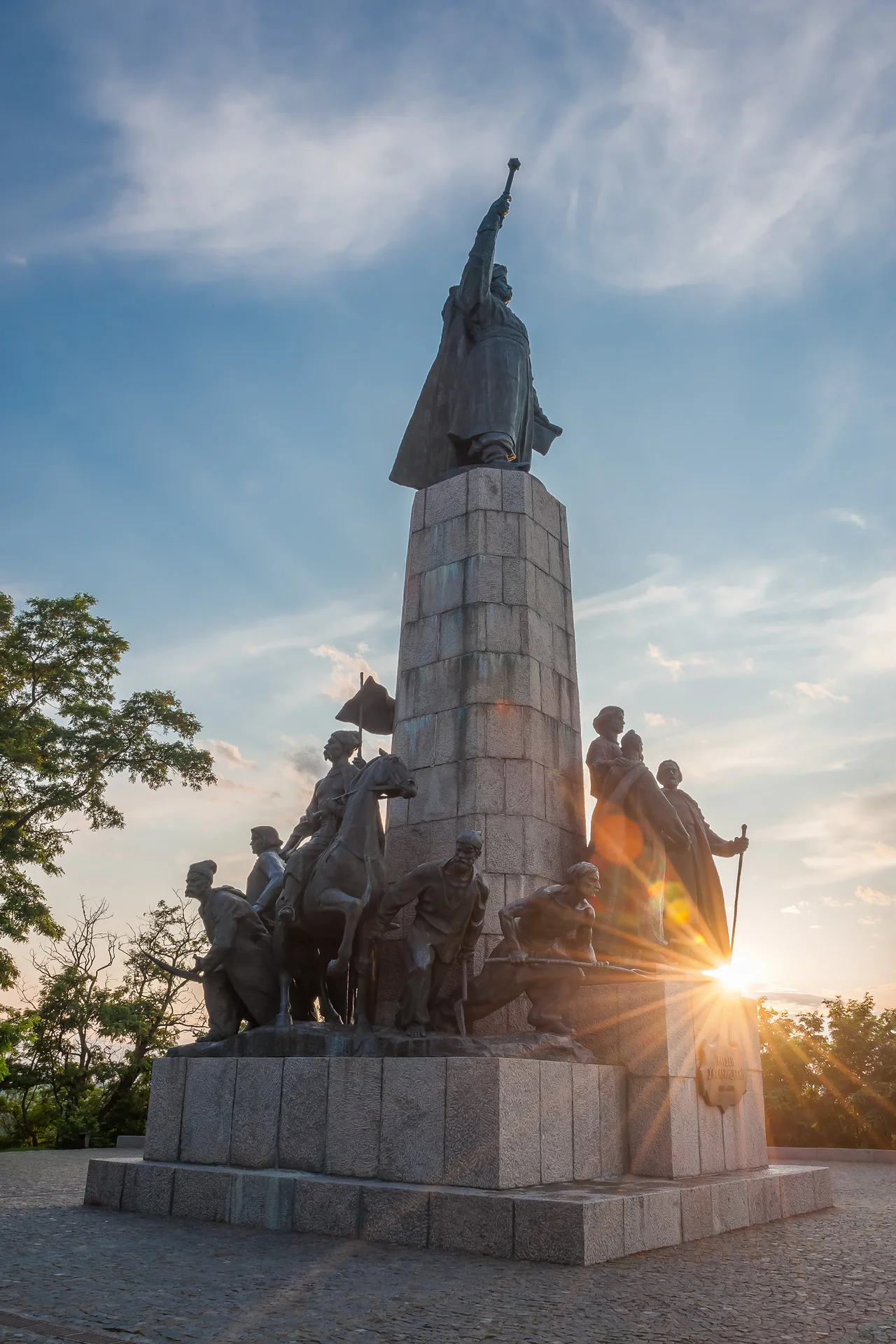
Power like that draws armies, and Chyhyryn's greatness did not last. After the seventeenth century the town declined into a semi-rural quiet, and in 1793 it was absorbed by the Russian Empire in the Second Partition of Poland. Its memory of self-rule flickered once more in 1917, when a congress of Free Cossacks met here and, by tradition, elected Pavlo Skoropadsky their hetman - a man who would soon lead Ukraine itself. Time and successive regimes were hard on the old landmarks: the Trinity Monastery, the town hall, and Khmelnytsky's palace were all destroyed, much of it under Soviet rule. Yet after Ukraine regained independence, the hetman's residence was rebuilt and opened as a museum. On Castle Hill, above the reconstructed fortress, a monument to Khmelnytsky looks out over the river - the capital that was, remembering itself.
From the Air
Chyhyryn lies at 49.083N, 32.667E, in Cherkasy Oblast, central Ukraine, on the Tiasmyn River not far from its confluence with the Dnieper, at about 124 meters elevation. From altitude, look for the town beside the winding Tiasmyn and its prominent Castle Hill; the broad Dnieper and the Kremenchuk Reservoir lie to the east. The nearest airport is Cherkasy (UKKE).
Nearby Stories
- Battle of Kurukov Lake (1625) 15 km away
- Melgunov Kurgan 19 km away
- Cherkasy 34 km away
- Khutir Nadiia 43 km away
- Kaniv Nature Reserve 50 km away
- Battle of Zhovti Vody 57 km away
- Battle of Korsun-Cherkassy 61 km away
- Velyki Sorochyntsi 96 km away