
The Painter's Mansion That Became a Hospital
Antelope wandered the grounds until the early 1970s. Not the kind of detail you expect from a hospital in the middle of one of the world's most congested cities, but Cikini Hospital has never been an ordinary medical facility. The building at Jalan Raden Saleh No. 40 in Central Jakarta began its life in 1852 as a mansion designed by Raden Saleh, Indonesia's most celebrated nineteenth-century painter -- a man who had studied in the Netherlands, exhibited alongside European Romantics, and returned to the Dutch East Indies with enough ambition to build himself a residence with a private zoo. Lions, antelope, and other wild animals roamed his estate. The gardens were so extensive that when Archduke Franz Ferdinand of Austria stopped by in 1893 during his world tour, he found preparations underway for the Batavia Exhibition, staged on the mansion's grounds. Today, the 5.6-hectare compound still feels like a park dropped into the urban chaos of Menteng, its trees and gardens encircling a 300-bed hospital that has been caring for patients for more than 125 years.
The Painter and His Palace
Raden Saleh Sjarif Boestaman was not merely a painter. He was the first Indonesian artist to gain international recognition, spending over twenty years in Europe where he studied under Cornelis Kruseman and Andreas Schelfhout, befriended European aristocracy, and painted dramatic canvases of hunts, eruptions, and shipwrecks in the Romantic tradition. When he returned to Java in the late 1840s, he designed his own residence in the Cikini area of Batavia -- a mansion grand enough to match his reputation. The house, completed in 1852, sat on sprawling grounds that he turned into a combination of botanical garden and private menagerie. Raden Saleh's taste for the dramatic extended to his domestic life. The wild animal collection was no casual hobby; it was a statement, an echo of the European aristocratic estates he had visited. After his death in 1880, the mansion passed through several hands before its next transformation.
A Queen's Gift, A Hospital's Birth
On March 15, 1895, a Dutch pastor named Cornelis de Graaf and his wife Adriana founded the Vereeniging Voor Ziekenverpleging In Indie -- the Association for Nursing in the Indies -- opening a modest medical center in Gang Pool, near the governor's state palace. The De Graafs needed funding, and they found it from an unexpected patron: Queen Emma of the Netherlands, who contributed approximately 100,000 guilders. That sum was enough to purchase Raden Saleh's former mansion in June 1897. The medical center relocated to the sprawling property, and on January 12, 1898, its status was upgraded to a full hospital -- the first Christian hospital in Indonesia. In gratitude, the institution was named Koningin Emma Ziekenhuis, Queen Emma's Hospital. The painter's grand residence, with its gardens and lingering menagerie, had found an improbable second life.
Occupation, Liberation, and the Long Handover
The hospital's management reads like a compressed history of twentieth-century Indonesia. During the Japanese occupation from 1942 to 1945, Cikini Hospital served the Imperial Japanese Navy. After Japan's surrender, it was managed first by RAPWI -- the allied organization for repatriating prisoners of war and internees -- and then by the Dutch colonial health service, the Dienst der Volksgezondheid. In 1948, control passed to a private foundation led by R.F. Bozkelman. Nine years later, in 1957, the foundation handed management to the Indonesian Church Council, known as DGI. Prof. Dr. Joedono served as acting director during the transition; Dr. H. Sinaga became the first official director. Each change of hands brought a new name -- the Dutch foundation name gave way to Yayasan Rumah Sakit DGI Tjikini, then to Yayasan Kesehatan PGI Cikini in 1989 when the church council itself was renamed. Today it operates as Primaya Hospital PGI Cikini, its latest incarnation in a chain of reinventions stretching back to the pastor's clinic in Gang Pool.
A Garden Hospital in a Concrete City
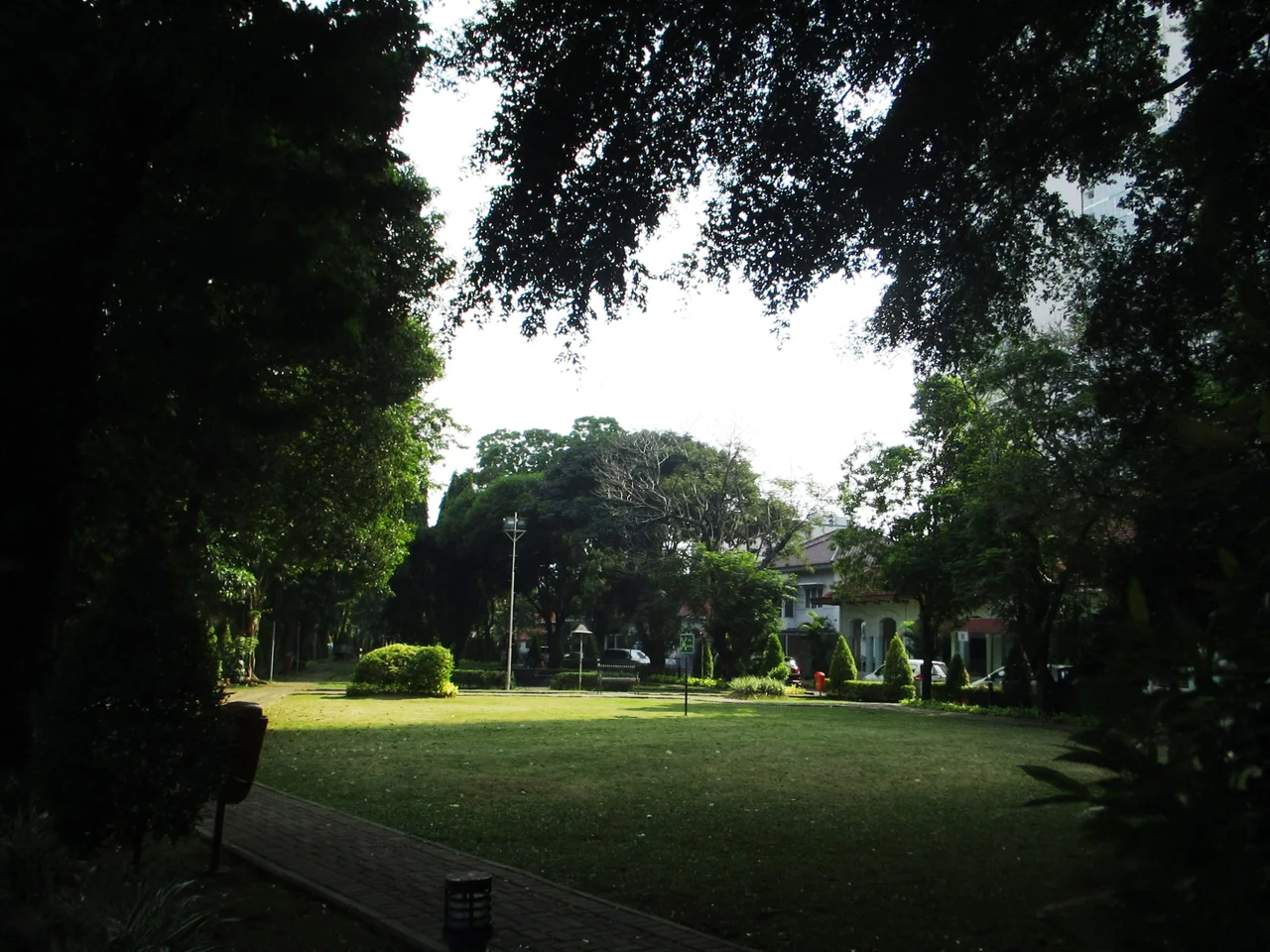
What makes Cikini unusual is not its medical services -- though it offers specialties from cardiology to oncology and runs a nursing academy -- but its setting. Five and a half hectares of gardens surround the hospital buildings, a remnant of Raden Saleh's original estate that has survived Jakarta's relentless development. The grounds were once a botanical garden and zoo. The antelope that grazed among the trees into the 1970s were the last descendants of the painter's nineteenth-century collection. Even after their removal, the compound retained its park-like character, an anomaly in a neighborhood of office towers and shopping centers. The hospital also houses artifacts of its layered past: nineteenth-century lithographs by Josias Cornelis Rappard show the mansion in its original glory, while photographs from the 1893 Batavia Exhibition document the temporary labyrinth and exhibition halls that were constructed on the grounds when Franz Ferdinand visited. Walk through the garden today and you are walking through strata of Indonesian history -- a painter's ambition, a queen's charity, a colonial occupation, a national church, and a modern hospital, all on the same five and a half hectares.
From the Air
Located at 6.19S, 106.84E in the Menteng district of Central Jakarta. From the air, Cikini Hospital is identifiable by its unusually large green compound amid the dense urban fabric of Menteng, roughly 1.5 km east of Merdeka Square and the National Monument (Monas). The hospital grounds appear as a distinct green rectangle surrounded by rooftops. Nearest major airport is Soekarno-Hatta International (WIII), approximately 27 km northwest. Halim Perdanakusuma Airport (WIHH) lies about 10 km southeast.
Nearby Stories
- The King's Footprints in the River 2.8 km away
- Rawagede Massacre 6.4 km away
- The Cruiser That Wouldn't Stop Fighting 14 km away
- Four Minutes Over the Java Sea 14 km away
- The Scholar's Mosque 21 km away
- Through the Cidepong Hills 37 km away
- Ujung Kulon National Park 97 km away
- The Islands That Vanished from Sight 352 km away