
The Ghost Fort Beneath the Mosque
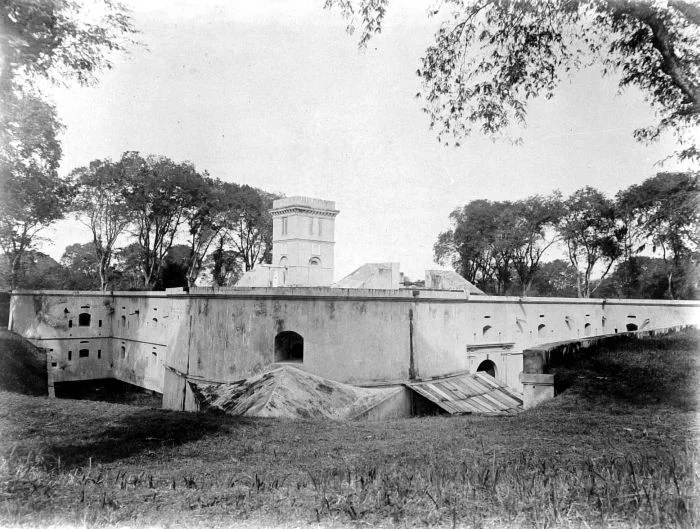
The fortress never fired a shot. Built in 1837 to defend Batavia from an attack that would not come for over a century, the Citadel Prins Frederik spent its entire military career in silence -- a rectangular brick fortification with bastions at each corner and cannon ports disguised as windows, guarding a city that no enemy bothered to assault until the Japanese arrived in 1942, by which time the citadel was a relic. Today, not a single brick remains. The site where Dutch soldiers once drilled beneath a clock tower is now occupied by Istiqlal Mosque, the largest in Southeast Asia, and the fort survives only in colonial-era photographs and the faint memory of a local name: Gedung Tanah, the Ground Building.
From Tavern to Hospital
Long before anyone thought to build a citadel here, the site between the two branches of the Ciliwung River served humbler purposes. Before 1669, a tavern stood on the spot -- one of those establishments that appeared wherever Dutch traders gathered in the East Indies. In 1723, a sergeant-major named Herman van Baijen rebuilt the tavern as a large country house, trading beer and trade gossip for the quieter ambitions of a gentleman's estate. The transformation did not last. By 1743, the building had become a hospital, known as the Outer Hospital because it sat beyond Batavia's city walls. For nearly eight decades, the sick and wounded were brought to these low hills inland from the coast, where the elevation offered a modest defense against the malaria that ravaged the swampy lowland city. The surrounding countryside was fertile, the topsoil deep and rich, and the location in what would become the Weltevreden district -- today's Sawah Besar -- was considered one of the healthiest spots in all of Batavia.
A Prince Lays the First Stone
Governor-General Johannes van den Bosch ordered the citadel built in 1837 as part of a planned defensive line running through what is now the Kebon Sirih and Menteng neighborhoods. Colonel Carel van der Wyck drew up the design: a rectangular brick fortress protected by an earth rampart, with bastions anchoring each corner. A central tower equipped with clocks, windows, and doors on all four sides served as a lookout post. The prince who laid the cornerstone and opened the finished fort was Willem Frederik Hendrik, a son of King William II of the Netherlands and one of the rare members of the Dutch royal family to actually visit the East Indies. The citadel took his name. Whether the prince appreciated the irony -- a fortress in a colony that generated wealth precisely because no one was attacking it -- history does not record.
Asia's Grandest Park
The fort did not stand alone. Surrounding it was Wilhelmina Park, named after the queen who was inaugurated in 1898, though the park itself predated her reign. Van den Bosch had commissioned it in 1834, three years before the citadel. At 9.32 hectares, it was reportedly the largest modern park in Batavia and, some claimed, the largest modern park in all of Asia at the time. The grounds served double duty: a vegetable garden for Dutch officers and a favorite promenade for VOC officials and landlords who had settled around Weltevreden. The park stretched out in front of Jakarta Cathedral Church. Within its boundaries stood an Atjeh-Monument, erected to commemorate Dutch soldiers who had died in the brutal Aceh War. By the mid-twentieth century, both the monument and the park had become symbols of colonial power that the newly independent Indonesia had little desire to preserve.
Erasure and Transformation
In 1961, the demolition crews arrived. The Atjeh-Monument came down first, a few months before construction began on the structure that would replace everything -- fort, park, and colonial memory alike. President Sukarno had chosen this precise site for Indonesia's grand national mosque, Istiqlal, and the choice was deliberate. Building the country's most important Islamic monument on the ruins of a Dutch military installation was an act of architectural overwriting, a declaration that the colonial chapter was not just over but buried. The mosque took seventeen years to complete. When President Suharto inaugurated Istiqlal in 1978, the Citadel Prins Frederik had been gone for nearly two decades, its bricks carted away, its earth ramparts leveled, its clock tower dismantled. What had been a fortress guarding Dutch imperial interests became the prayer hall of a nation that had expelled the empire. The Ground Building returned to the ground.
From the Air
The former site of Citadel Prins Frederik is at 6.17S, 106.83E in Central Jakarta, now entirely occupied by the Istiqlal Mosque complex. From the air, look for the massive white dome of Istiqlal immediately northeast of Merdeka Square, adjacent to the twin spires of Jakarta Cathedral. The Ciliwung River runs along the eastern boundary of the former park. Nearest major airport is Soekarno-Hatta International (WIII), approximately 25 km northwest. Halim Perdanakusuma Airport (WIHH) is about 12 km southeast. No trace of the original fortification is visible from any altitude.
Nearby Stories
- The King's Footprints in the River 2.8 km away
- Rawagede Massacre 6.4 km away
- The Cruiser That Wouldn't Stop Fighting 14 km away
- Four Minutes Over the Java Sea 14 km away
- The Scholar's Mosque 21 km away
- Through the Cidepong Hills 37 km away
- Ujung Kulon National Park 97 km away
- The Islands That Vanished from Sight 352 km away