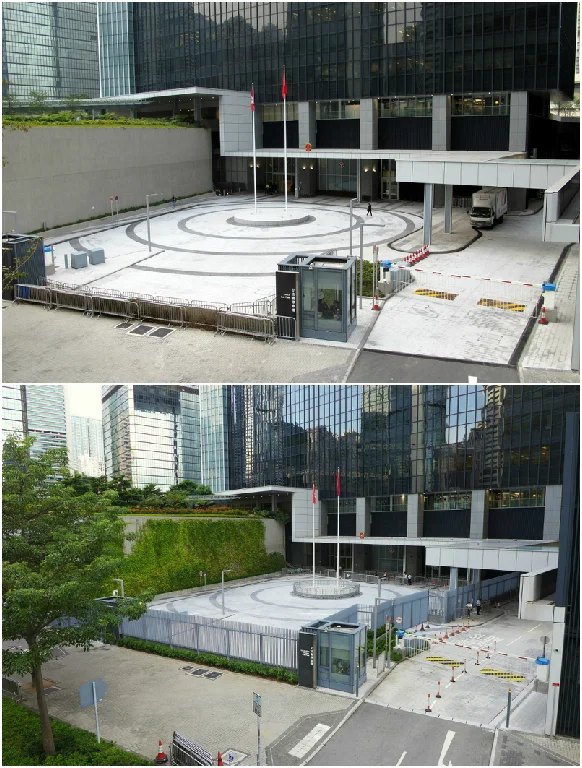

Civic Square (Hong Kong)
The name came from the protesters, not the architects. The government called it the East Wing Forecourt of the Central Government Complex. Protesters occupying it during the 2012 Anti-National Education Campaign began calling it the Civil Square, then Civic Square, and the name stuck — a small act of renaming that declared the space belonged to the public even as officials insisted it did not. That dispute over who a piece of concrete belongs to turned out to be about much more than property rights. In the years that followed, Civic Square became the pivot point of Hong Kong's most significant democratic confrontations, a few thousand square meters carrying the weight of a city's political future.
The First Occupation: A Curriculum Becomes a Crisis
In August 2012, the Hong Kong government announced plans to make Moral and National Education a compulsory subject — a curriculum critics called patriotic indoctrination. The student group Scholarism, led by teenagers, organized what became one of the largest protests the city had seen in years. On 30 August 2012, Scholarism members occupied the Central Government Offices forecourt. Three of them began a hunger strike there. The Civil Alliance Against the National Education quickly announced an indefinite occupation. Within days, more than 8,000 people were gathering each evening after school, filling the forecourt and spilling into Tamar Park and Tim Mei Avenue. At its peak, organizers reported over 120,000 people joined the rallies. On 8 October 2012, the government backed down, shelving the curriculum guidelines. The occupation ended. The space had shown what it could do.
The Night the Gate Came Down
In July 2014, the government quietly closed the forecourt, installing a locked gate and a metal fence. The timing was not accidental. Hong Kong was moving toward a confrontation over electoral reform. Beijing had announced it would allow residents to vote for the Chief Executive — but only from a list of pre-approved candidates. For pro-democracy advocates, the offer was a controlled simulation of universal suffrage, not the real thing. On 22 September 2014, the Hong Kong Federation of Students and Scholarism launched a class boycott and began protesting outside the government headquarters. On 26 September, a group of protesters rushed the fence and climbed into the closed Civic Square. Police moved in with pepper spray. The footage of students scaling the gate, and the arrests that followed, triggered an immediate escalation. Two days later, Occupy Central launched its civil disobedience campaign. The Umbrella Movement had begun. What might have remained a manageable protest became, in part because of the gate, the largest sustained civil disobedience campaign in Hong Kong's history.
The Official Version
On 22 October 2014, Chief Secretary Carrie Lam addressed Civic Square directly. She restated that the forecourt was government property — neither a public place nor a public open space — and that the public had no absolute right of access. It was, she said, primarily a vehicular passageway. The government's legal position was technically defensible. The forecourt was, on paper, private government property. But the argument that a space adjacent to the seat of government was simply a driveway, with no civic dimension, was a distinction that hundreds of thousands of people found impossible to accept. Felix Chung of the Liberal Party asked the government to consider opening the square to the public. The Hong Kong Federation of Students offered to exchange Civic Square for the cleared roads in Admiralty. Both proposals were declined.
A Square Fenced Off
The Umbrella Movement ended in December 2014 after 79 days. The main protest sites were cleared by police. Civic Square remained closed — fenced, gated, and monitored. It has remained so since. The space that protesters named, occupied, and argued over still exists, technically open on weekdays as a passageway, but effectively sealed against any gathering. For those who remember the autumn of 2012 and 2014, the forecourt's current quiet carries a particular kind of weight. The fencing is not merely an administrative decision about vehicular access. It is a statement about who Hong Kong belongs to, and who gets to say so. The question the protesters asked by naming this place Civic Square has not been answered. It has only been fenced.
From the Air
Civic Square sits at 22.2804°N, 114.1662°E in the Tamar district of Admiralty on Hong Kong Island's northern shore. From the air, the Central Government Complex is identifiable as the large governmental precinct just east of the CBD, with the Legislative Council Complex and Tamar Park visible alongside it. Hong Kong International Airport (VHHH) is approximately 30 km to the west on Lantau Island. At lower altitudes on approach from the east, the government complex is visible along the harbor waterfront, set between the financial towers of Central to the west and Wan Chai to the east.
Nearby Stories
- Lok Ma Chau Loop 2.3 km away
- Portas do Cerco 2.3 km away
- Kweilin Incident 17 km away
- Wanshan Archipelago Campaign 34 km away
- Nanxiong Formation 115 km away
- Battle of Nanpeng Island 148 km away
- Heyuan 169 km away
- Cape Maobitou 632 km away